The waiter's tap, the food that left the shelf, the wage that was signed, the riyal that reached the bank — all of it is the same record, written once and read everywhere.
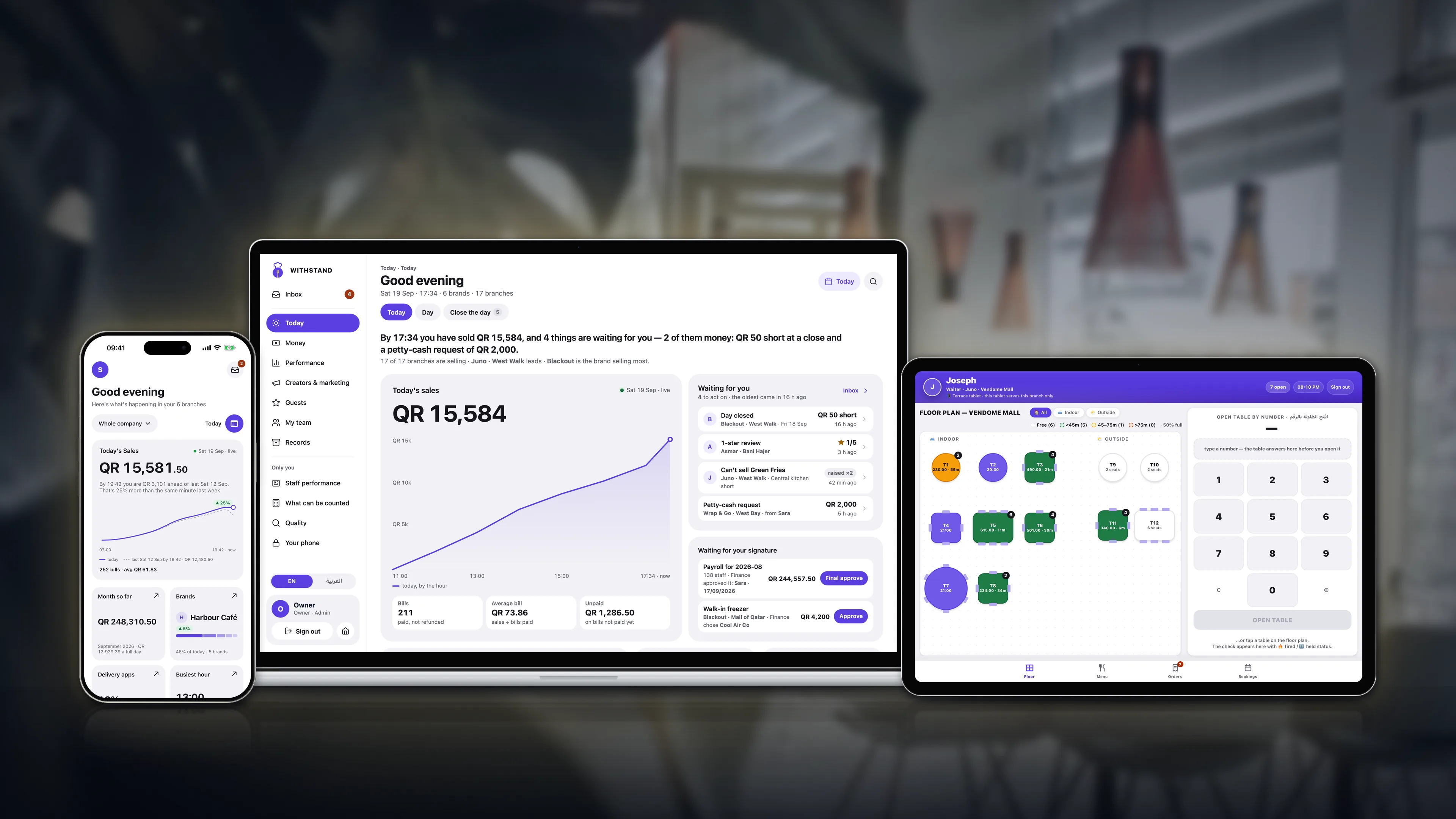
Every person in the restaurant has their own screen. Each one writes into the same record, so nobody re-types anything. Tap a person to see their part of the day.
QR 15,581.50today's sales · ▲ 25%Bill #1200029QR 132.00 · paid by cardTable 34 guests · QR 490.00 running
Real MiM screens, shown with sample data.
Proof of motion
What shipped this week
A product that moves every week says more than a promise. Each line below is dated, and each one passed 297 gates on its way out.
9 Sept 2026
The guest's receipt
Opened from the QR on the paper bill: English or Arabic, the points it earned, a WhatsApp share, and a private door to the manager before Google.
9 Sept 2026
One sheet for every reason
Taking a dish off sale, a refund, a booking — typed on one sheet with the keypad inside it. No floating keyboard, one exit, a button that sleeps until the record is complete.
8 Sept 2026
The Pass
The whole order on one card, courses in the law's order. Start releases a course to its stations; Away is allowed only when the course before it is away.
8 Sept 2026
Marketing answerable to the till
A post joins to the dish it names and to that dish's plates from the permanent book — a lift with a named baseline, never a like count.
Fifteen departments, one database
Everyone gets their own screen
Each department has its own staff, its own sign-in, and screens built for that job — writing into the same record as everyone else. Pick one. Every screen is drawn from the real MiM software — the same layout, the same rules, demo data.
1 / 15keep scrollingplays by itself · tap to stop
The whole group
Front of house
Kitchen & supply
The office
People & place
1 / 15
Tap any department
Head office · the Owner’s screen
Every branch, one screen
What is selling right now across the group — by the hour, by brand, by payment, every branch ranked — built from the same rows every department wrote. Nothing re-keyed, nothing summarised by hand.
Live dashboardDecision inboxEvery branch ranked
Writes into the shared record: reads everything · signs the approvals
Swipe the screen sideways to see all of it
MMim restaurantsHead OfficeInbox4TodayMoneyPerformanceCreators & marketingGuestsMy teamRecordsOnly youStaff performanceWhat can be countedQualityENالعربية
Today · Live dashboardLive dashboardWhat is selling right now, across every branch
Total sales: every paid bill today · refunds and merged bills left out
Checks paid489paid, not refunded
Avg checkQR 125.56÷ checks paid
Food costQR 18,29730% of sales
Gross profitQR 43,103sales − food cost
Open tables0dine-in, still open
Covers seated0guests at them now
In kitchen0new or cooking
UnpaidQR 0.00bills not paid yet
Sales by hourDoha time · the trading day runs 04:00 → 03:00 · paid bills, whole groupPeak 20:00 · QR 7,480
04:0008:0012:0016:0020:0000:00
Sales by restaurant · todayEach brand's share of today's paid sales
61.4kQR today
JJUNO40%QR 24,500
SSaffron House40%QR 24,440
BBake & Co20%QR 12,460
Payment methods · todayEach part of a split bill counts on its own
61.4kQR today
Card65%QR 40,120
Cash26%QR 15,660
App9%QR 5,620
Today · every branch, real numbersMost sales first · a branch with no sale yet is not listed
BranchOrdersRevenueAvg check
SSaffron House · Al Sadd96QR 16,120QR 167.92
JJUNO · West Walk83QR 14,860QR 179.04
JJUNO · Lusail Boulevard74QR 9,640QR 130.27
SSaffron House · The Pearl69QR 8,320QR 120.58
BBake & Co · Msheireb88QR 6,480QR 73.64
BBake & Co · Villaggio79QR 5,980QR 75.70
Group total · 6 branches489QR 61,400QR 125.56
Group sales · last 7 daysMedian QR 58,900 · 7 trading days · QR per day
61,400
WedThuFriSatSunMonTue
Today is the last bar, so far · a day without trade shows a dash
RKRaza K.ServerJUNO · West Walk
🟢You are clocked in4h 16m so far
↓ in 16:58
🕐 CLOCK IN / OUTType the number showing on the till, then tap the button. The app knows whether you owe an in or an out.
······
Clock OUT
🤒 REPORT SICKTell us at least 3 hours before your shift so cover can be found. If you are already unwell and it is later than that, still report it — it is always recorded, and being told late is far better than not being told.I am sick today
📞 Complaints & calls — every guest issue, on the record Log the complaint · record every call & explanation · resolve it or escalate — everything reports to the Owner.
➕ New casebranch and what happened — required
— branch —CallFood quality
Customer namePhoneOrder # (optional)
What happened — the guest's words, the situation…
Open case → Owner informed
🔴 Open (0)✅ Resolved (2)All (2)
RESOLVEDLow review08/09 19:30 · by Priya N.
JUNO · Lusail Boulevard · Google review
👤 guest — “★★ — Waited 25 minutes for mains.”
📞 08/09 19:30 · Priya N.: routed to Lusail's manager
✅ Resolution: answered on Google at 19:52 by Lusail's manager
RESOLVEDFood quality08/09 16:05 · by Priya N.
Bake & Co · Villaggio · In person
👤 guest — “The coffee came cold.”
✅ Resolution: replaced, comp QR 18.00 — Owner informed
⭐ Google reviewsOfficial Google Places API · read every 6 h
Group rating⭐ 4.52across 6 branches
🥇 BestAl Sadd ⭐ 4.7Saffron House
⚠️ Needs attentionMsheireb ⭐ 4.3Bake & Co
📊 Rating by restaurantout of 5 · under 4★ needs attention
Saffron House · Al Sadd4.7
JUNO · West Walk4.6
Bake & Co · Villaggio4.6
Saffron House · The Pearl4.5
JUNO · Lusail Boulevard4.4
Bake & Co · Msheireb4.3
JUNO · West Walk — newest voices
⭐⭐⭐⭐⭐guestan hour ago
The fire bird is worth the drive.
JUNO · Lusail Boulevard — newest voices
⭐⭐guest2 hours ago
Waited 25 minutes for mains.
🍳 Central KitchenIndustrial Area · supplies 6 branchesTue 8 Sept 2026 · 07:30
TMTariq M.Central Kitchen manager · Industrial Area
Central unitInbox1DashboardProductionBranch orders1My items & recipesMy numbersStockTransfersMy stockOrder from Central StoreWastageInventory
🍳 Central Kitchen — branch orders Only the items YOU supply arrive here. Produce them, then dispatch what you actually made — the branch counts it in, and the value is charged to that branch.SUPPLIED THIS MONTHQR 19,640
🏪 BRANCHSaffron House · Al Sadd📅 need by 9 Septby Fatima S. · 08 Sep, 06:05
📝 Thursday is machboos night — the spice mix first, please
ItemAskedSendingValue
Hummus basekg1212QR 14.00/kg
Machboos spice mixkg44QR 62.00/kg
🚚 Dispatch what I madeCannot supply
📜 Recently supplied
JUNO · West Walk — 3 itemsQR 1,236.008 Sept
JUNO · Lusail — 2 itemsQR 742.008 Sept
Saffron House · The Pearl — 4 itemsQR 918.007 Sept
JUNO · West Walk — 3 itemsQR 1,180.007 Sept
Saffron House · Al Sadd — 3 itemsQR 640.007 Sept
JUNO · Lusail — 2 itemsQR 698.006 Sept
Saffron House · The Pearl — 3 itemsQR 804.006 Sept
🧁 Central PastryMim restaurants · Industrial AreaTue 8 Sept 2026
ARAhmed R.Pastry chef · Central Pastry
Central unitInboxDashboardProductionBranch orders2My items & recipesMy numbersStockTransfersMy stockOrder from Central StoreWastageInventory
🧁 Central Pastry — branch orders
Only the items YOU supply arrive here. Produce them, then dispatch what you actually made — the branch counts it in, and the value is charged to that branch.
SUPPLIED THIS MONTHQR 25,641.00
🏪 BRANCHBake & Co · Msheireb📅 need by 2026-09-0807 Sept, 22:10
Item
Asked
Sending
Value
Croissantspc
240
240
QR 2.50/pc
Pistachio cakecake · 12 slices
6
5
QR 96.00/cake
Pain au chocolatpc
120
120
QR 3.00/pc
Cheesecakecake
4
4
QR 84.00/cake
Muffinspc
60
60
QR 2.50/pc
Cookiespc
90
90
QR 1.50/pc
Cinnamon rollspc
48
48
QR 3.00/pc
🚚 Dispatch what I made✕ Cannot supply
🏪 BRANCHBake & Co · Villaggio📅 need by 2026-09-0807 Sept, 22:35
Item
Asked
Sending
Value
Almond croissantspc
96
72
QR 3.50/pc
Pain au chocolatpc
72
72
QR 3.00/pc
Cheesecakecake
3
3
QR 84.00/cake
Date cakecake
3
3
QR 60.00/cake
Browniespc
72
72
QR 2.50/pc
Cookiespc
60
60
QR 1.50/pc
Cinnamon rollspc
36
36
QR 3.00/pc
🚚 Dispatch what I made✕ Cannot supply
📜 Recently supplied
Bake & Co · Msheireb — 7 item(s)QR 2,301.0007/09/2026
Bake & Co · Villaggio — 7 item(s)QR 1,362.0007/09/2026
📦 Central StoreMim restaurants · Industrial AreaTue 8 Sept 2026
📥 Goods Received Note — PO #PO-2291 · Doha Fresh Producedraft · not posted yet Count what actually came off the truck — only good stock enters the store, and Finance is warned not to pay in full.
Item
Brand
Ordered
Received
Damaged
Expiry
Status
Tomatoes/kg ▲ 9% vs last delivery
local
120
120
0
12 Sept
✓ full
Kale/kg
local
40
40
0
11 Sept
✓ full
Lemons/kg
—
60
54
0
20 Sept
📉 short 6.00
Onions/kg
—
200
200
0
30 Sept
✓ full
Potatoes/kg
—
300
300
0
5 Oct
✓ full
Mixed herbs/kg
local
30
30
2
10 Sept
💥 damaged
Post the GRNCancel▲ a rise over 5% vs the last delivery is told to Finance and Head Office
🔀 Routing desk📤 Issued this morning
JUNO · West Walk by Noor H. · 8 Sept 06:05 · issued 06:40 · 10 full, 2 short
Chicken breast18 kgissued18 ✓🏬 Central Store
Kale6 kgissued4 of 6 ⚠️🏬 Central Store
Parmesan2 kgissued2 ✓🏬 Central Store
+9 more lines
The store is the hub — only the Central Store buys.
📦 My stock — Central Storeyour room only
Expired0
Expiring ≤7d3
Below par1
⏰ Expiry watch — use it, move it, or write it off
Tomatoes· last delivery18 kg🟡 2d left
Chicken breast24 kg🟡 3d left
Mixed herbs· local1.5 kg🟡 1d left
🛒 OrderingJUNO · West WalkTue 8 Sept 2026
NHNoor H.Branch manager · JUNO West Walk
🛒 OrderingInbox1Order from Central StoreWastageInventory count👥 StaffRotaPlan vs actualClock-in code
🛒 Store order — JUNO · West Walk Your PIN identifies you and your branch — this order is stamped JUNO · West Walk, sent by Noor H. Raw food, bar, non-food, cleaning, packaging.
Item (type or pick)
Brand — pick or typeQtykg🥩 Food — raw+
🥩118Kale2 kg✕
Normal📅 Needed by Thu 10 SeptNote for purchasing (optional)Send to purchasing
Branch requestsSigned in from PIN: Noor H. · Branch manager · JUNO West Walk
Delivered08 Sep, 06:40 · by Noor H.
102 Chicken breast × 18kg · 118 Kale × 6kg · 131 Parmesan × 2kg · +9 more
✏️ Edited by Hassan M.: 2 lines short — kale 4 of 6 kg; the rest issued
Confirm received — post to food cost
Received07 Sep, 06:35 · by Noor H.
102 Chicken breast × 16kg · 118 Kale × 5kg · 131 Parmesan × 2kg · +7 more
🤝 Received by Noor H. · QR 2,140.00 posted to JUNO food expenses
Received06 Sep, 06:38 · by Noor H.
102 Chicken breast × 15kg · 118 Kale × 5kg · 131 Parmesan × 2kg · +6 more
🤝 Received by Noor H. · QR 1,980.00 posted to JUNO food expenses
TodayHome3End of dayDrawer & payoutsInboxWaitingPayrollSigned approvalsBranch requestsMoney outExpensesPetty cash
2026-08 closed clean by Layla T. — 2026-09 started new.
One thing needs you this morning: sign 3 items (oldest waited 2 days). Everything else is inside its lines.
rewritten live from the registers — never hand-typed
Yesterday · 2026-09-07💰 QR 58,900.00 · 447 order(s)🏷 discounts QR 1,240.00 · 31×↩️ refunds QR 310.00 · 2×🗑 voids 5× QR 172.00leakage = QR 1,550.00 = 2.6% of the day
⏳ Awaiting signature3 · QR 1,440.00oldest 2 days
💵 Cash in transitQR 0.00all received
🧾 We owe suppliersQR 4,860.00QR 0.00 due / overdue
📊 Revenue this monthQR 478,250.008 days · 1–8 Sept
🍔 Food cost (theo.)30.6%from costs stamped at each sale
⏳ Waiting for youoldest first, never by amount — the case in full on its own screen
💸Paid-out · Lusail Boulevard"cleaning" · raised by Tariq S. → you2 daysQR 180.00Review & sign
💸Paid-out · Al Sadd"ice" · raised by Fatima S. → you6 hQR 60.00Review & sign
🔧Quote · West Walk fridgeGulf Cooling · Jamal A. → youtodayQR 1,200.00Review & sign
There is no bulk-sign — a signature is a decision, and each one gets its own read on its own screen.
📡 What driftedexceptions only — empty is the good state
1 approval(s) waited over 2 daysQR 180.00
oldest: Paid-out · Lusail Boulevard — sign it or refuse it, but decide
The Pearl · remit arrived short/overQR 40.00
2026-09-08 — counted differs from what the till declared
A drift leaves when its register says it is resolved — nothing here is dismissed by hand.
📊 Month so far, by branch · 3 of 6
JUNO · West WalkQR 116,420.00
Saffron House · Al SaddQR 124,380.00
Bake & Co · VillaggioQR 48,900.00
No target set = no % claimed
🧾 We owe, by due date
not due QR 4,860.00due ≤7d QR 0.00overdue QR 0.0030d+ late QR 0.00
One supplier = one number: invoice, else goods received, else the order. Due dates from each supplier's own terms.
🗓 Fixed points
👥WPS payrollAugust approved — waits for the Owner’s signature
🧾Suppliers due ≤7 daysnothing falls due this week
🔒2026-09 files at month end22 day(s) left · not filed yet
📣 MarketingInboxWhat to do nextThe roomCreators we hostWhich dishes we marketedInstagramWhat to post nextWho to bring backAdviceThis weekWITHSTAND card
📣 The room — did anything we posted sell food?
Every marketing tool can say a post got 286 likes. Only this software holds the bill. A post joins to the dish it names, and the dish to its plates from the permanent book.
JUNOSaffron HouseBake & Co
THE VERDICT
6 posts named a dish. 2 moved it. One named a dish the kitchen could not serve.
72 hours after each post, against that dish’s own 28-day mean · bills with a refund or a void left out
🚫 1 post advertised a dish the kitchen cannot serve
Tea is off sale at JUNO · West Walk · equipment broken
Meta does not know your equipment is broken. The 86 list does.
Posts — and what each one did to the kitchen6 posts · 6 name a dish · newest first
VIDEOno photo read — caption only
Jalapeño sliders, the way the kitchen eats them
Tue 1 Sept · 18:40
286
likes
5
comments
open on Instagram ↗
WHAT THE TILL DID+128%
Micro Sliders : Jalapeño18 → 41 plates/day
How a post finds its dishThe longest whole menu name inside the caption, four letters or more. “Sliders” alone would not do it — “Micro Sliders : Jalapeño” is on the menu, so the reel joins to it. A caption with no menu name joins to nothing, and says so.
💻 IT DepartmentMim restaurants · 6 branchesTue 8 Sept 2026
🔧 Maintenance — job board, all branches Take a job → fix it → enter the cost → it posts to that branch's expenses and P&L automatically. The branch confirms to close.
⏳ New — decide: in-house or outsource (1)
Signage light out · Saffron House · The Pearl
Exterior / signage · Electrical · The Pearl manager · 08 Sep 09:05
what needs you today — ranked, worst first; each line opens its room
①Bilal R. is working without a valid Health card (MOPH) — 3 days expired. renew before anything else on this list — the inspection question with a fine attachedEXPIREDopen →
②Hassan M.'s QID / Residence renews in 9 days — start now, renewals take weeks. quiet, but on the list until it is booked9dopen →
③Jamal A.'s QID / Residence renews in 18 days — start now, renewals take weeks. quiet, but on the list until it is booked18dopen →
PEOPLE846 of 6 branches staffed · 0 inactive
WAITING FOR YOU0nothing pending
EXPIRING ≤ 60 DAYS4Health · QID
2026-08 PAYROLL · NETQR 296,950Approved by Finance
⏳ WAITING FOR YOUOpen all →
Nothing is waiting — every request has been answered.
📄 DOCUMENTS EXPIRINGDocuments & visas →
Bilal R.Health card (MOPH)EXPIRED
Hassan M.QID / Residencein 9 days
Jamal A.QID / Residencein 18 days
Yusuf E.QID / Residencein 27 days
🖐 ON SHIFT NOW
14West Walk
14 clocked in today
📲 STAFF PHONES
61/ 84
on self-service · the rest still need a code from 👥 Staff directory
🏖 LEAVE OWED, TODAY
QR 187,440
untaken days × daily rate (Art. 80) — payable if everyone left tomorrow
🛏 Arrivals — prepare a placeHR marks a new hire as “company accommodation” and the request lands here immediately — name, position, branch and the day they arrive.Nobody is waiting for a bed.
🏠 Staff accommodation — villas, beds, occupancy Register every villa/flat, assign employees by number, watch occupancy. Rent posts to Group expenses.🛏 88 / 96 beds · 92%
➕ Register a property
Name — Villa 3, Flat 12B…BedsRegister
🏘 Villas — beds and occupancy4 villas · 96 beds
Villa 1🛏 24/24 beds
Villa 2🛏 23/24 beds
RKRaza K.Server↩ Move out
— assign employee —Assign bed
Villa 3🛏 20/24 beds
Villa 4🛏 21/24 beds
🚐 Driver schedule — staff pick-up & drop+ Add run
Every run: driver, time, villa → branch, days. Print it and stick it in each villa.
No runs yet.
🛒 Request a purchase for accommodation
Mattresses, gas, cleaning… the request lands in the Central Store inbox, badged 🏠 ACCOM.
What to buyQtypcSEND
🔧 Report villa maintenance
AC broken, leak, electrical — becomes a real job in the Maintenance department.
🚨 Fridges 0–5°C, freezers −18°C or below, logged today✓✕—
2 fridges logged · 1 out of range at 05:50 — 6.1 °C → corrected to 3.9 °C, batch held
📄 Documents
🚨 Allergen information available and current✓✕—
The fourteen GCC categories (GSO 9) · JUNO menu signed off — every ingredient answered, blank is never safe
🧼 Personal hygiene
🚨 Valid health cards for every food handler on shift✓✕—
🚨 Hand-wash basin stocked (soap, towels) and used✓✕—
A 🚨 critical failure fails the visit whatever the score — a blank is not a pass
JUNOWest WalkTill 1
RKRaza K.Server · JUNO West Walk
🔍 Search items · ابحث في القائمة☰ availability
All ItemsStartersMainsSidesDessertsDrinks
KS
Kale SaladQR 48.00
BT
Burrata & TomatoQR 52.00
🚫 86Sold out2h
CC
Crispy CalamariQR 42.00
CW
Chicken WingsQR 44.00
BT
Beef TatakiQR 58.00
JF
J Fire BirdQR 84.00
R3
Ribeye 300 gQR 128.00
LC
Lamb ChopsQR 145.00
GS
Grilled SalmonQR 96.00
SB
Smash BurgerQR 62.00
MR
Mushroom RisottoQR 68.00
GH
Grilled HammourQR 98.00
PF
Parmesan FriesQR 24.00
GC
Grilled CornQR 18.00
GS
Garden SaladQR 22.00
TM
Truffle MashQR 26.00
CF
Chocolate FondantQR 38.00
C
CheesecakeQR 36.00
FL
Fresh LemonadeQR 22.00
SW
Sparkling WaterQR 14.00
OPEN TABLE Table T2 · 2 👥Close table
🚨 Tree nuts🚨 Sesame
0 item(s) already sent · running QR 0.00
Kale SaladQR 48.00
HOLDS1%−1+
Note (no onions...)
J Fire BirdQR 84.00
HOLDS2%−1+
Note (no onions...)
Parmesan FriesQR 24.00
HOLDS1%−1+
Note (no onions...)
SubtotalQR 156.00
TotalQR 156.00
🍽️ Place order · QR 156.00
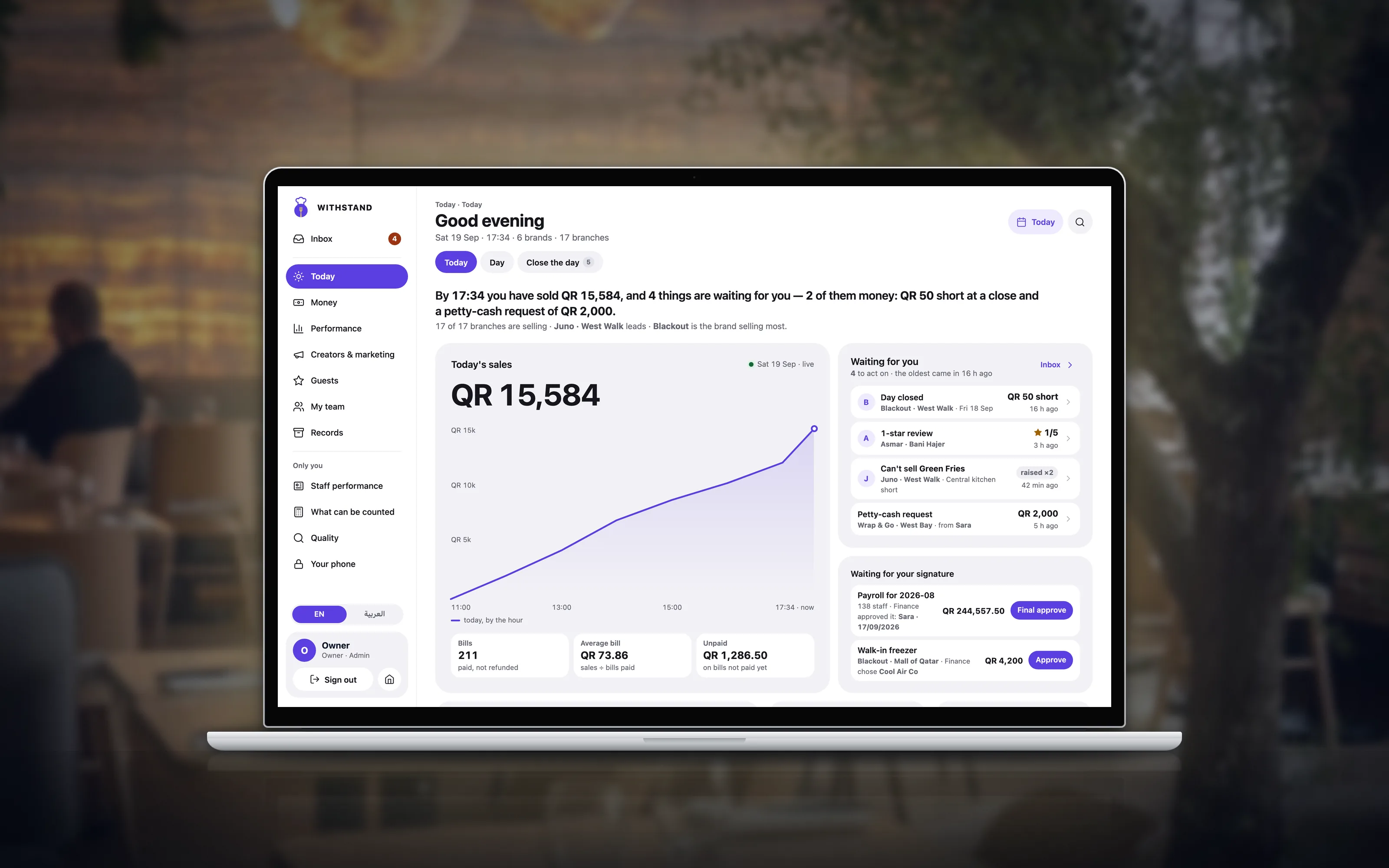
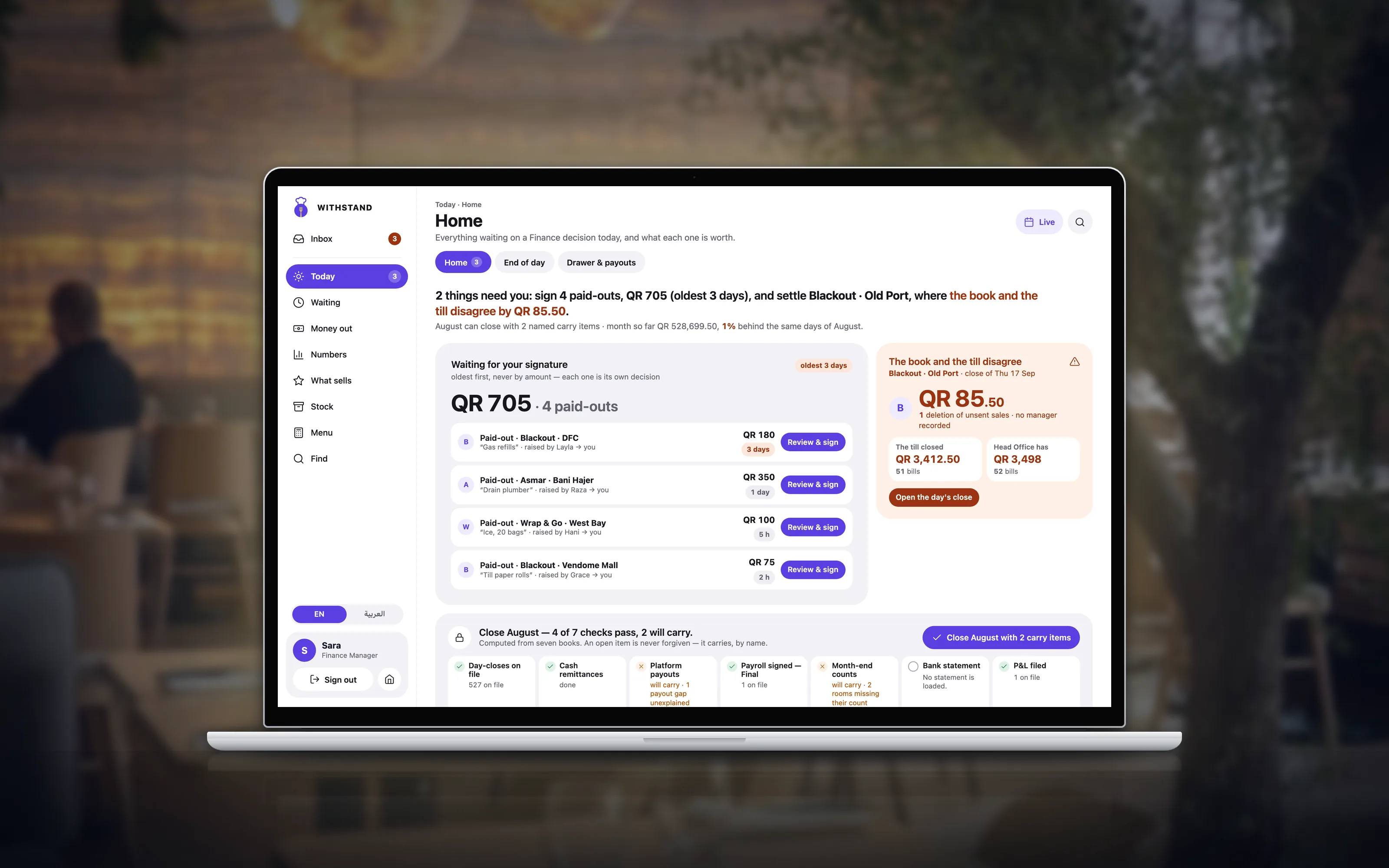
Head Office — the Owner's Today The day in one sentence — what has sold so far and what is waiting for him — then the sales line by the hour and what needs his signature.Finance — Home The paid-outs waiting for her signature, oldest first and never by amount — and any day's close where the book and the till disagree.
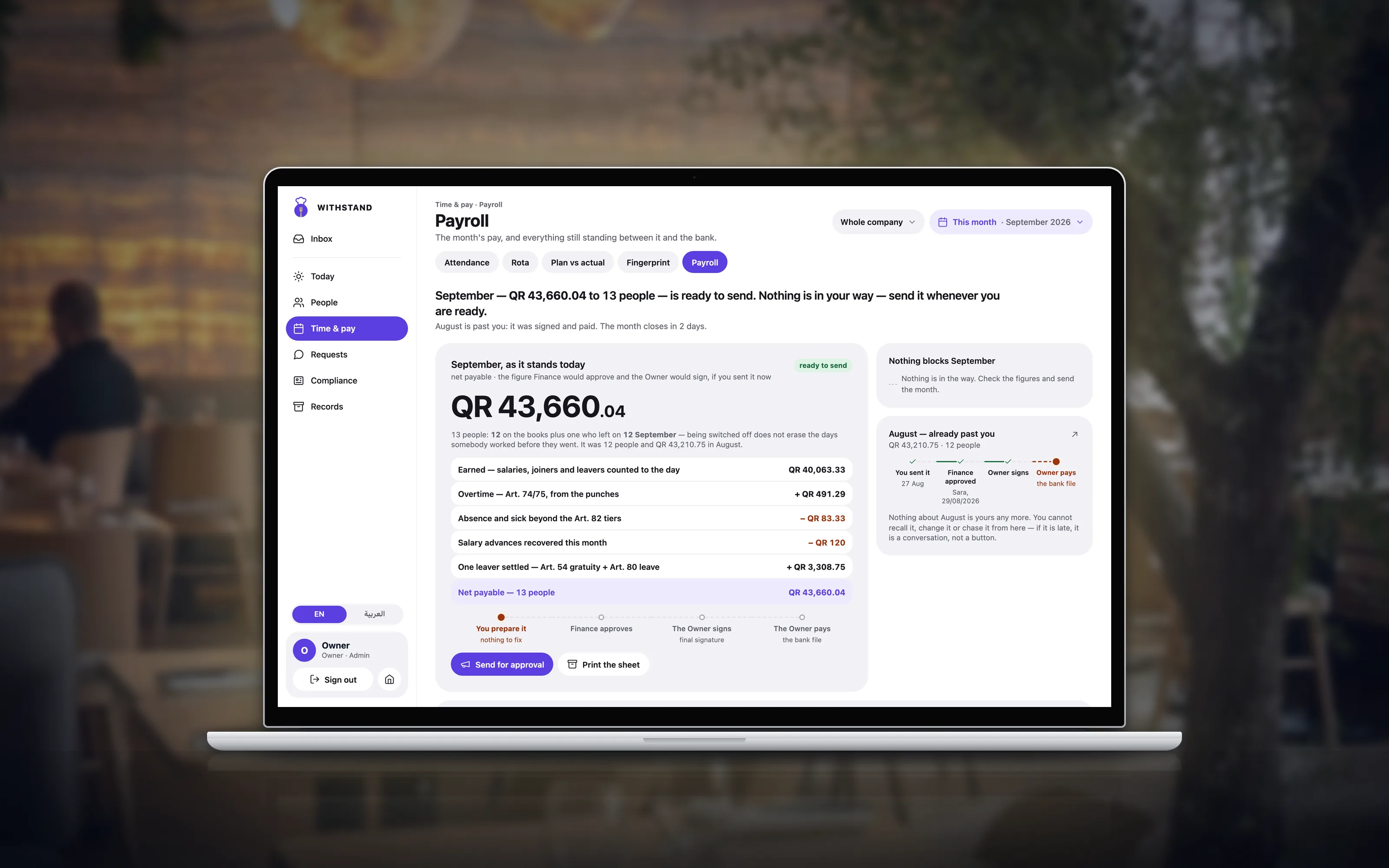
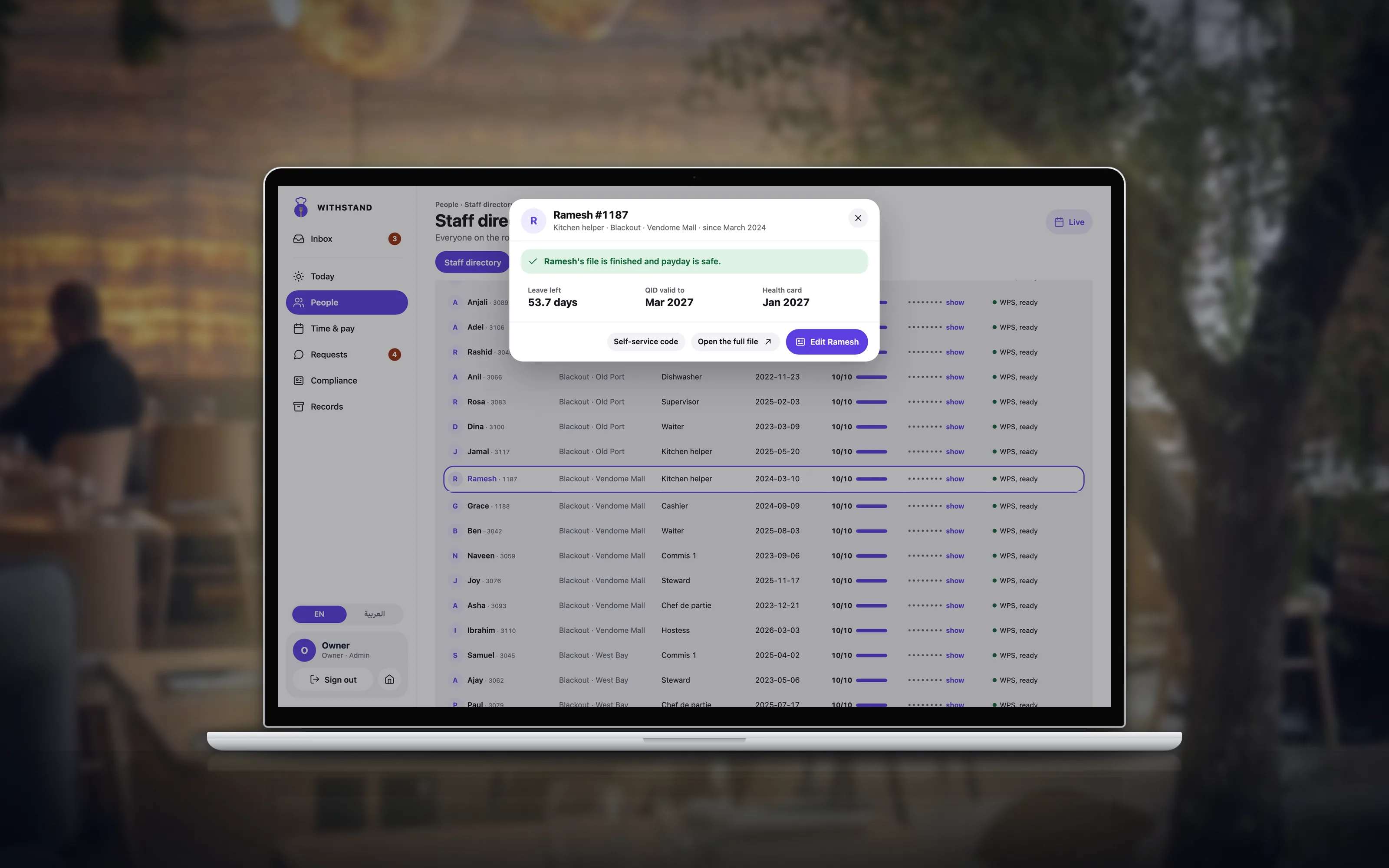
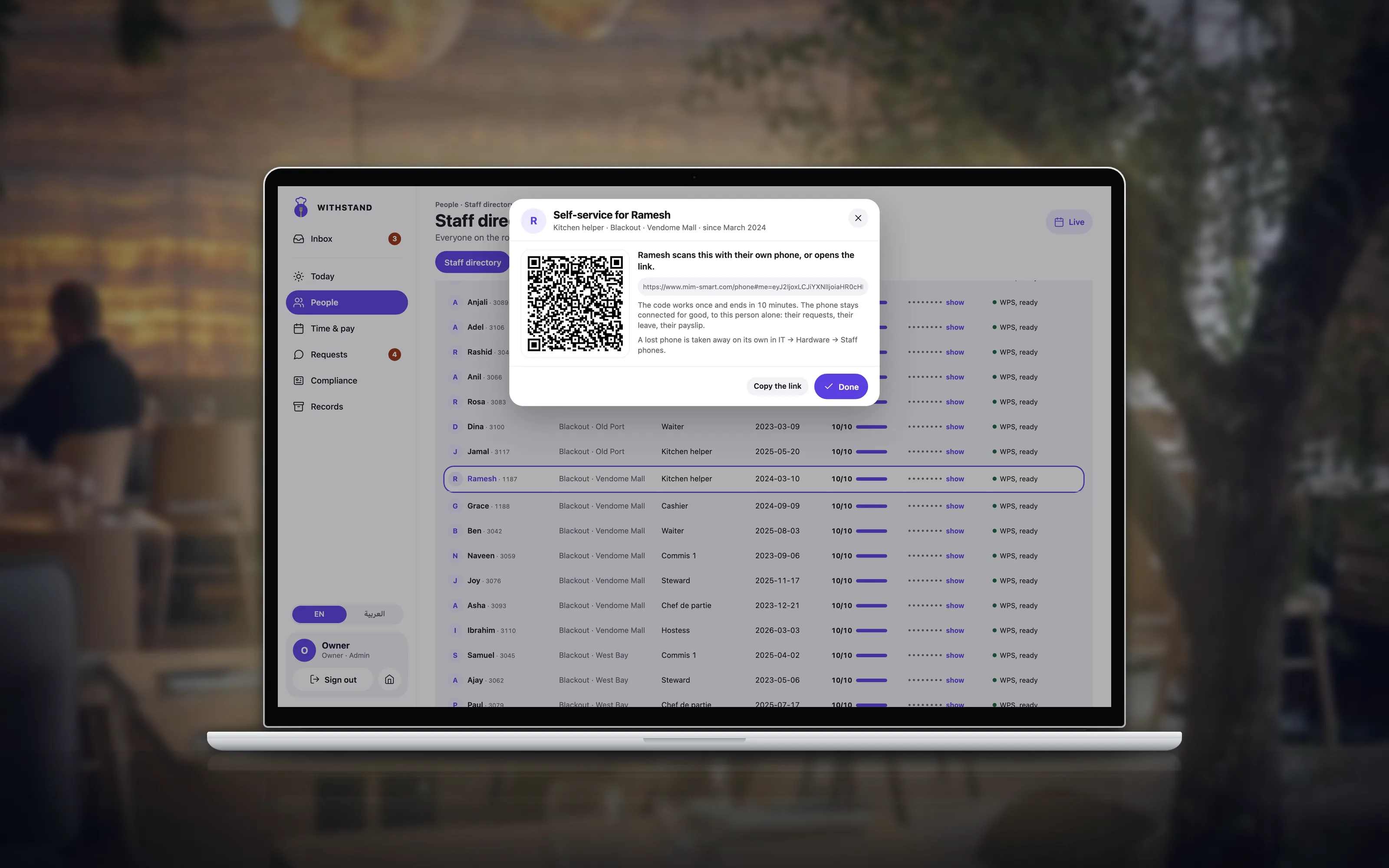
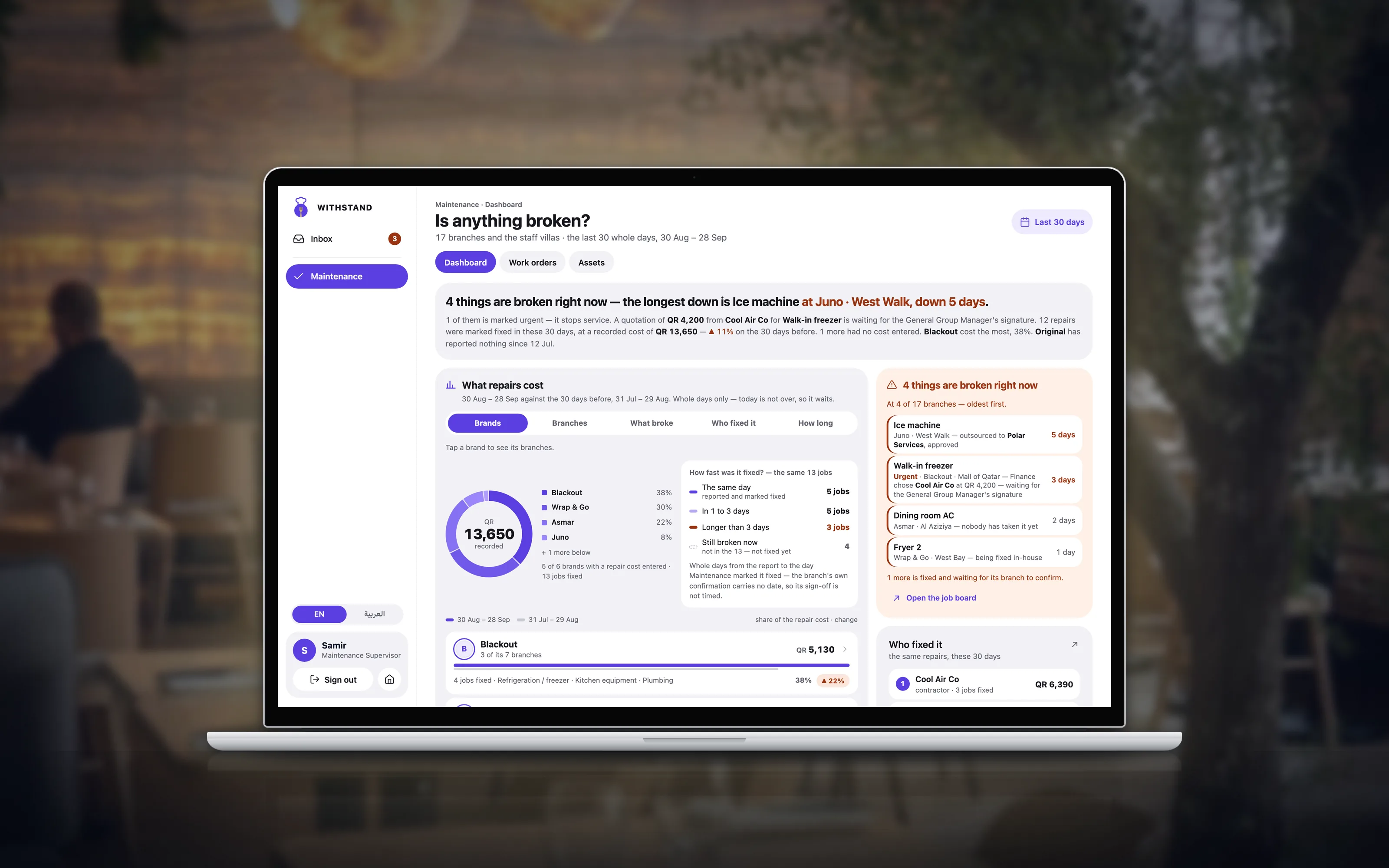
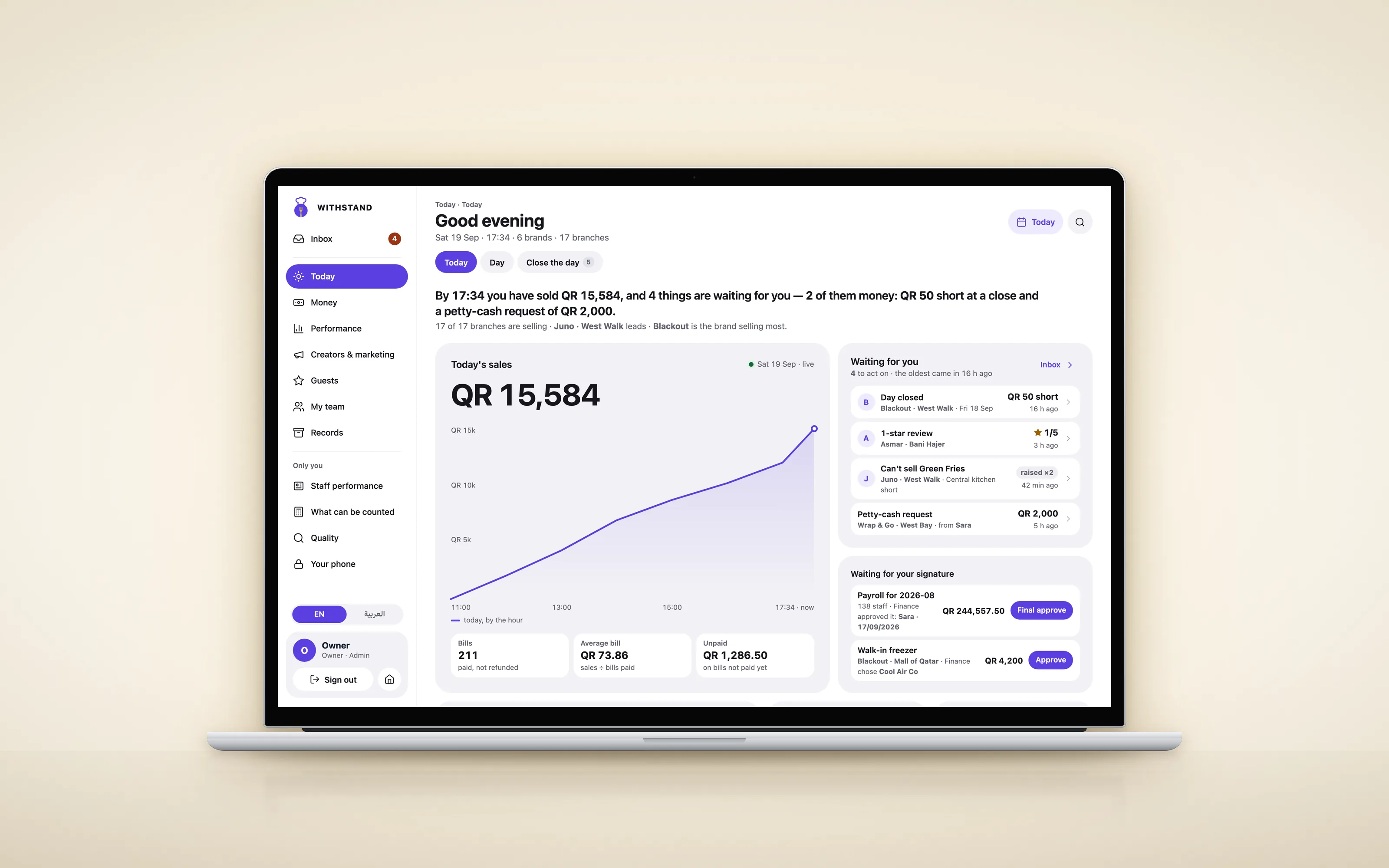
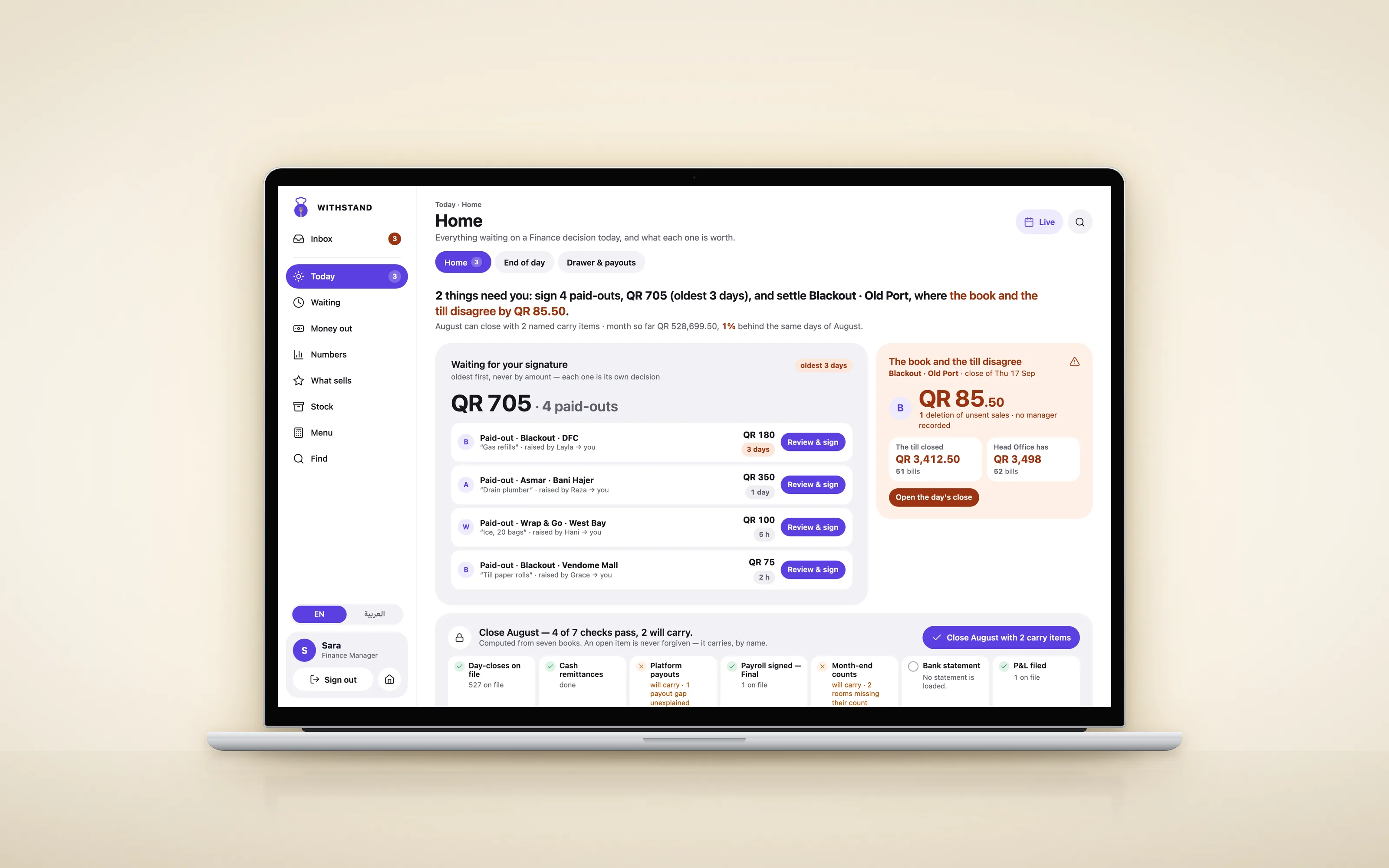
HR — Payroll The month's net pay as one figure, and whether it is ready to send — overtime, absence and a leaver's settlement each name their article of the Labour Law.HR — Ramesh's sheet Opened from the staff directory: whether his file is finished and his payday is safe, on one sheet.HR — Ramesh's self-service code He scans it with his own phone. The code works once and ends in 10 minutes; the phone then stays his alone.Maintenance — Is anything broken? What is broken right now, oldest first — and what repairs cost over the last 30 days, by brand, by branch, by what broke and by who fixed it.The same Today, on an ivory backdrop Each approval waiting for his signature has its own button, and says what Finance has already done.Finance Home, on an ivory backdrop The month's close along the bottom, check by check — and an open item is never forgiven: it carries, by name.
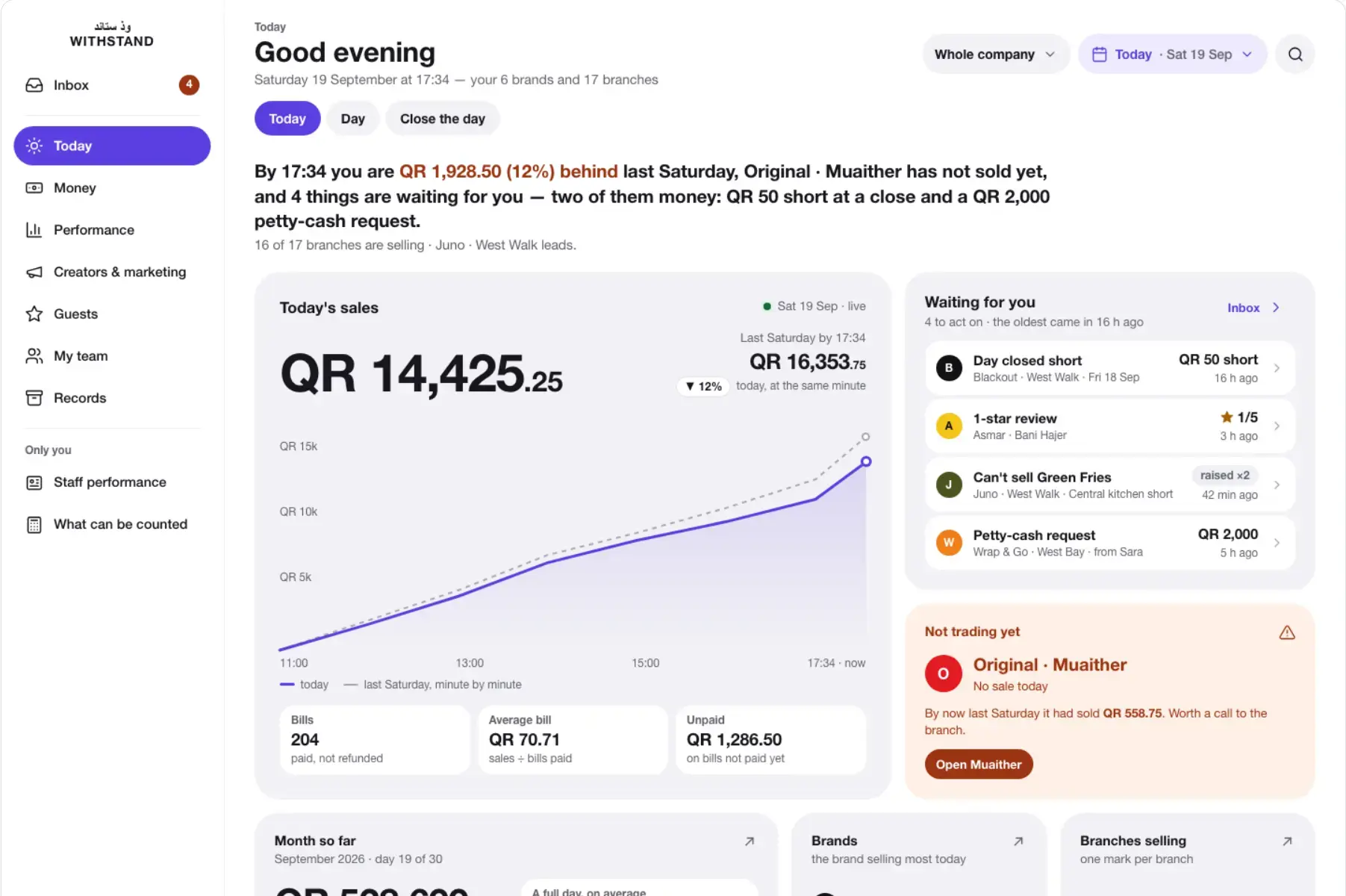
Fifteen screens replace the pages that were hardest to read. Each one starts with a single sentence that answers it, fits a 13-inch laptop, and works in Arabic.
One sentence first, the detail below itEvery figure on one lineFits a 1280 × 800 laptopEach network in its own colours
Head Office · Today
In one sentenceQR 1,928.50 behind last Saturday at 17:34, one branch not selling, 4 things waiting.
Screens shown with sample data.
Where the money actually enters
The screen your staff touch all day
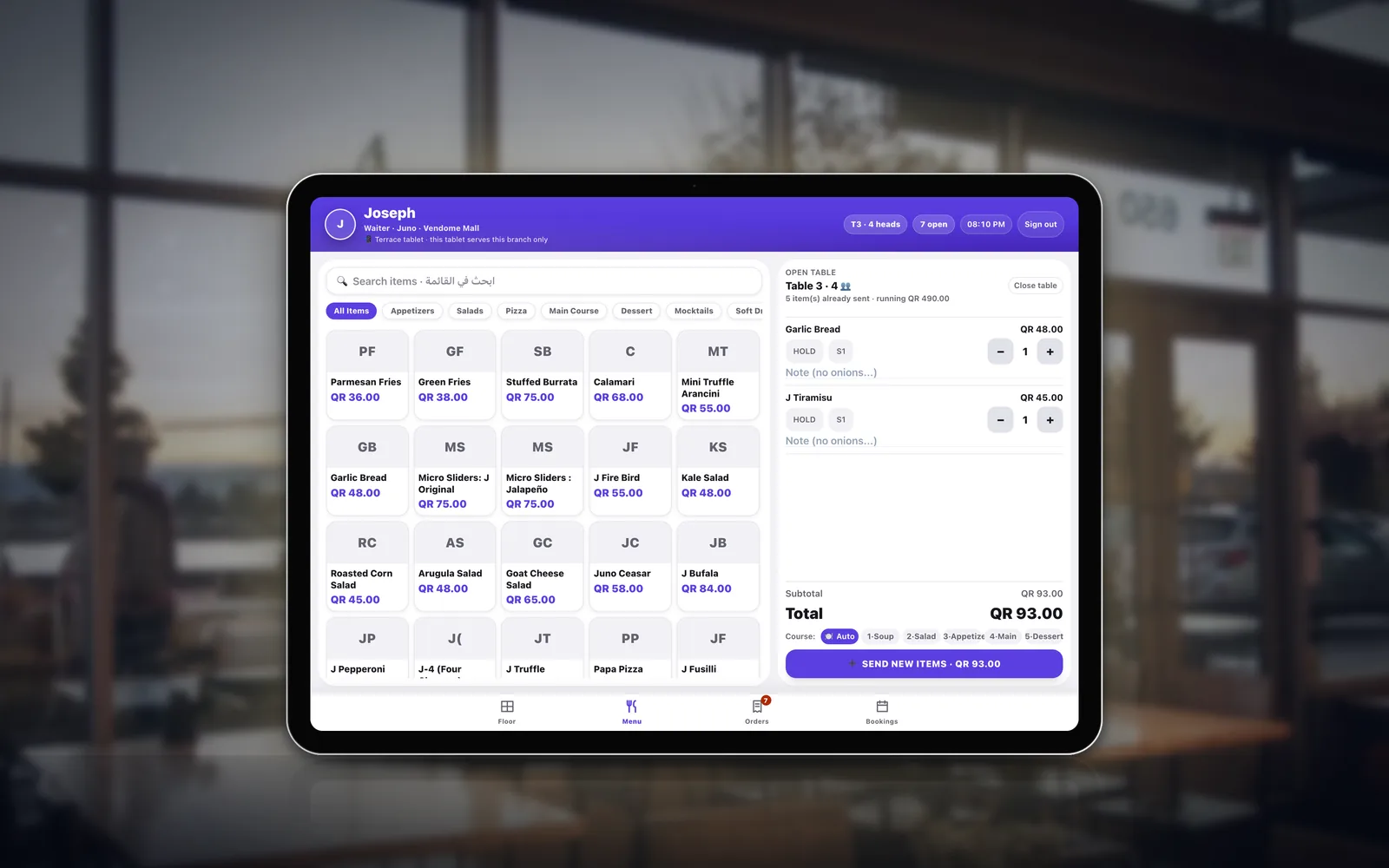
Fast enough for a Thursday night, and every tap on it is already a row in the stock ledger, the P&L and the day close. Nothing gets re-typed anywhere, ever.
Swipe the screen sideways to see all of it
JUNOWest WalkTill 1
RKRaza K.Server · JUNO West Walk
🔍 Search items · ابحث في القائمة☰ availability
All ItemsStartersMainsSidesDessertsDrinks
KS
Kale SaladQR 48.00
BT
Burrata & TomatoQR 52.00
🚫 86Sold out2h
CC
Crispy CalamariQR 42.00
CW
Chicken WingsQR 44.00
BT
Beef TatakiQR 58.00
JF
J Fire BirdQR 84.00
R3
Ribeye 300 gQR 128.00
LC
Lamb ChopsQR 145.00
GS
Grilled SalmonQR 96.00
SB
Smash BurgerQR 62.00
MR
Mushroom RisottoQR 68.00
GH
Grilled HammourQR 98.00
PF
Parmesan FriesQR 24.00
GC
Grilled CornQR 18.00
GS
Garden SaladQR 22.00
TM
Truffle MashQR 26.00
CF
Chocolate FondantQR 38.00
C
CheesecakeQR 36.00
FL
Fresh LemonadeQR 22.00
SW
Sparkling WaterQR 14.00
OPEN TABLE Table T2 · 2 👥Close table
🚨 Tree nuts🚨 Sesame
3 item(s) already sent · running QR 132.00
🧾 Print bill💳 Pay
No items yet — tap a dish
SubtotalQR 0.00
TotalQR 0.00
➕ Send new items · QR 0.00
Payment — Check #1200029QR 132.00
💵 Cash💳 Card📲 JUNO App
Tip · إكراميةNoneQR 2QR 5QR 10Custom
Remaining · المتبقيQR 132.00
RestQR 50QR 100QR 200QR 500
Amount (QR 132.00)Add Card · QR 132.00
Mix payments freely — e.g. QR 100 cash + rest on card. Check closes automatically when fully paid; cash change is calculated.
Process the amount on the bank terminal, then tap Add Card.
LOYALTY (OPTIONAL) · نقاط الولاء5530 0412Maryam A. · 273 pts (= QR 136.50) — earns +13 pts💎 Redeem 264 pts — pay QR 132.00 with points
Cancel payment
AMOUNT
QR 132.00
QR 132.00 due
123456789.0⌫
Add Card · QR 132.00
Every payment route, one screen
Cash, card or the brand’s app, a tip, split tenders with the change worked out, and the guest’s loyalty card on the same sheet: Maryam earns +13 points on this QR 132.00 bill.
The allergy question is asked, not hoped for
It appears on the check and travels to the kitchen screen with the order. Undetermined never reads as "free".
86'd once, sold out everywhere
Mark a dish off at one till and it reads “86 · Sold out” on every till, as the calamari does on the Restaurant POS screen above. Nobody rings up what the kitchen cannot cook.
It keeps selling with the line down
Orders queue locally and settle when the link returns. An empty answer is never mistaken for a real zero.
Given away, still counted
At 20:49 the fries ran late and Noor put them on us: the line stays on the check at QR 0.00 with the QR 24.00 struck through, and the bill closes at QR 132.00. A comp is a line with a price and a name, not a missing plate.
Arabic, right to left
Including the receipt. The layout flips; nothing ends up reading backwards.
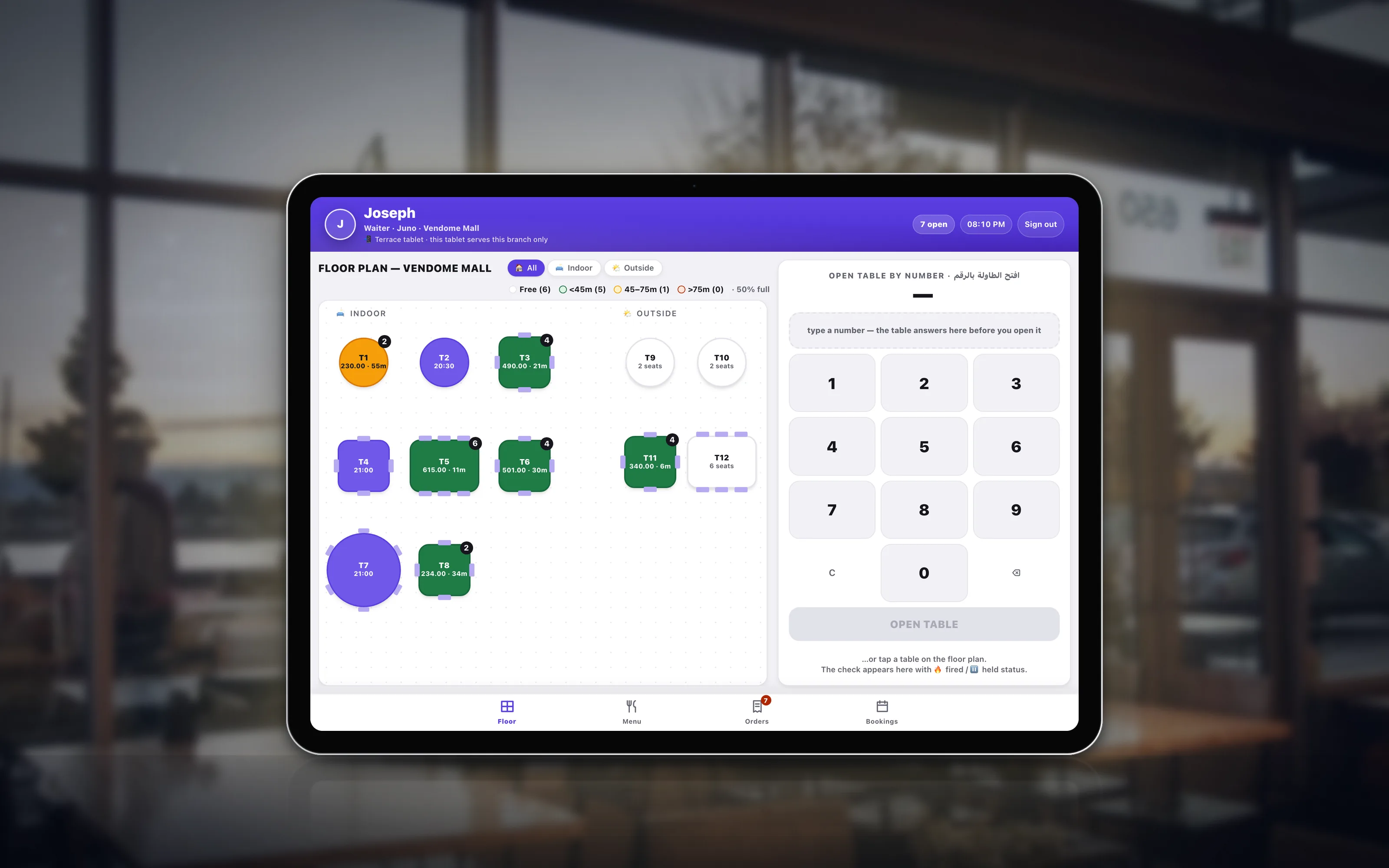
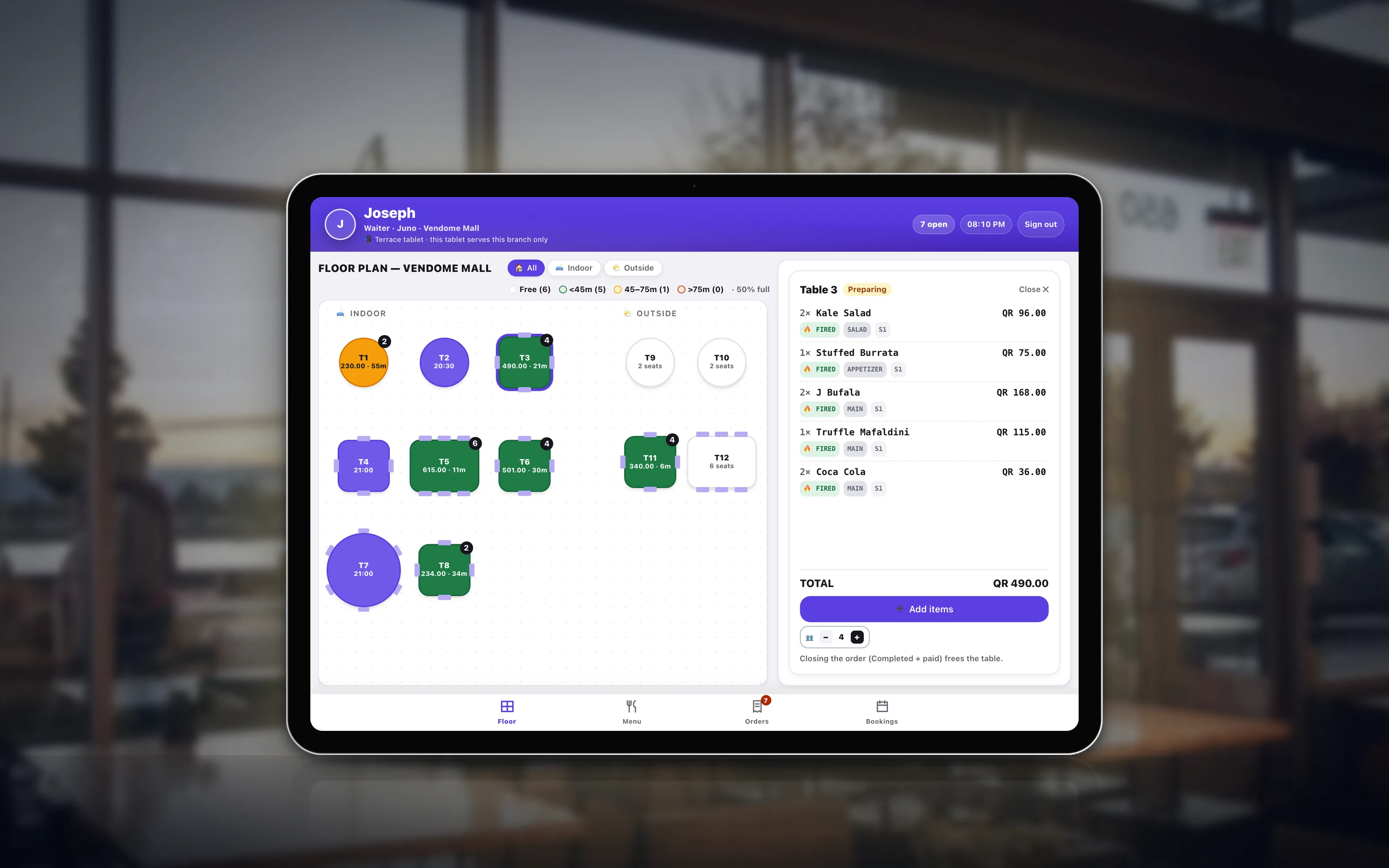
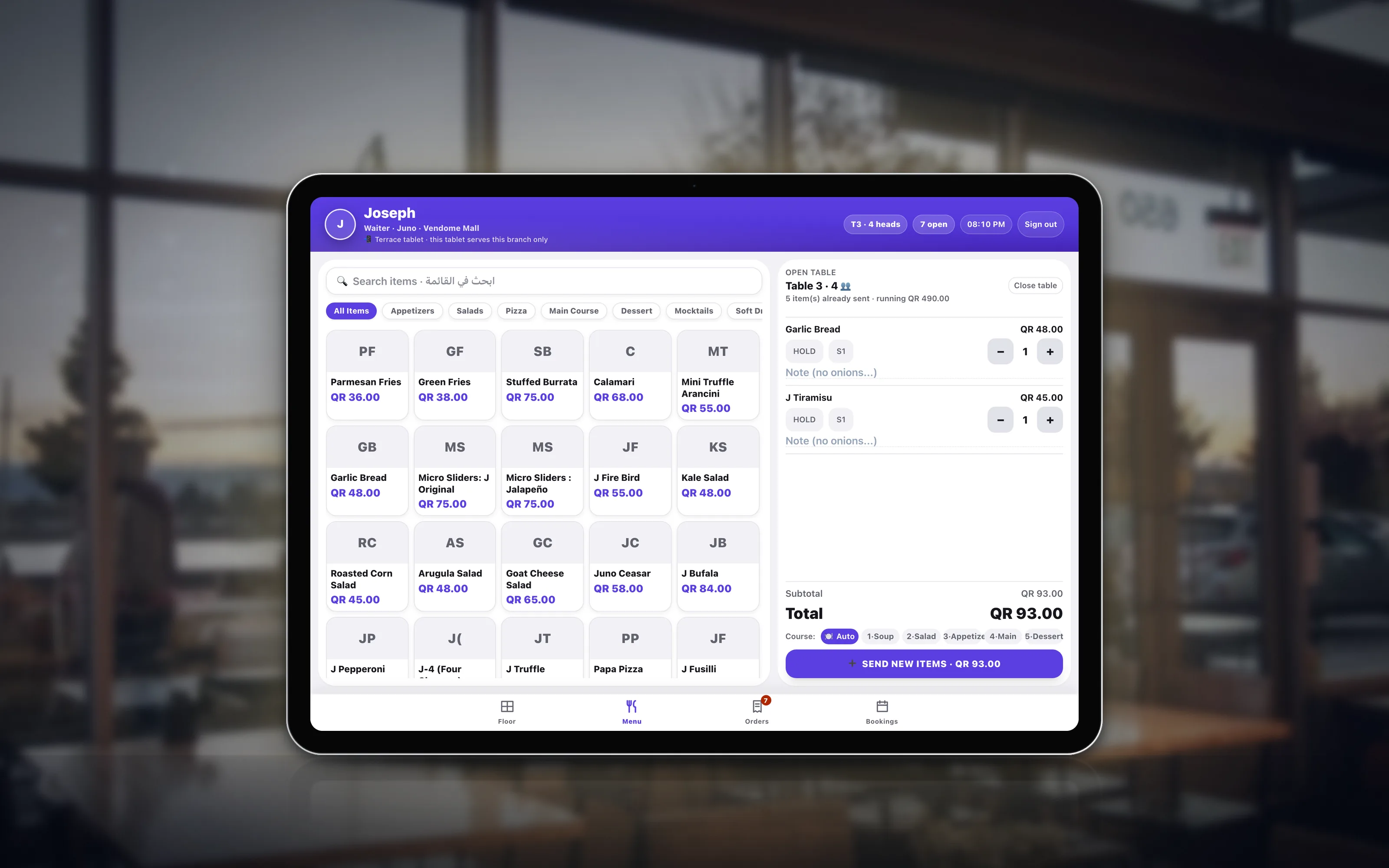
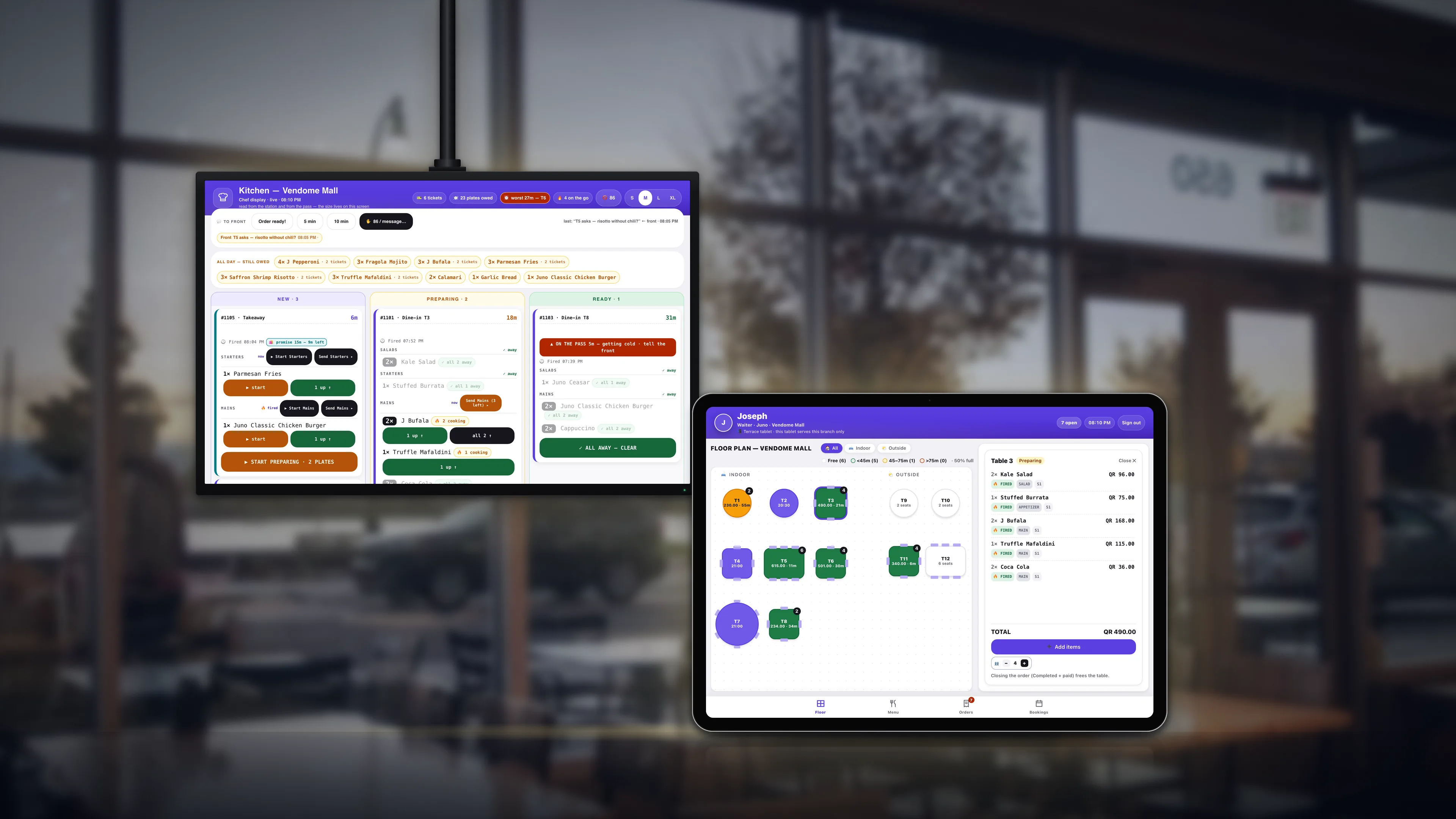
Waiter tablet — the floor Joseph's floor plan: every table's state, each open table's bill and minutes, and a keypad to open one by its number.Waiter tablet — Table 3's order Each line fired to the kitchen with its course, the bill so far, and Add items one tap away.Waiter tablet — adding to the order New items wait in Table 3's next round until Send new items fires them to the kitchen.
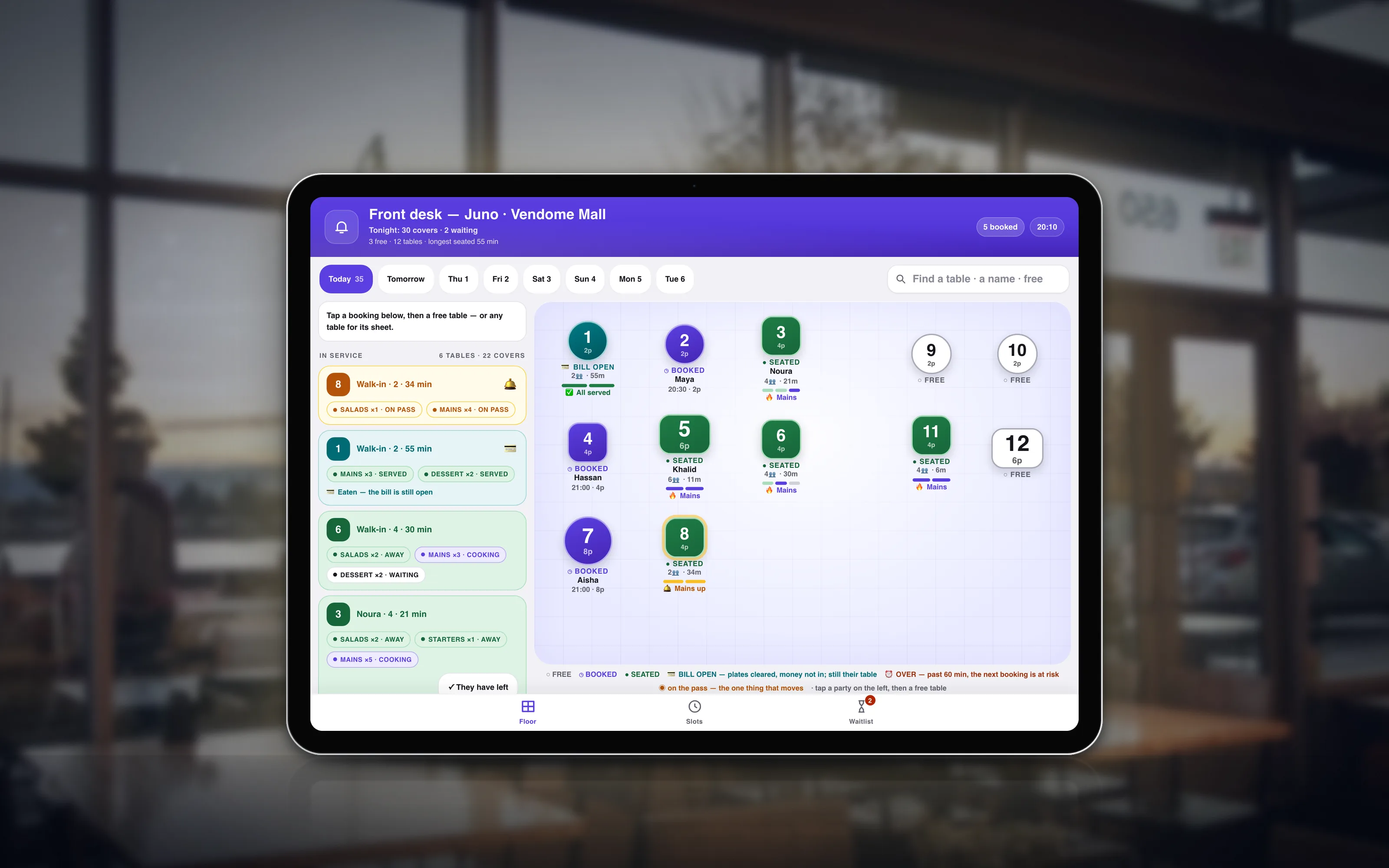
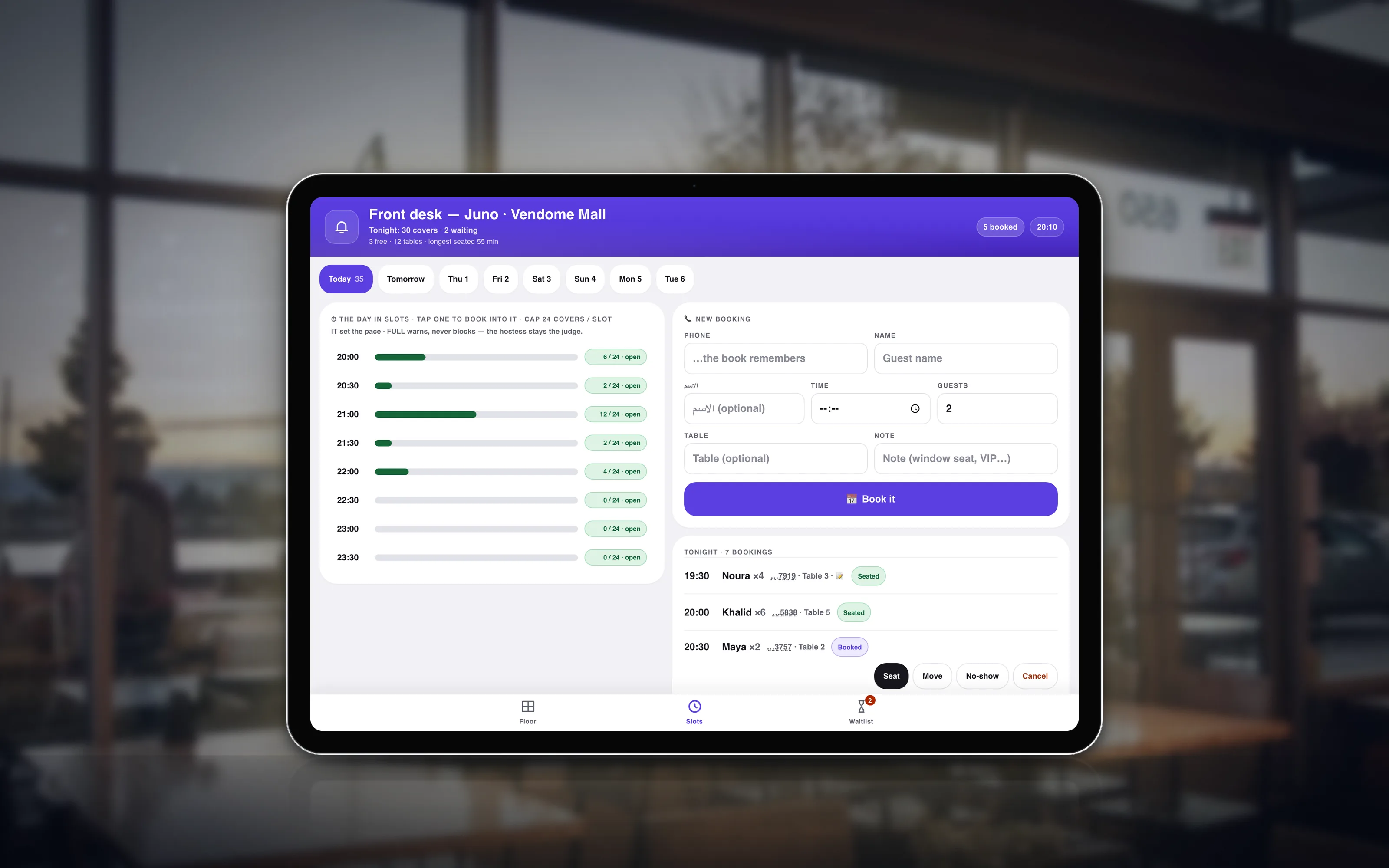
Hostess desk — the floor with tonight's bookings Tonight's covers and who is waiting, up top — then who is seated, which tables are booked, which bills are open and which tables are free.Hostess desk — tonight's bookings The evening in half-hour slots, a new booking on one sheet, and each booking with Seat, Move and No-show.
Kitchen · The Pass
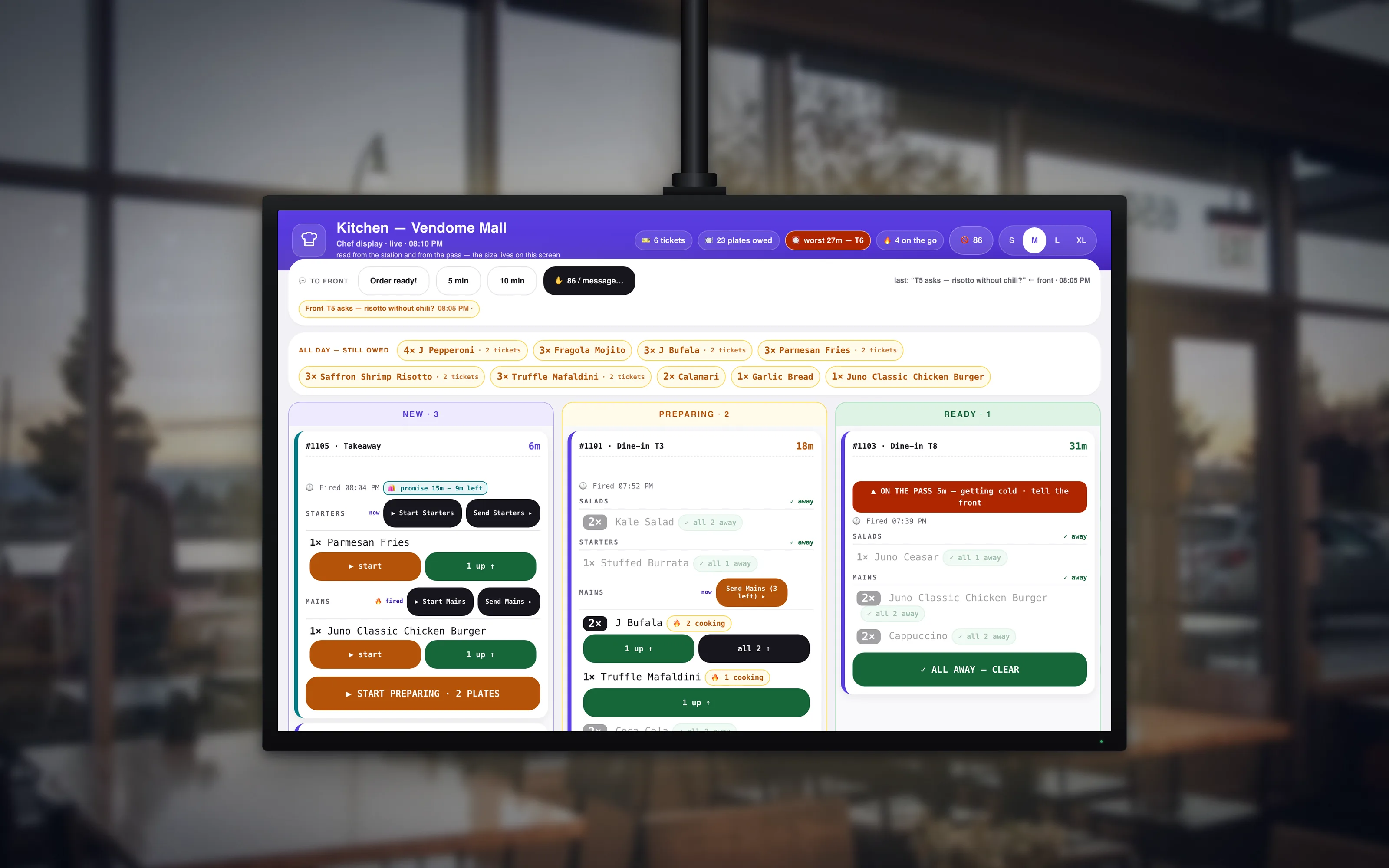
The whole order on one card, course by course
A chef works a table, not a list of plates. The Pass shows every course in the order the law of service says they go out — and the rule is in the software, not on a sticky note.
Start releases a course to its stationsEach station sees only the plates released to it, and a "coming" strip of what is queued — so a branch with nobody on the pass still cooks everything.
Away only when the course before is awayA main cannot leave ahead of a starter that still owes a plate. The button says why it is asleep: "Soup still owes 2 plates". The waiter's fire overrides it, on purpose.
An unanswered allergy question is amber on the pass itselfThe one screen that sends the plate is the one that must see it. A declared allergy is red with its handling line. Silence never reads as "no allergy".
Chef tablets pair by QREvery plate moves New → Preparing → Ready on the tablet; the clock on each ticket is the one the guest is feeling. Paid is not cooked — a paid ticket stays until the chef bumps it.
On the go (2)
#1200031 · Dine-in T4· 4 coversnow: Mains
⚠ Allergy question not answered
ask the table before this food leaves the pass
1Starters✓ away
2Mains1 of 2 started · 3 owed · 🔥 fired
3Dessertsqueued
▶ Start Mains · 1
⏳ Mains still owes 3
The Pass on the till's kitchen board, demo data. The same rule runs the chef tablet.
The kitchen, both ends Table 3's order on the waiter's tablet, and its ticket on the chef display.Chef display — New, Preparing, Ready Each order on one card, courses in order — and a plate left waiting on the pass says: getting cold, tell the front.
New
MiM Hygiene · the kitchen's phone
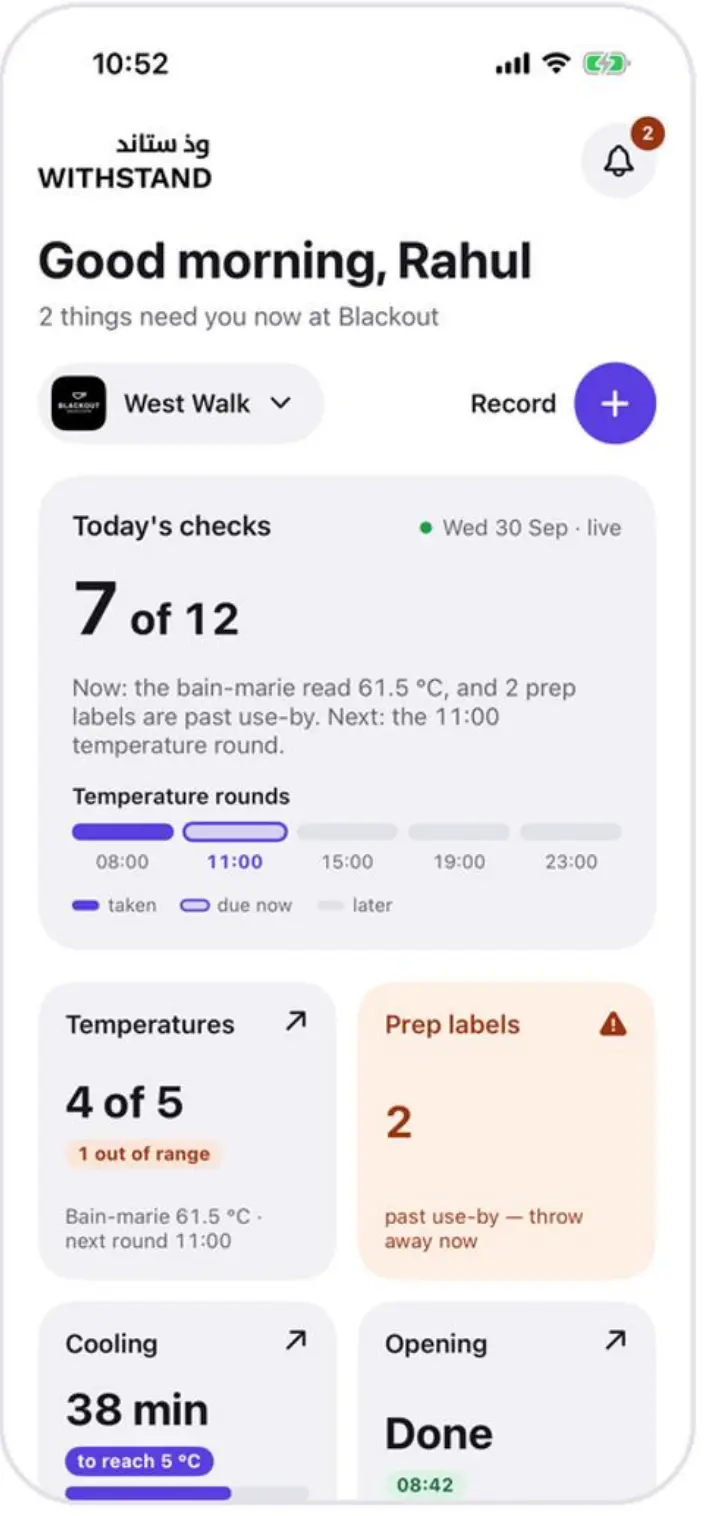
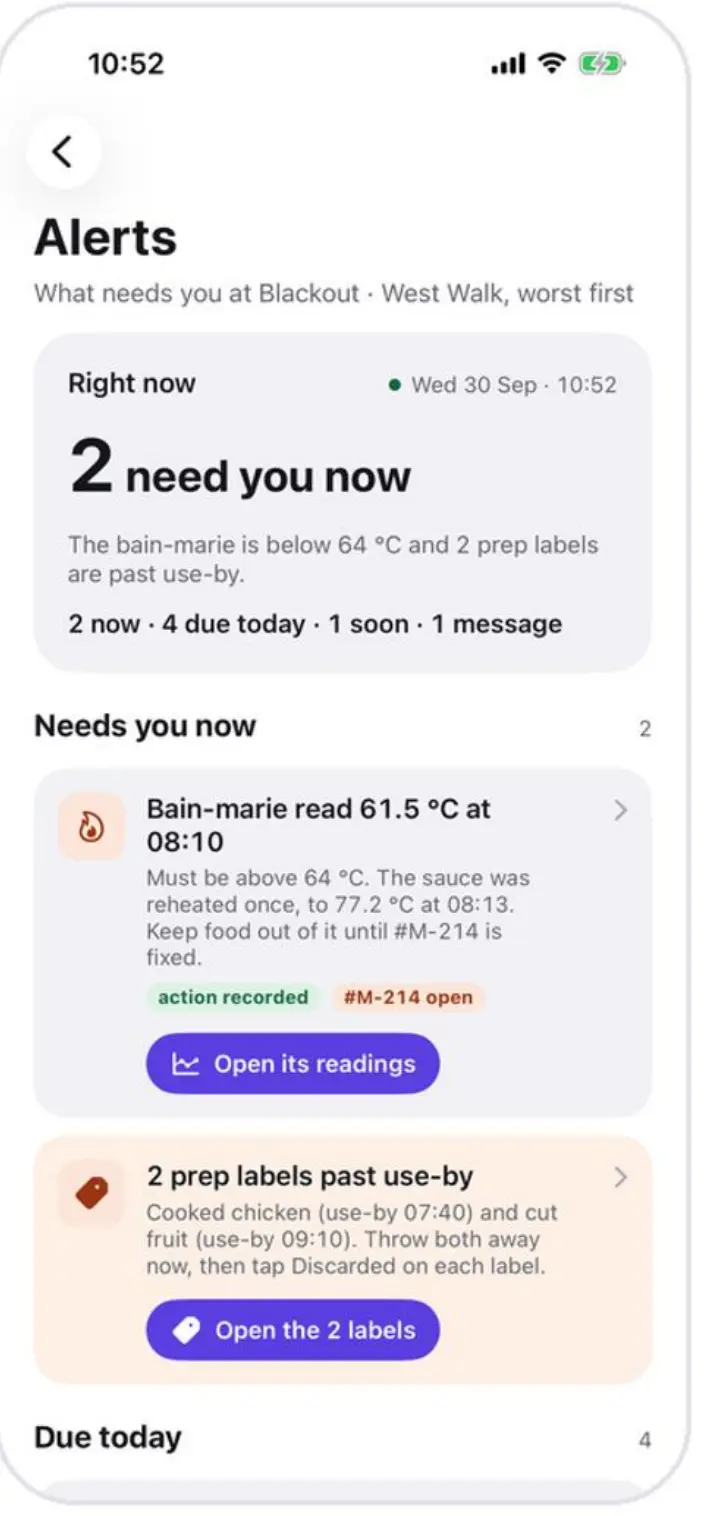
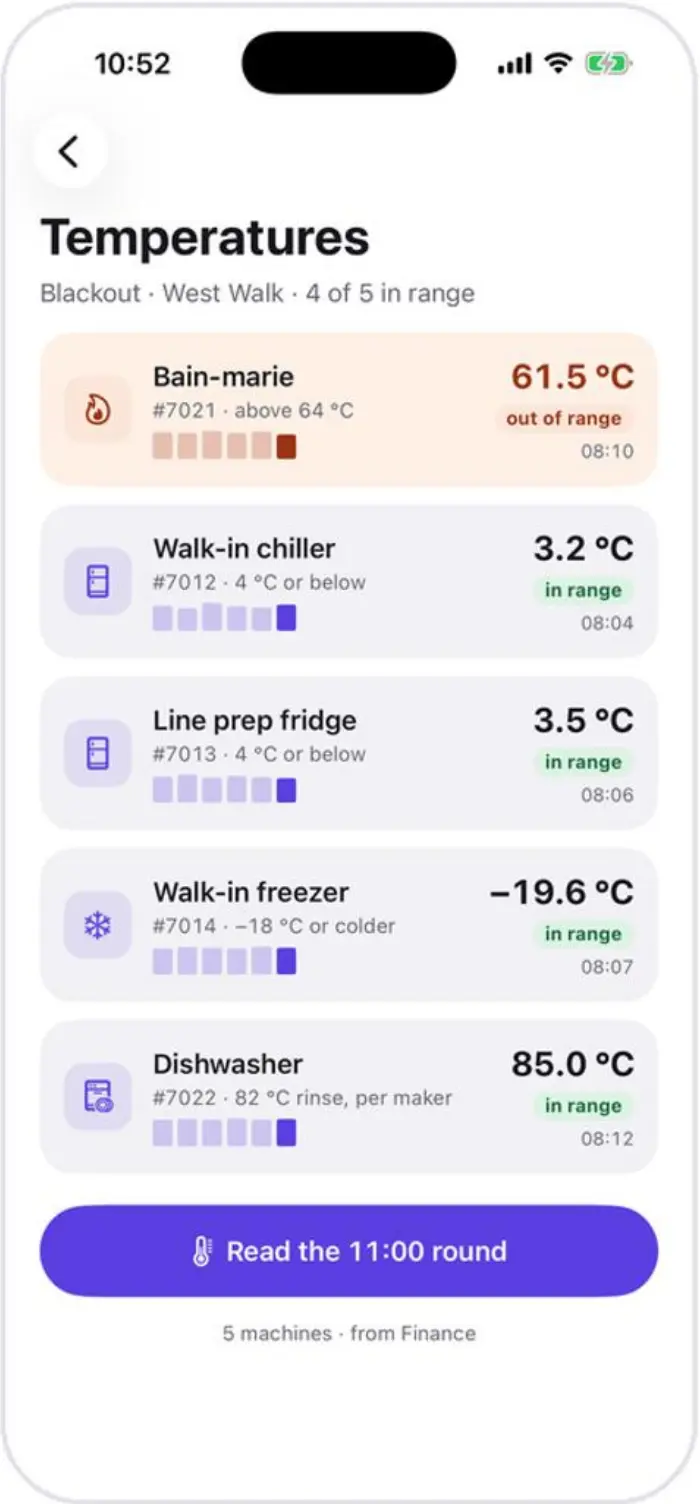
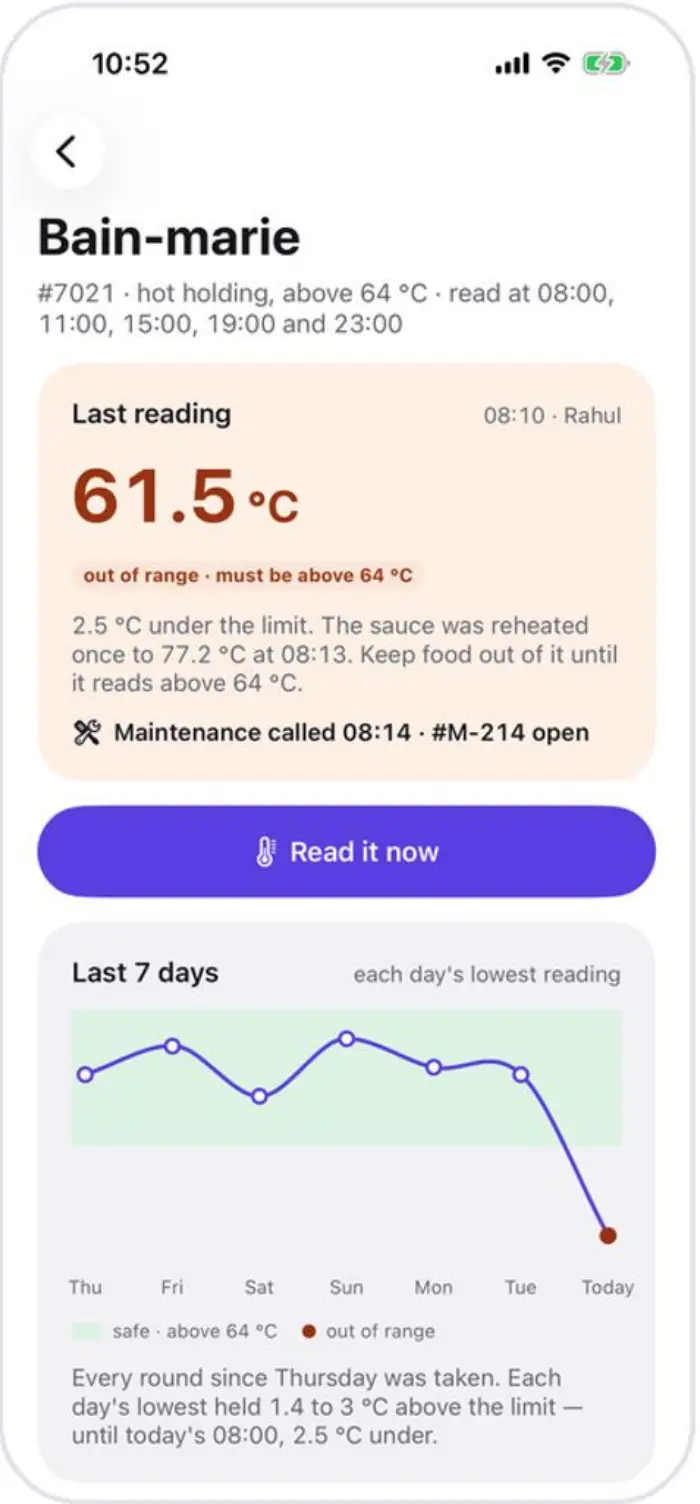
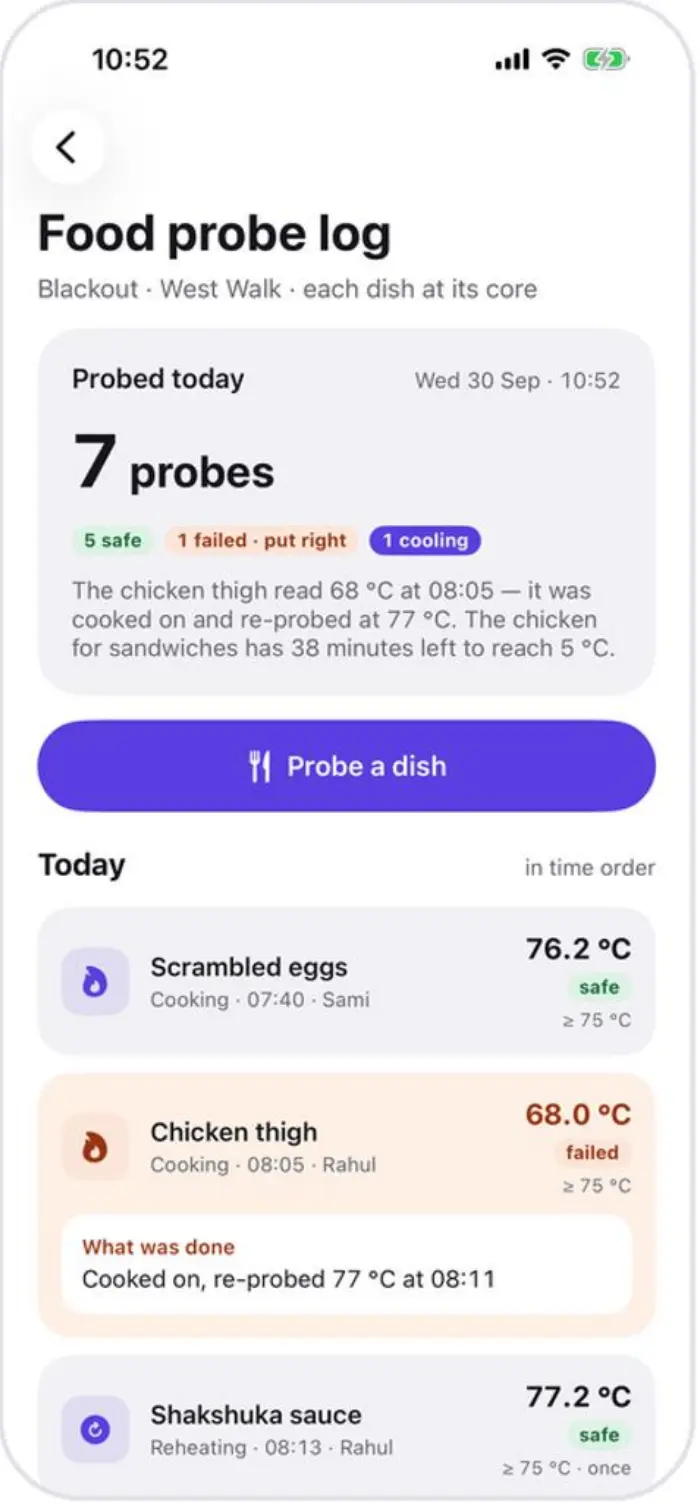
Food safety, recorded on the kitchen's own phone
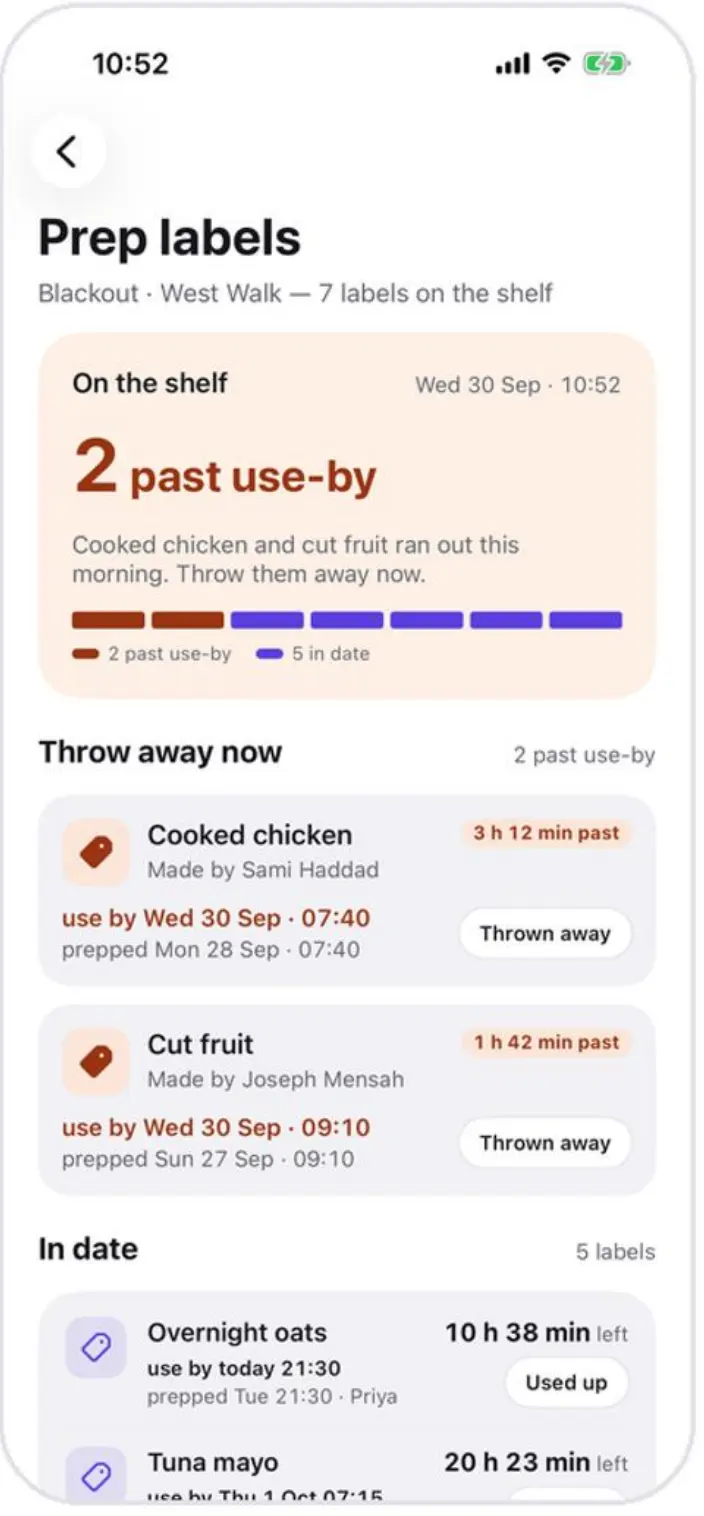
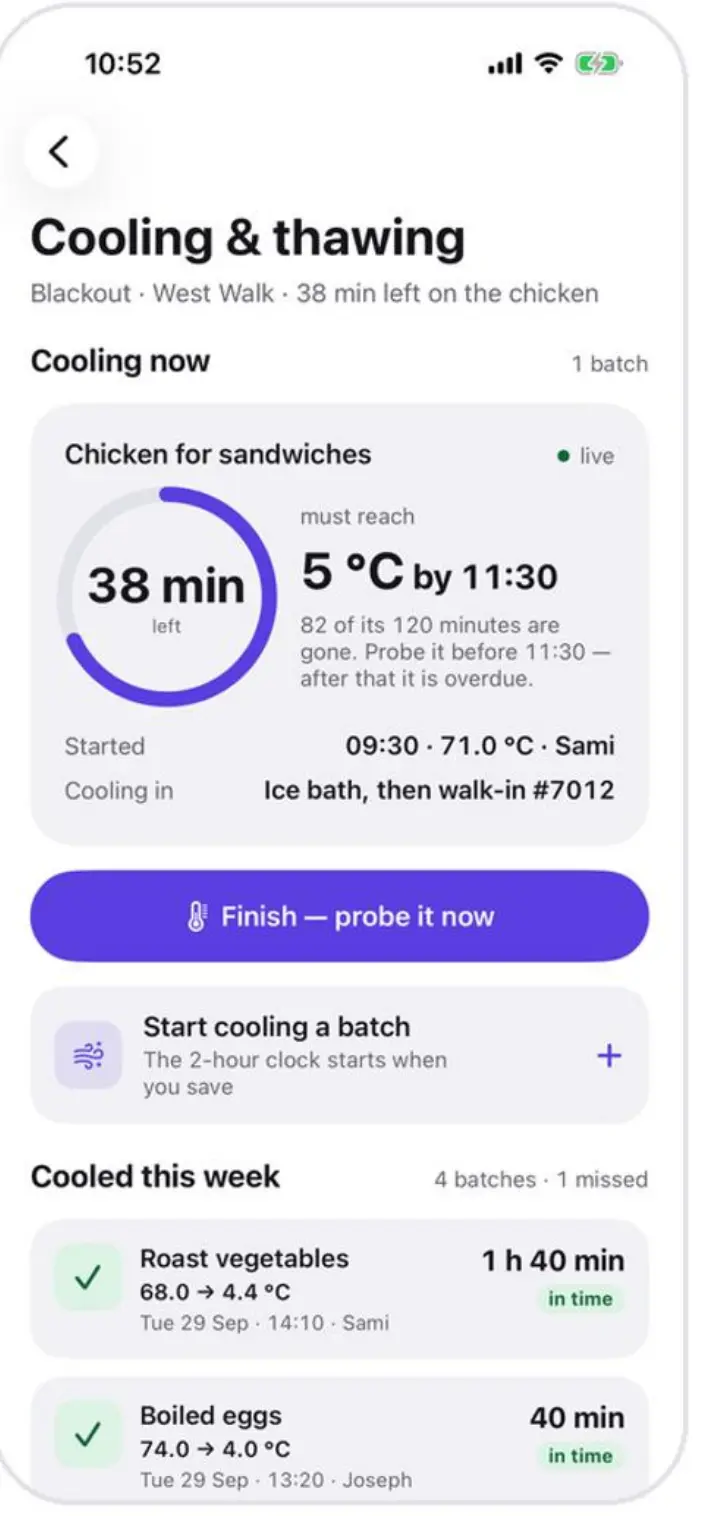
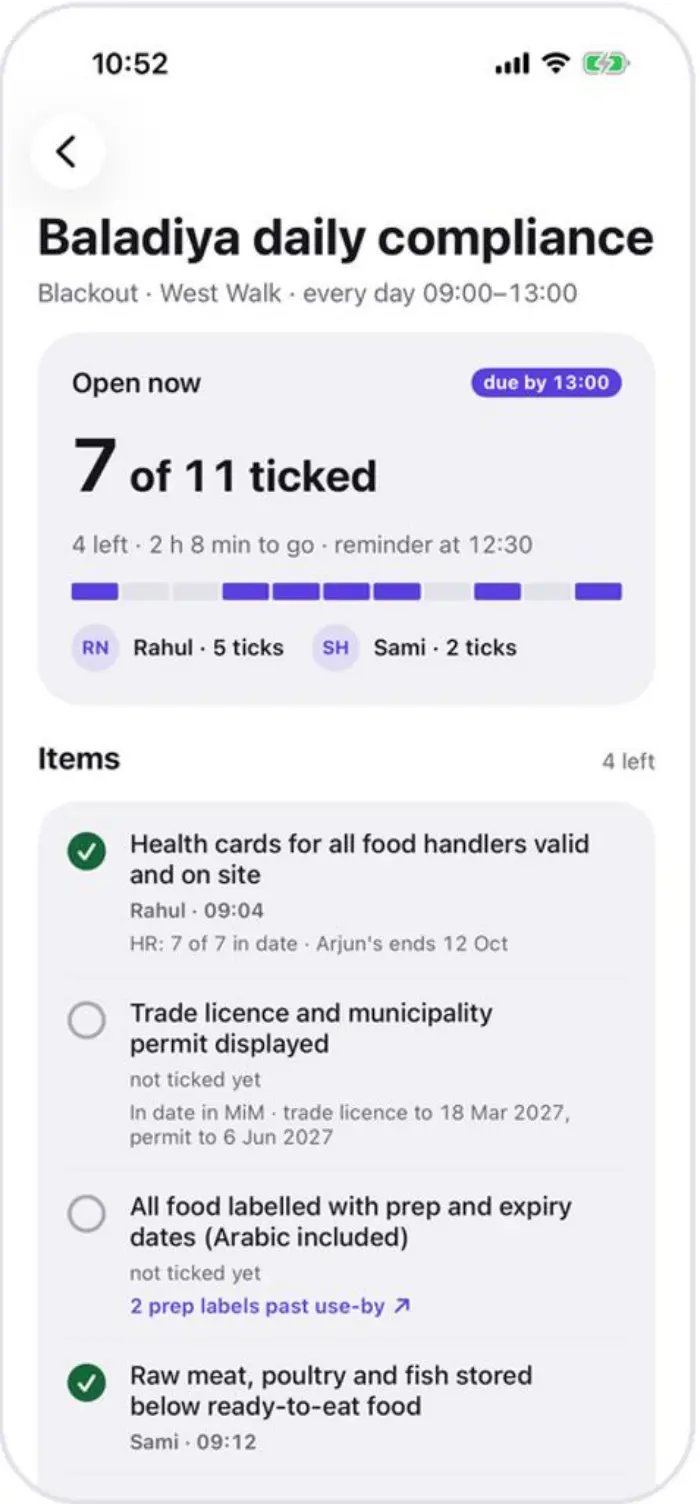
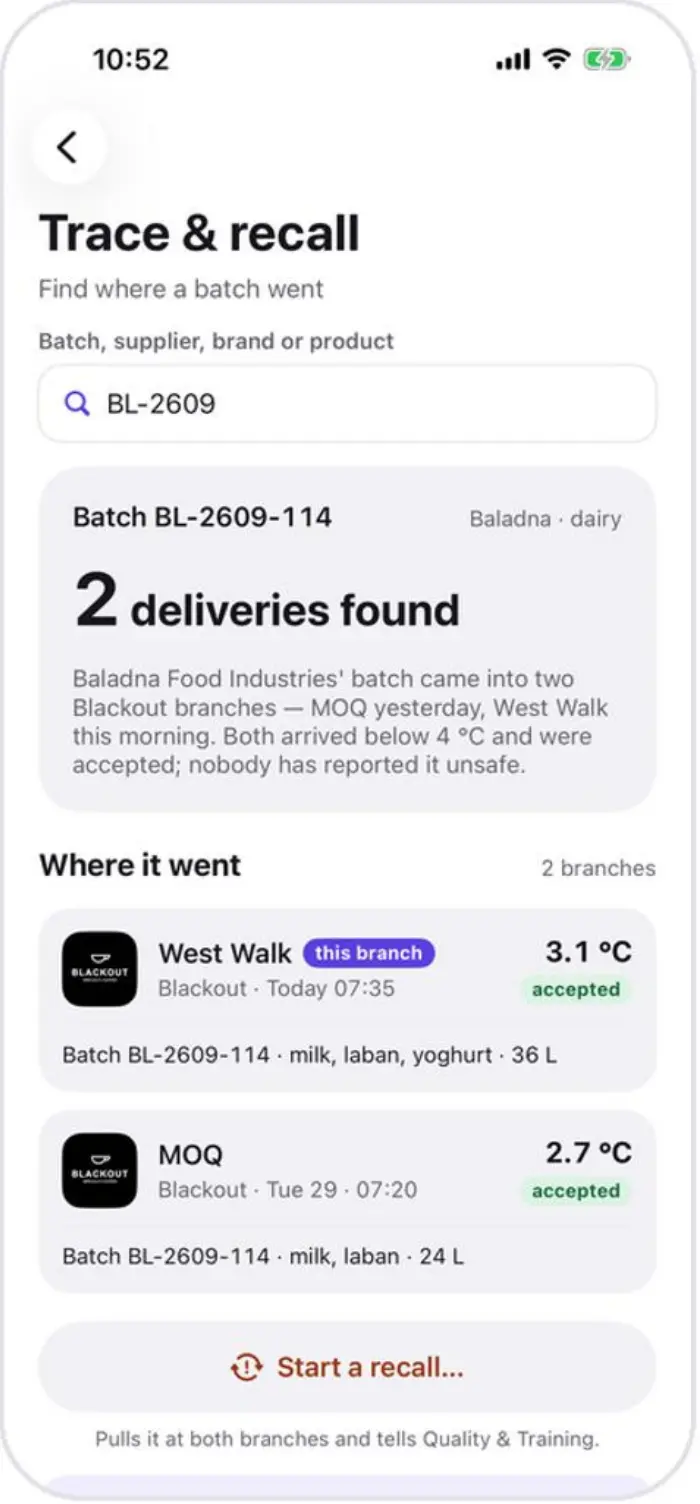
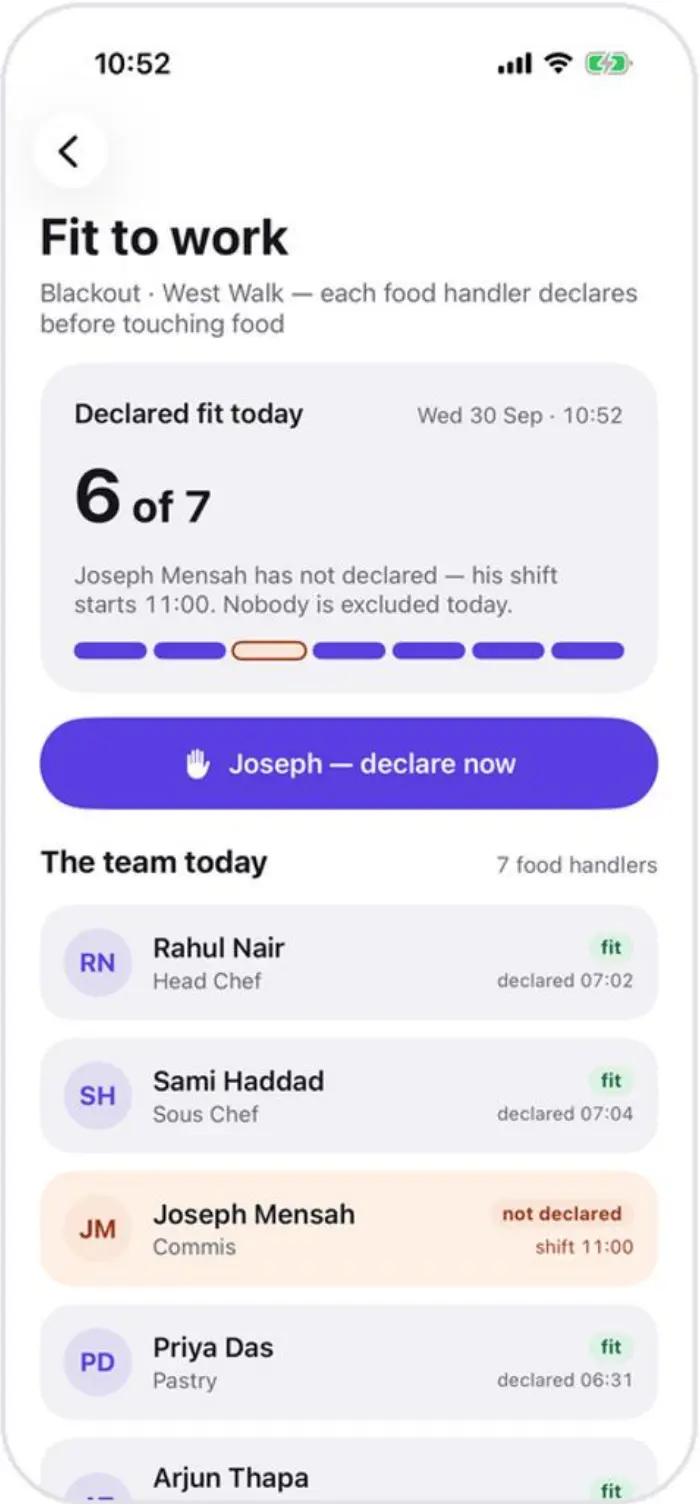
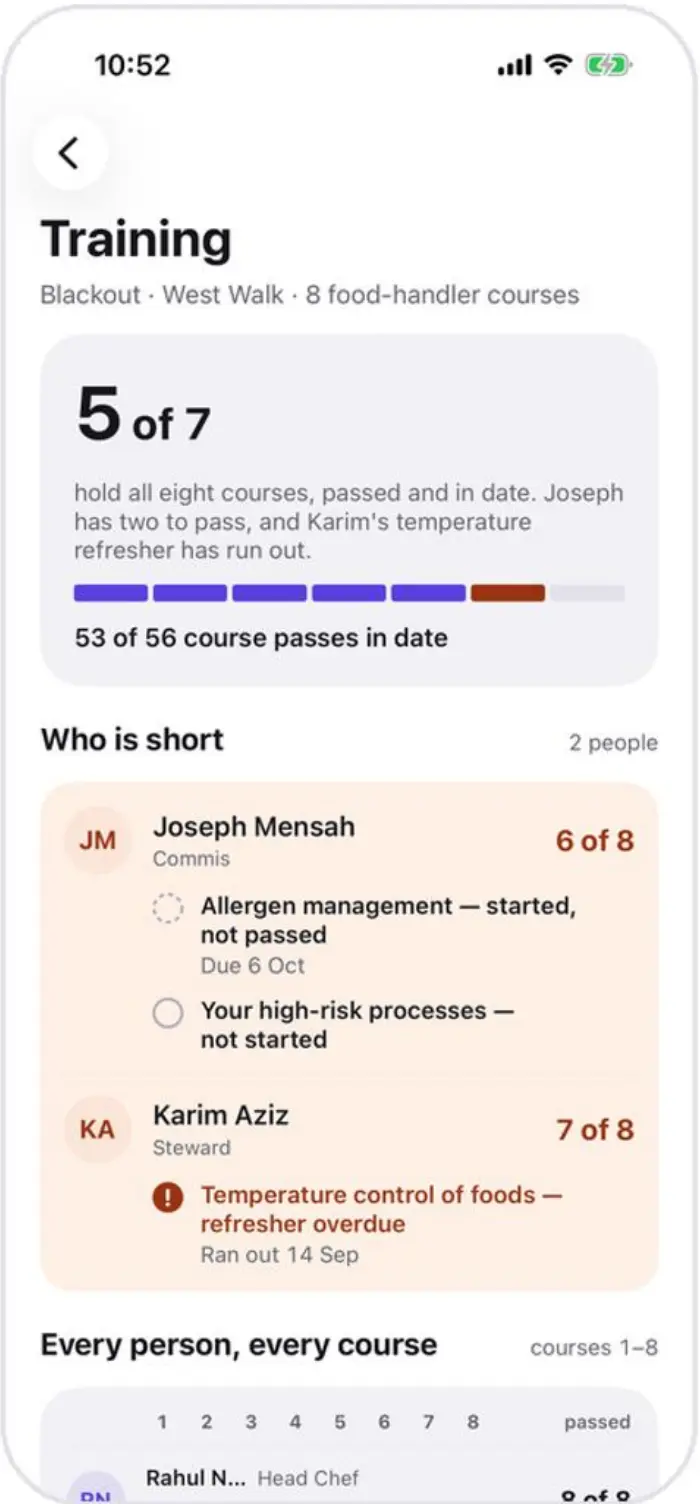
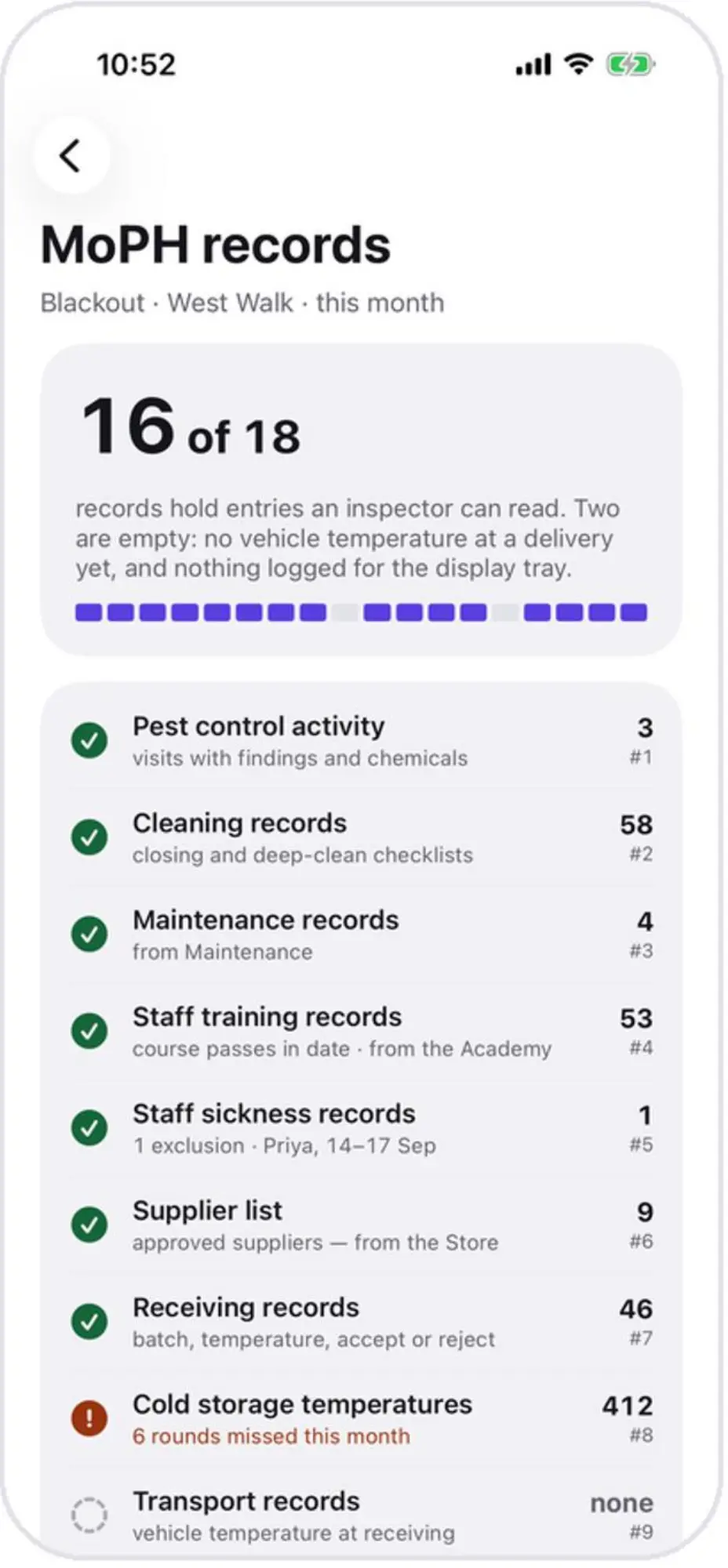
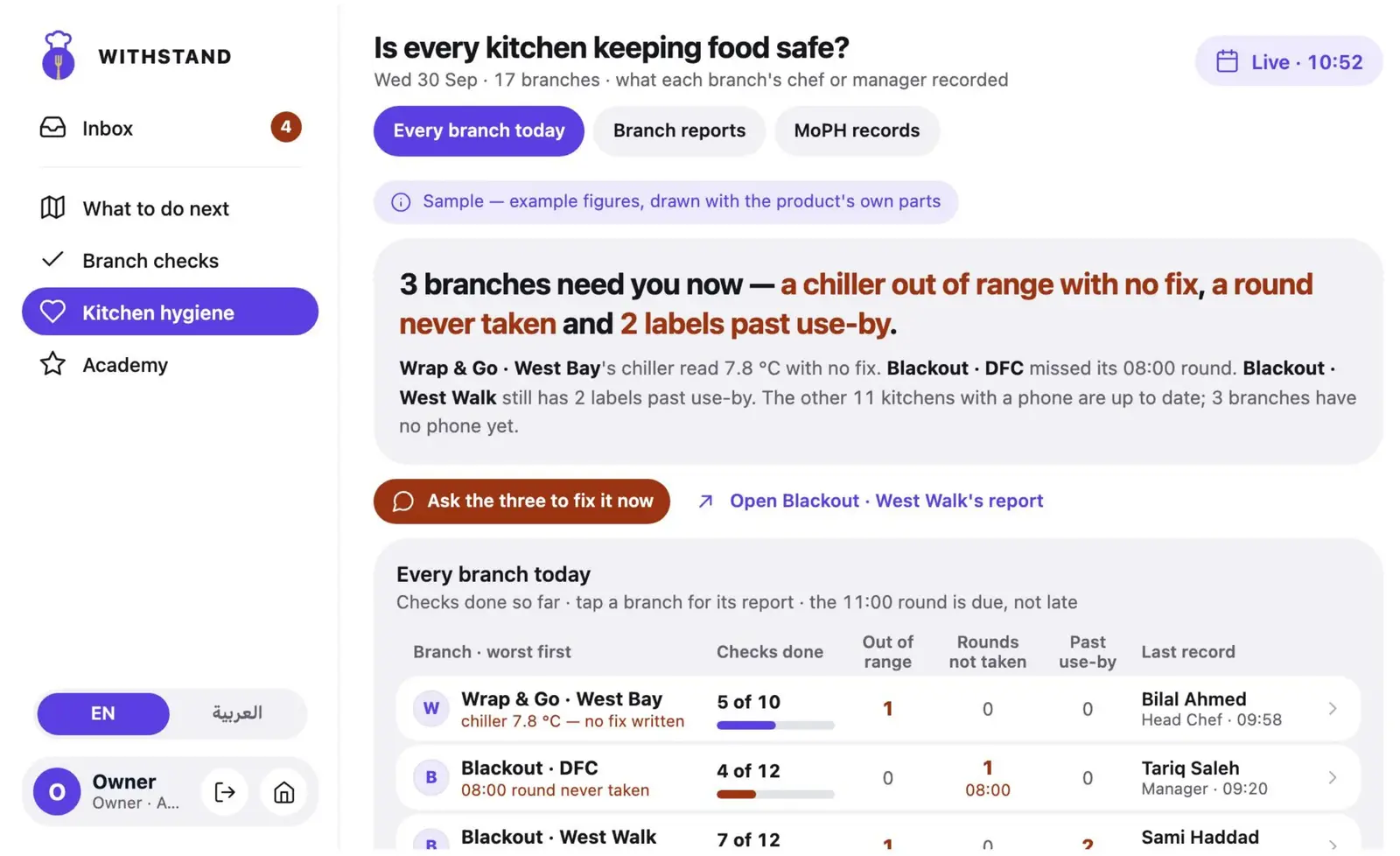
The head chef records temperatures, prep labels, cooling, deliveries and fit-to-work on one phone. Every record goes to Quality & Training and lands in the 18 MoPH records an inspector reads.
The Code's limits · MoPH, October 2020
64 °Chot holding, above
75 °Cat the core, 30 seconds
5 °Ccooled within 2 hours
4 °Ccold holding, or below
3 daysready-to-eat on the shelf, at most
4 °Cchilled delivery, below
Hometoday at the branchAlertswhat needs you, worst firstTemperaturesmachines from Finance, never platesOne machine's weekthe bain-marie, round by roundFood probe logeach dish at its corePrep labelsthrow away now, the rest in dateCoolingthe 2-hour clock, liveBaladiya daily complianceevery tick saves as you goTrace & recallwhere a batch wentFit to workdeclared before touching foodTrainingevery course, from the AcademyMoPH records16 of 18 hold entries this month
Ordering · Hygiene phones
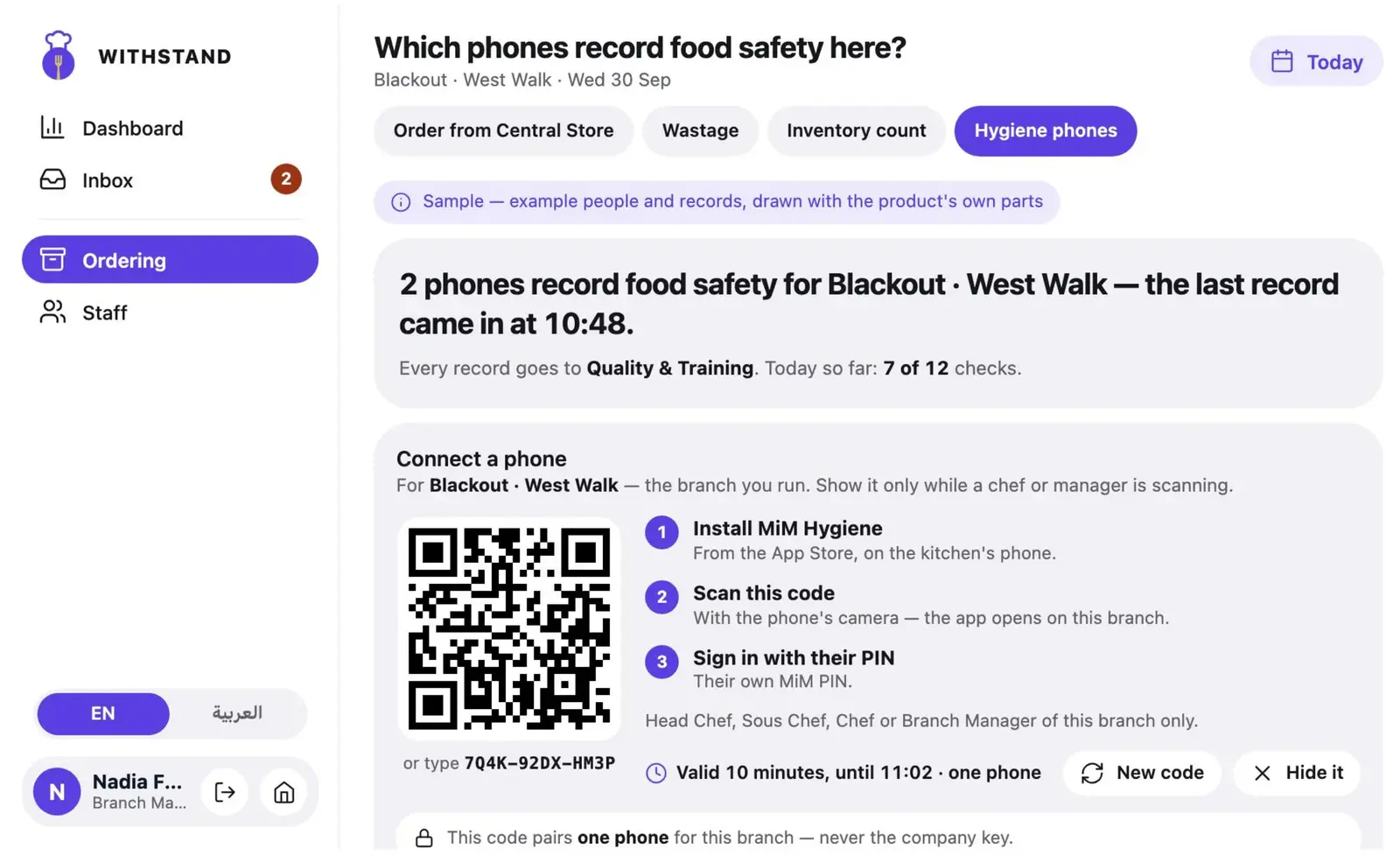
Connect a phone from Ordering
The branch manager shows a code in Ordering. The phone is paired to that one branch, and the code lasts ten minutes.
Install MiM Hygiene on the kitchen's phone
Scan the code with the phone's camera
Sign in with your own MiM PIN
Quality & Training · every branch today
Quality & Training sees every kitchen
“Is every kitchen keeping food safe?” One sentence names the branches that need you now, worst first, with one button that asks them to fix it.
Only the people who should
Head Chef, Sous Chef, Chef or Branch Manager. Any other PIN is refused, and so is a chef whose health card has expired.
Five languages on the line
English, العربية, हिन्दी, नेपाली and Tagalog. Each cook reads the app in their own.
A problem becomes a work order
The bain-marie read 61.5 °C at 08:10. The fix is written down, and Maintenance gets work order #M-214 from the same tap.
Screens shown with example figures.
Why groups lose money they never see
The cost of the gap
Five systems, five truths
A restaurant group does not run on one system. It runs on a till, a spreadsheet, a WhatsApp group, an accountant's file, and four delivery tablets. Each holds a different version of the truth.
Every seam between two systems is a place where money goes missing.
The till knows the sale — but not what the plate cost.
The spreadsheet knows stock — until someone forgets to update it.
Every aggregator tablet needs its own 86'ing.
The accountant knows last month — and only what was re-typed.
One system, end to end
MiM is not a POS with reports bolted on. It is one database that every department writes into and reads from — so there is one version of every number, and it is today's.
Money enters once, at the till, and is never re-typed.
The P&L and the cockpit run the same arithmetic.
Every riyal out carries a signature, and every drawer is counted against its register.
Marketing sees demand in portions — never a riyal.
Demo data · not a real branch
What the screens actually say
A count means somebody has to act. These two screens read the same evening at JUNO West Walk: the owner’s phone at 21:14, and the chef display at 20:45 with table T2’s bill #1200029 on the fire.
M4
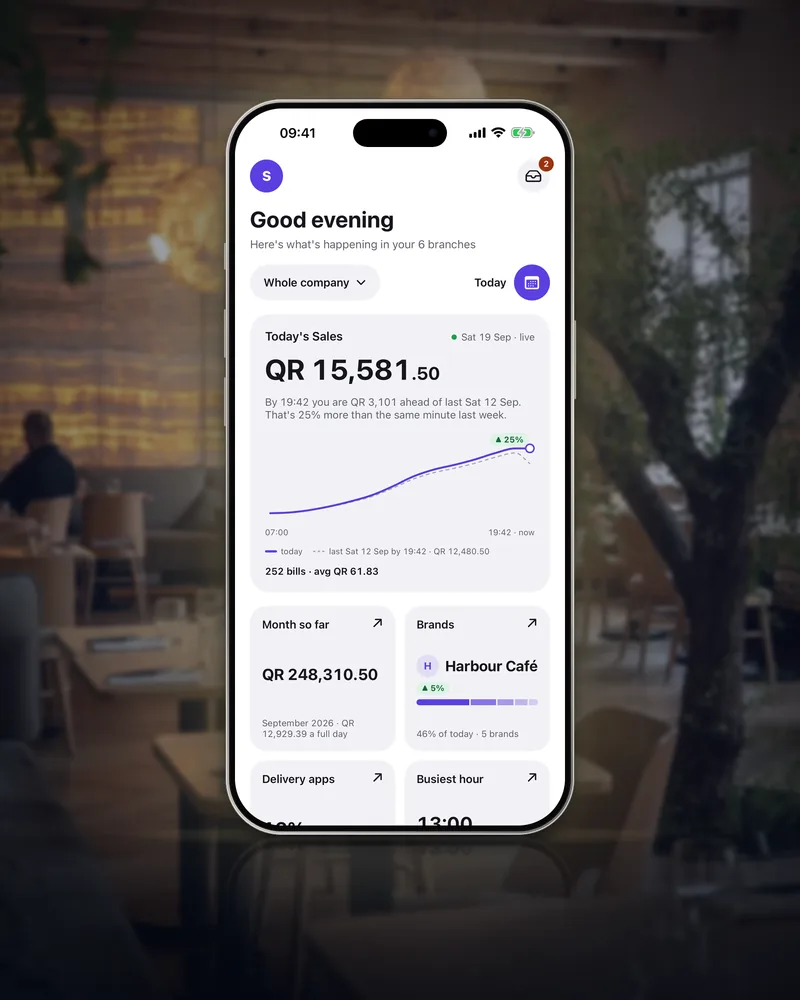
Good evening
Here’s what’s happening at JUNO · West Walk
JUNO · West Walk Today
Today’s SalesTue 8 Sep · live
QR 12,930.00
By 21:14 you are QR 958 ahead of last Tuesday. That’s 8% more than the same minute last week.
▲ 8%
11:0021:14 · now
todaylast Tuesday by 21:14 · QR 11,972
72 bills · avg QR 179.58
Busiest hour
20:00
QR 2,860 in that hour
Top seller
J Fire Bird
38 sold · QR 3,192
Payment
67% Card
Cash 22%
Order types
64% Dine-in
Takeaway 20%
The owner's phoneOpened on one branch: its sales so far against last Tuesday at the same minute, the busiest hour, and what sold best.
QR 12,930 by 21:148% ahead of last Tuesday at the same minute, not against last Tuesday’s whole day.
Busiest hour: 20:00QR 2,860 rung in that hour; 72 bills so far today.
Top seller: J Fire Bird, 38 soldThe same plate the chef display shows cooking for table T2.
How guests paid: 67% by cardCash 22%, and the rest paid through the JUNO app.
Kitchen — West Walk
Chef display · live · 20:45
🎫 6 tickets🍽 9 plates owed⏰ worst 14m — T4🔥 4 on the go🚫 86SMLXL
💬 TO FRONTOrder ready!5 min10 min✋ 86 / message…last: “5 min” → front · 20:40Kitchen 5 min 20:40 · Karim
ALL DAY — STILL OWED2× Ribeye 300 g2× Lamb Chops2× Grilled Hammour · 2 tickets2× J Fire Bird · 2 tickets1× Parmesan Fries
⚠️ ALLERGY QUESTION NOT ANSWEREDask the table before this food leaves the pass
🕐 Fired 20:31
STARTERS✓ away
2× Burrata & Tomato✓ all 2 away
MAINSnow▶ Start MainsSend Mains ▸
2× Lamb Chops🔥 2 cooking1 up ↑all 2 ↑
1× Grilled Hammour▶ start1 up ↑
⏸ STILL TO COME — DO NOT COOK4× Chocolate FondantDESSERTWAITING
SEND ALL ↑ · 3 LEFT
READY · 2
#1200025 · Dine-in T1121m
▲ ON THE PASS 1m
🕐 Fired 20:24
1× Ribeye 300 g✓ all 1 away
1× Smash Burger✓ all 1 away
✓ ALL AWAY — CLEAR
#1200030 · Takeaway9m
▲ ON THE PASS 2m
🕐 Fired 20:36 🛍 promise 15m — 6m left
1× J Fire Bird✓ all 1 away
✓ ALL AWAY — CLEAR
The chef displayEvery plate moves New → Preparing → Ready. The clock on each ticket is the one the guest is feeling.
Demo data. On a live install these screens read from your own branches. Every department’s own screen, HR, Finance, the Central Store and Head Office among them, is in the departments explorer above.
Who it is for
Built for groups that outgrew the spreadsheet
If one person is still re-typing yesterday's numbers into a file every morning, you are the operator this was built for.
By the shape of the business
One restaurantThe whole system, one branch. Same engine, nothing switched off.
Multi-brand groupsSix brands under one owner, each with its own menu, prices and look — one set of books.
Central kitchen operationsA kitchen or pastry that produces for the branches, and needs the cost to follow the tray.
Owners who read the numbers themselvesThe cockpit is for the person who signs the cheques, not only the accountant.
By the style of service
Casual and fine diningTables, courses, allergies at the table, a hostess desk and a service log.
Cafés and bakeriesFast counter service, takeaway packaging costed, pastry produced centrally.
Takeaway and deliveryOwn delivery and the aggregators, with the commission taken off before the profit line.
Bars and loungesBar tops on the floor plan, late trading nights that belong to the right day.
Honest status, not a wish list
What it connects to
Every row says what it does and which way the data goes. “Running” means it is live on MiM’s server today; “Coming” means it is not connected yet, and the row says what it waits for.
Outside the building — running today
6 running · official channels only
Apple WalletRunning
MiM → the guest’s iPhoneThe guest adds the loyalty card from the bill; every paid bill earns points, spent by scan at the till.
WhatsAppRunning
MiM → a share linkThe receipt page sends the bill and the card by a wa.me link; staff-request codes travel the same way.
Instagram & FacebookRunning
Meta → MiM · read onlyEach brand’s posts, reach and insights through Meta’s official Graph API, beside the till’s own takings.
TikTokRunning
TikTok → MiM · read onlyThe official TikTok Business API, one business account per brand, on the same board.
Google reviewsRunning
Google → MiM · every 6 hoursEach linked branch’s five newest reviews, routed to that branch and to Customer Service.
Bank payday file (WPS)Running
MiM → the bankPayroll signed by HR, Finance and the Owner becomes the QIB-format salary file (SIF) for the Wage Protection System.
TotalQR 132.00
WITHSTAND card
This bill earned +13 points
Add your card to Apple Wallet
WhatsApp
Save PDF
The foot of bill #1200029’s receipt page, as the guest sees it: the card goes to Apple Wallet, the bill goes by WhatsApp.
Devices it drives — running today
8 running · MiM’s own screens, each paired by QR
Thermal printers (ESC/POS)Running
MiM → paperReceipts and kitchen tickets through the print bridge; on a browser till the Arabic receipt prints as a picture.
Waiter tabletsRunning
Both waysOrders taken at the table land on the same check the till sees.
Chef displays (the Pass)Running
Both waysEach order on one card, courses in order; the plate’s status goes back to the floor.
Hostess deskRunning
Both waysBookings, the waitlist and the floor; seating a guest carries the table to the till.
Staff phonesRunning
Both waysPunches, payslips, leave and requests on the staff member’s own phone.
The Owner’s iPhone appRunning
Both waysSales pace, approvals, reviews and alerts for every branch; App Store review submitted 20 Sept 2026.
Browser and Windows tillsRunning
Both waysThe till runs in a browser on any machine, or as the desktop till on Windows POS hardware.
Push alerts (Apple push)Running
MiM → iPhonesThe Owner app and staff phones hear of a demo request, a refused sign-in, a review, the day’s pace.
NEW ORDER #1200029
JUNO · West Walk · 20:34
*** ALLERGY — TREE NUTS / SESAME *** *** SEPARATE BOARD · CLEAN KNIFE ***
DINE-IN · TABLE T2
*** MAINS COURSE ***
================================
1 x J FIRE BIRD
--------------------------------
1 x PARMESAN FRIES
Bill #1200029’s hot-kitchen ticket, laid out line for line as the till prints it: the allergy prints above everything, on every printer the order touches.
Coming — said plainly
Not connected yet · each row says what it waits for
Delivery platformsComing
Talabat · Snoonu · Rafeeq · Keeta → MiMBuilt, awaiting the platforms’ keys. Our Talabat partner application was filed on 5 Sept 2026.
E-invoice (General Tax Authority)Coming
MiM → the tax authorityReady to map when the format is published; the bilingual digital receipt already exists.
Accounting exportMapping: coming
MiM → your accountantCSV file today · ledger mapping on request.
Delivery · TALABATPreparingPreview · not live
1×J Fire Bird84.00
1×Parmesan Fries24.00
Paid · Talabat CardQR 108.00
✗ Reject order
How a platform order will land on the till once a key is issued: its own order type, settled by the platform, with a reject door. Not live today.
On the owner's phone, not just the office
The one screen you check from the car
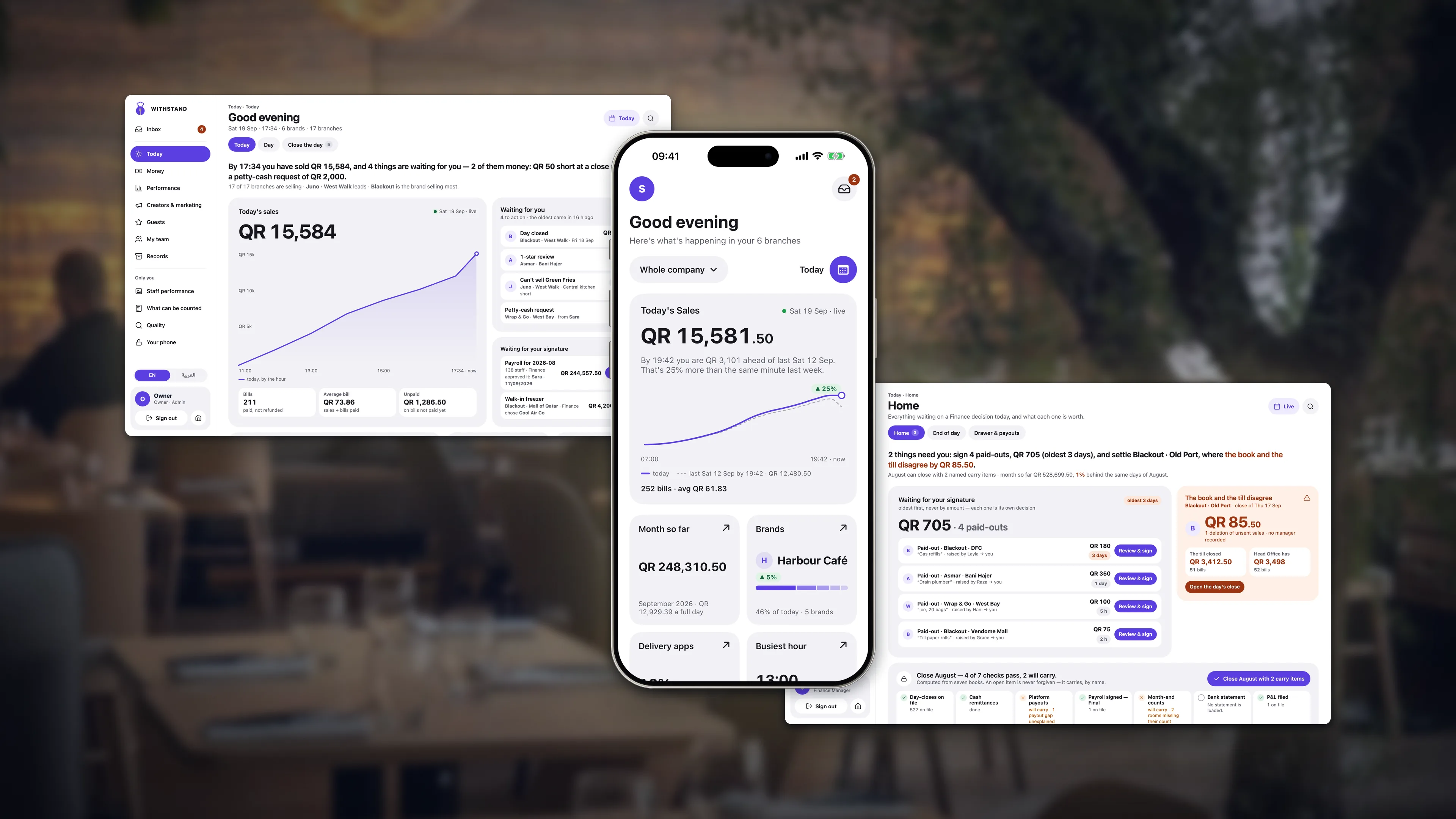
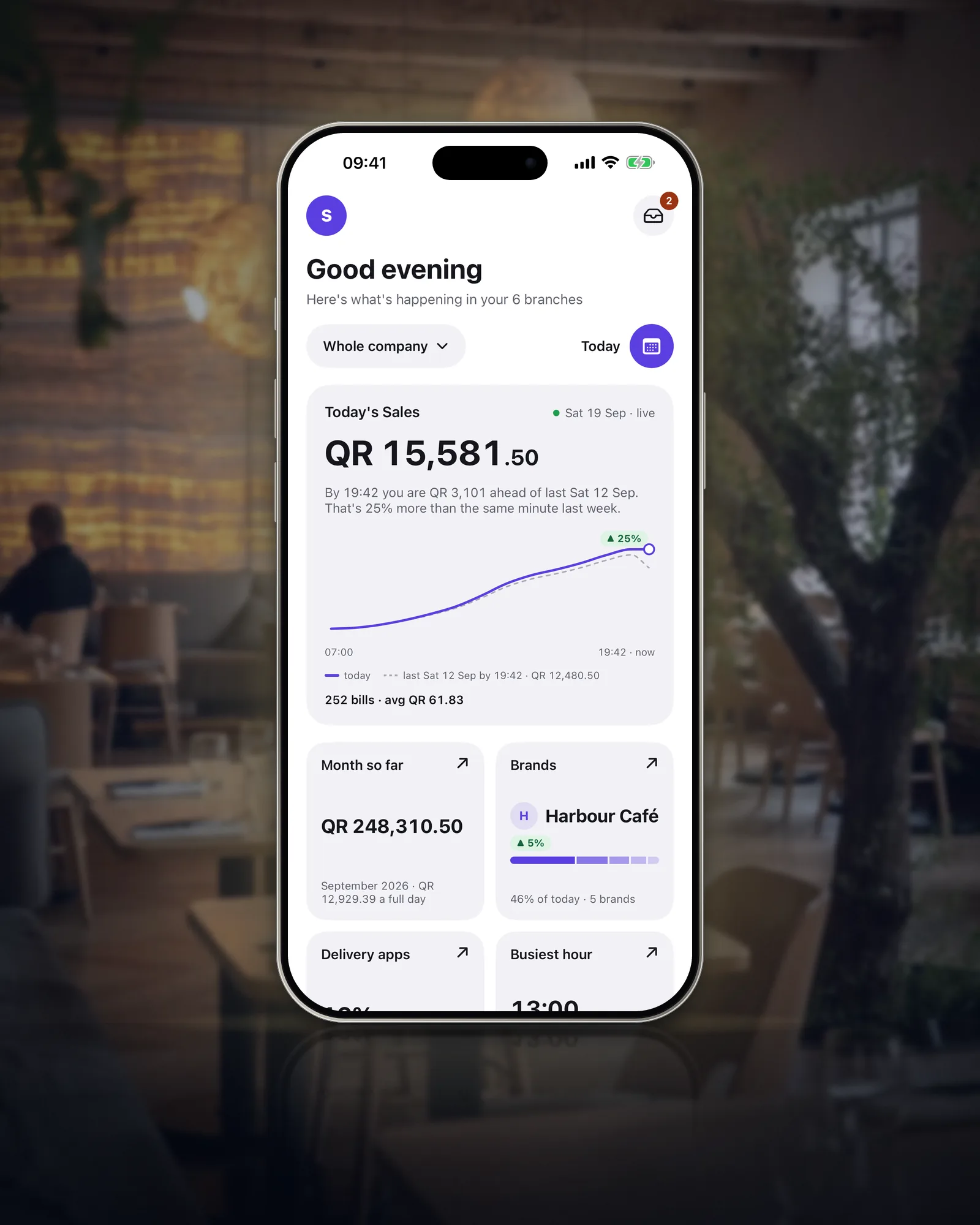
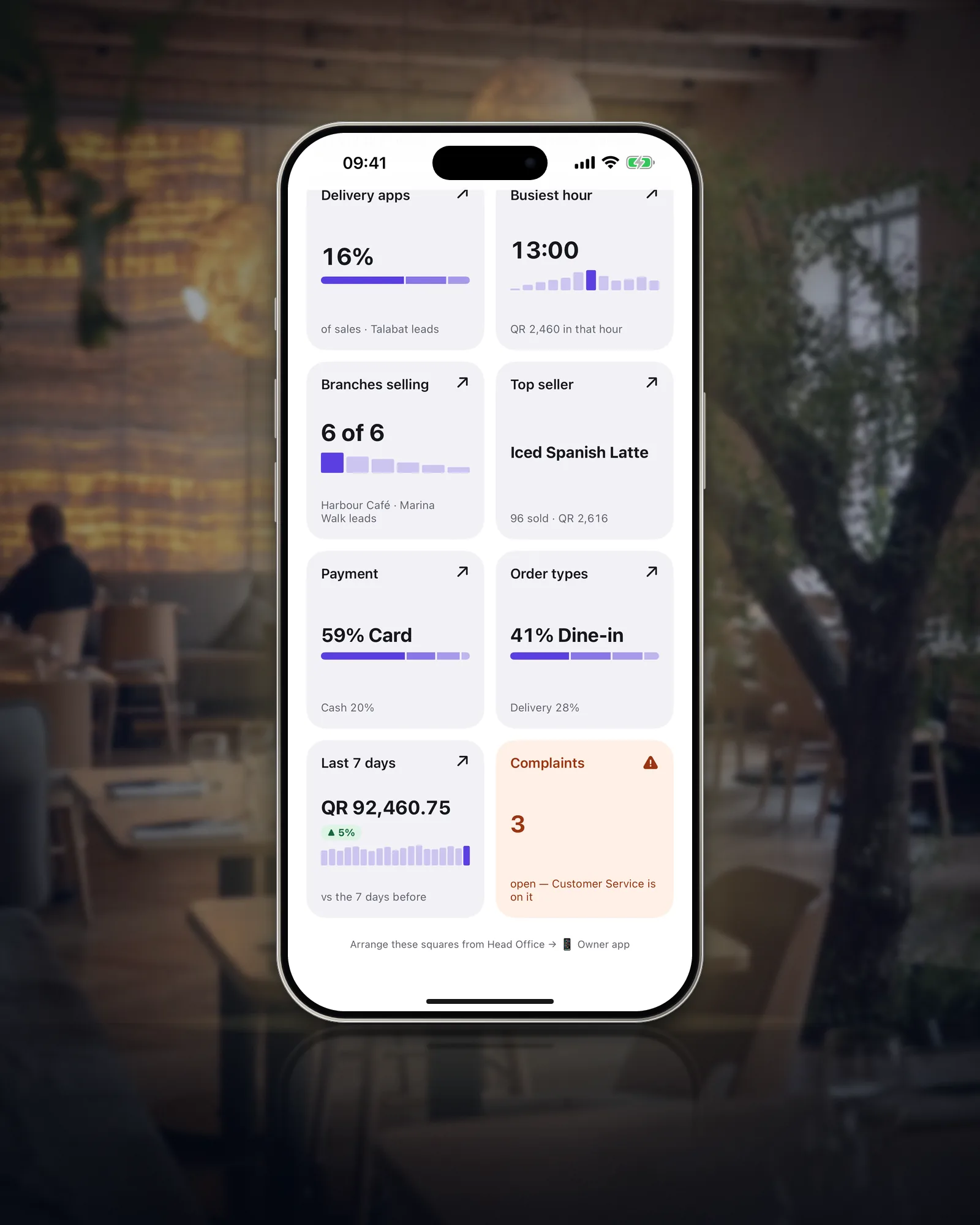
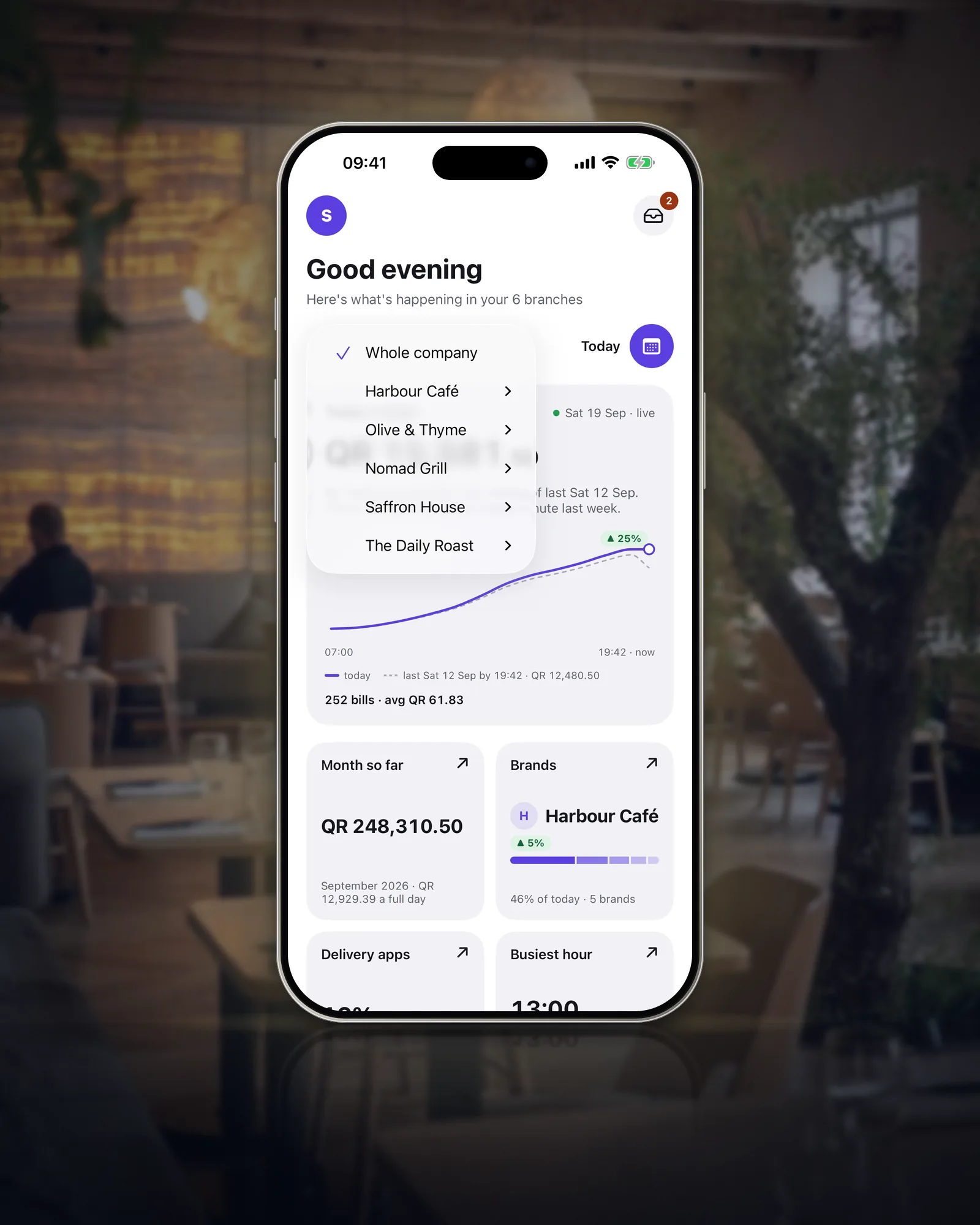
Three screens. Not a report you request — the day as it happens, and what is waiting for you.
M4
Good evening
Here’s what’s happening in your 6 branches
Whole company Today
Today’s SalesTue 8 Sep · live
QR 53,425.00
By 21:14 you are QR 3,957 ahead of last Tuesday. That’s 8% more than the same minute last week.
▲ 8%
10:0021:14 · now
todaylast Tuesday by 21:14 · QR 49,468
Brands
JJUNO
40% of today · 3 brands
Branches selling
6 of 6
Saffron House · Al Sadd leads
Payroll
QR 312,400
gross · August · 84 people
Guests served
420
so far · 6 branches
SalesThe whole company’s day so far, against last Tuesday at the same minute — then brands, branches, payroll and guests, one square each.
TodayInbox
Your inbox
4 waiting
The oldest came in Mon 16:20.
All 4Money 4ReviewsAlarms
Waiting for you
Parmesan Fries on usNoor H. · 25 min agoQR 24.00
Refund at West WalkNoor H. · 2 h agoQR 96.00
Payroll 2026-08 approved by Financeneeds FINAL management approval · Mon 17:05
PO #PO-2291Doha Fresh Produce · Mon 16:20QR 4,860.00
Handled
2-star reviewJUNO · Lusail Boulevard · 1 h ago★ 2/5
CRITICAL at Central Kitchenfridge 6.1 °C → 3.9 °C · 15 h ago
Tap any item to read it in full. Approvals that move money are confirmed in Head Office on the Mac.
InboxWhat waits on you, newest first, with who asked and how much — the comp, the refund, the payroll, the purchase order. What is handled drops below.
InboxInbox item
ReviewsHandled
2-star reviewJUNO · Lusail Boulevard
2 out of 5
👤guest · in the last week“Waited 25 minutes for mains.”➡️Reply on Google before it spreads
systemTue 8 Sept, 19:30Handled by Priya N. · 1 h ago““Replied on Google 19:52”
ReviewsA one- or two-star review reaches you as an alert: the guest’s own words, the branch, and who answered it on Google, and when.
“Are we up or down?” — answered honestly
Before closing, comparing today's takings to a whole day tells you nothing. You will always look down, and you will learn to ignore the number.
So the app compares today to the same minute of the day you are measuring against. At 21:14 on Tuesday 8 September, JUNO West Walk reads last Tuesday's takings up to 21:14 — and says so on the chip, so you know what you are being told.
What most systems show at 21:14
QR 12,930 vs QR 13,980 · ▼ 8%
…because they used last Tuesday’s full day
A number that is wrong every day until closing
What MiM shows
▲ 8% vs last Tuesday · by 21:14
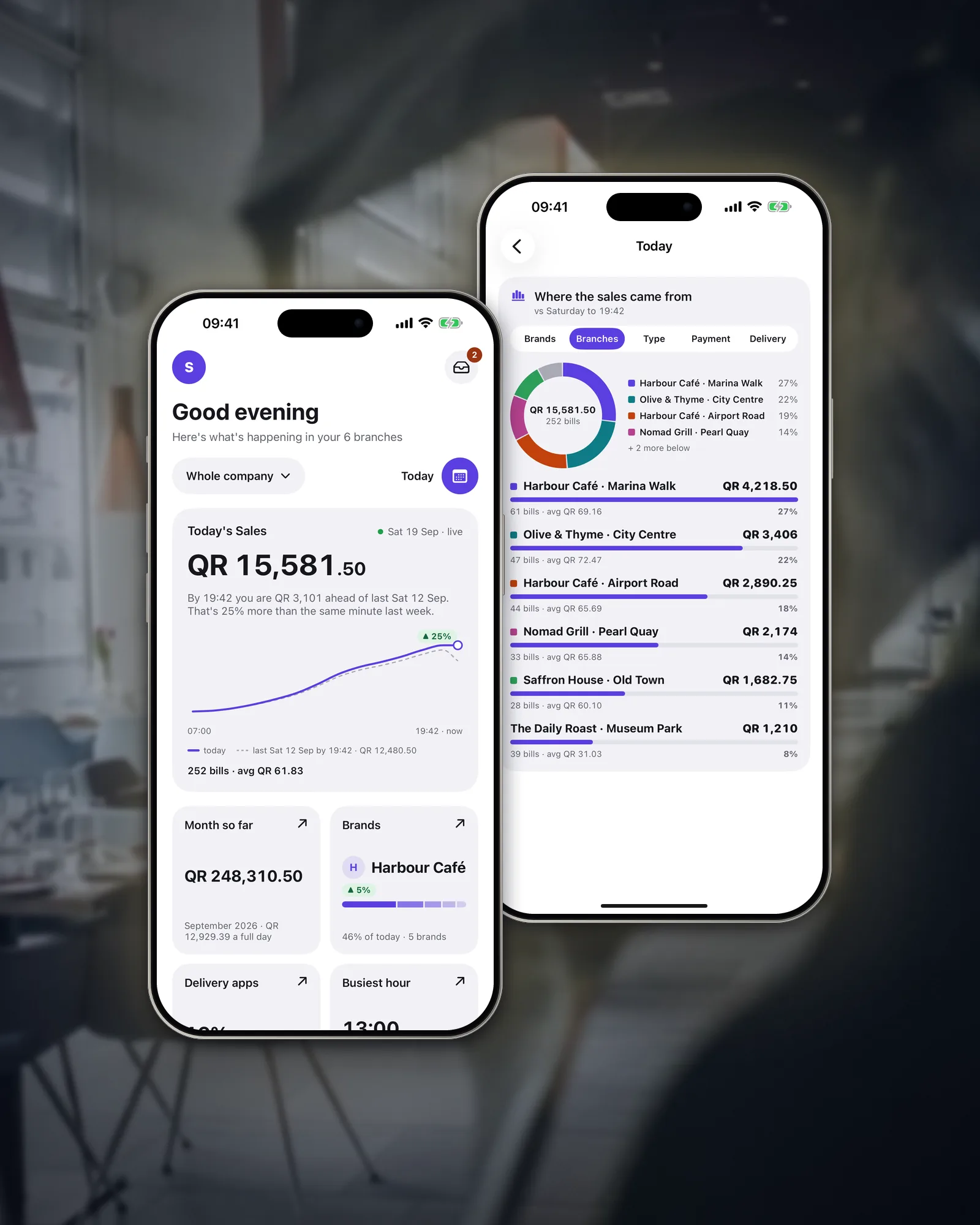
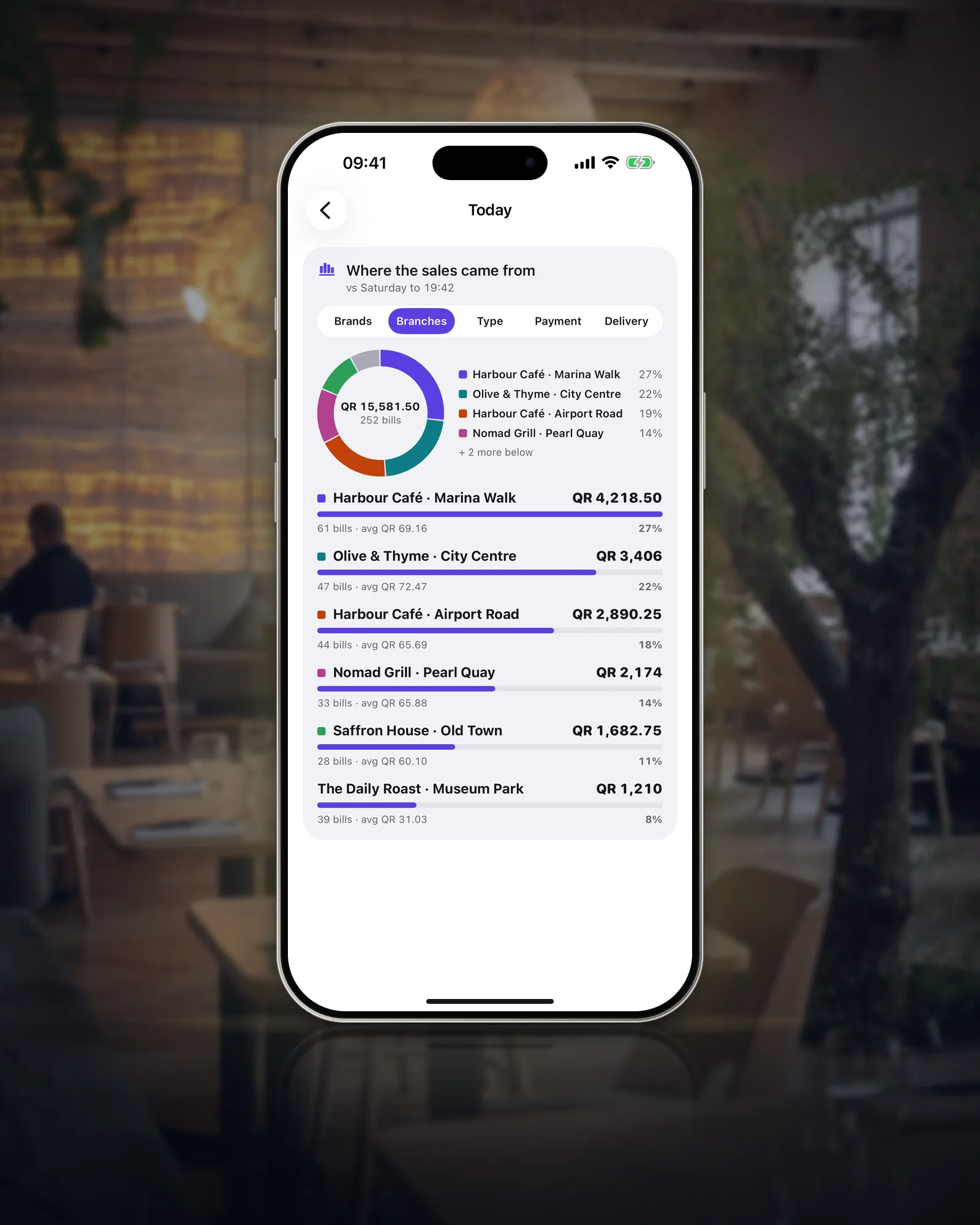
The Owner app, with the back office behind it The Owner app on an iPhone, in front of Head Office's Today and Finance Home on a Mac.Today, and where it came from Today's sales so far — then branch by branch, each with its bills and average.
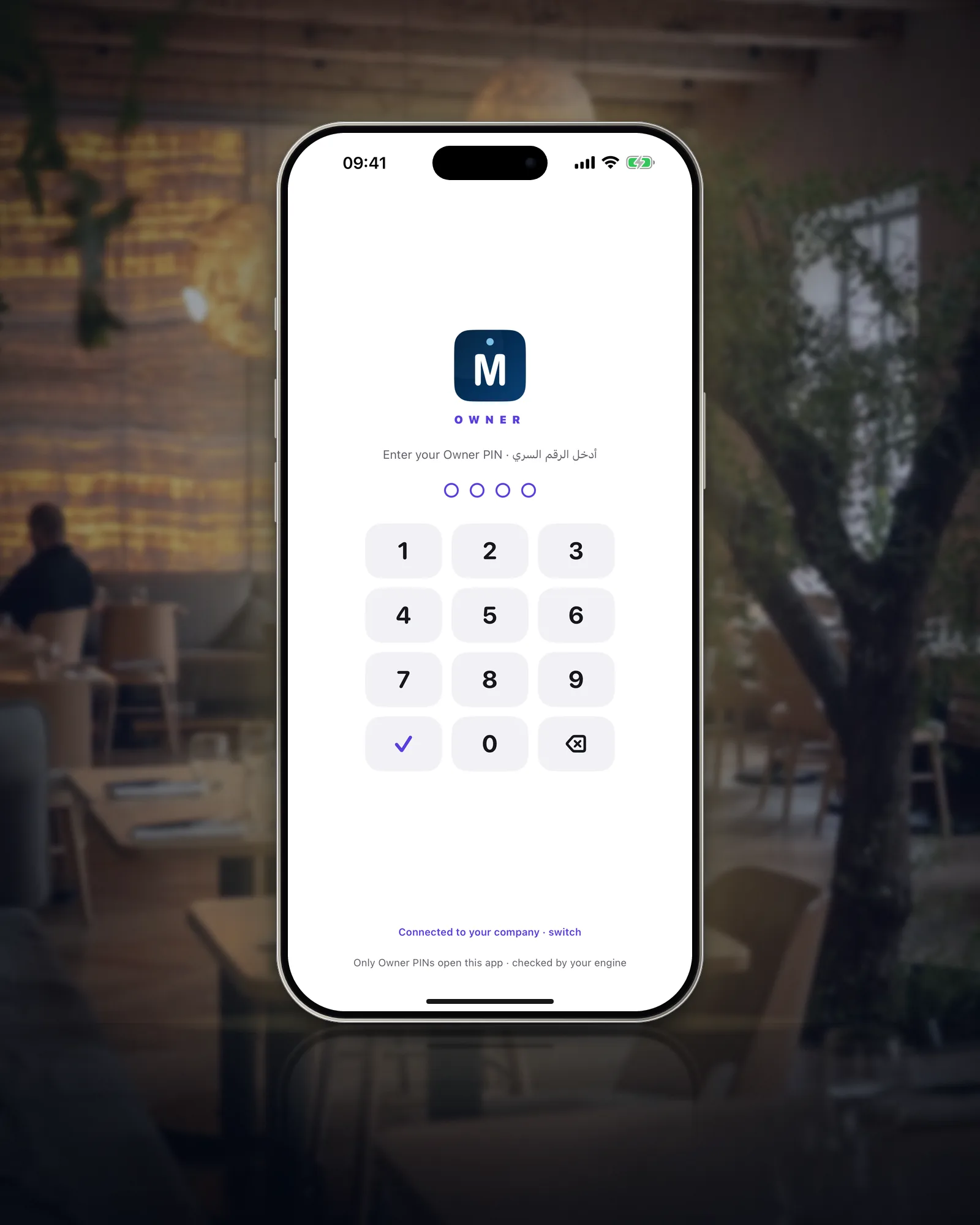
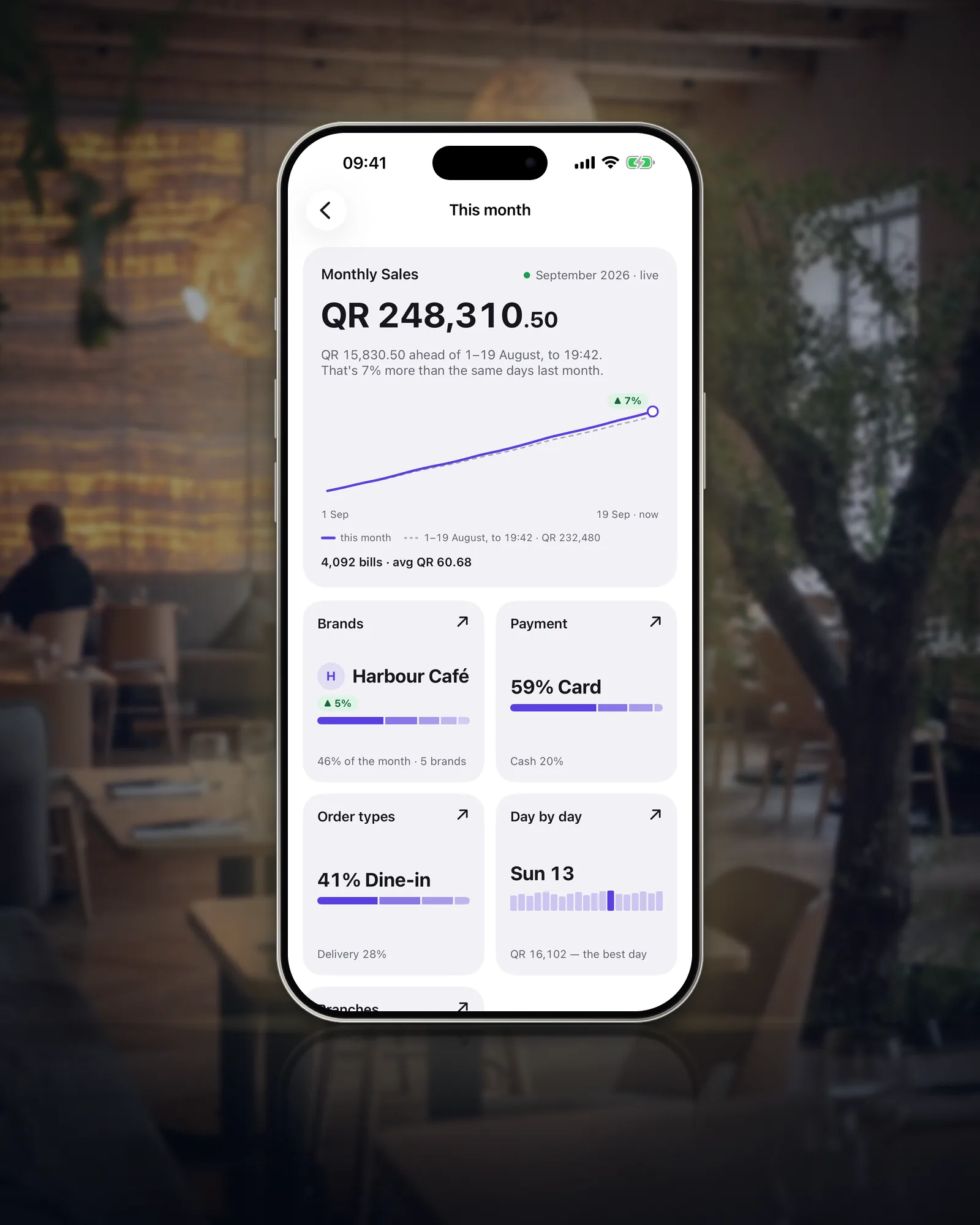
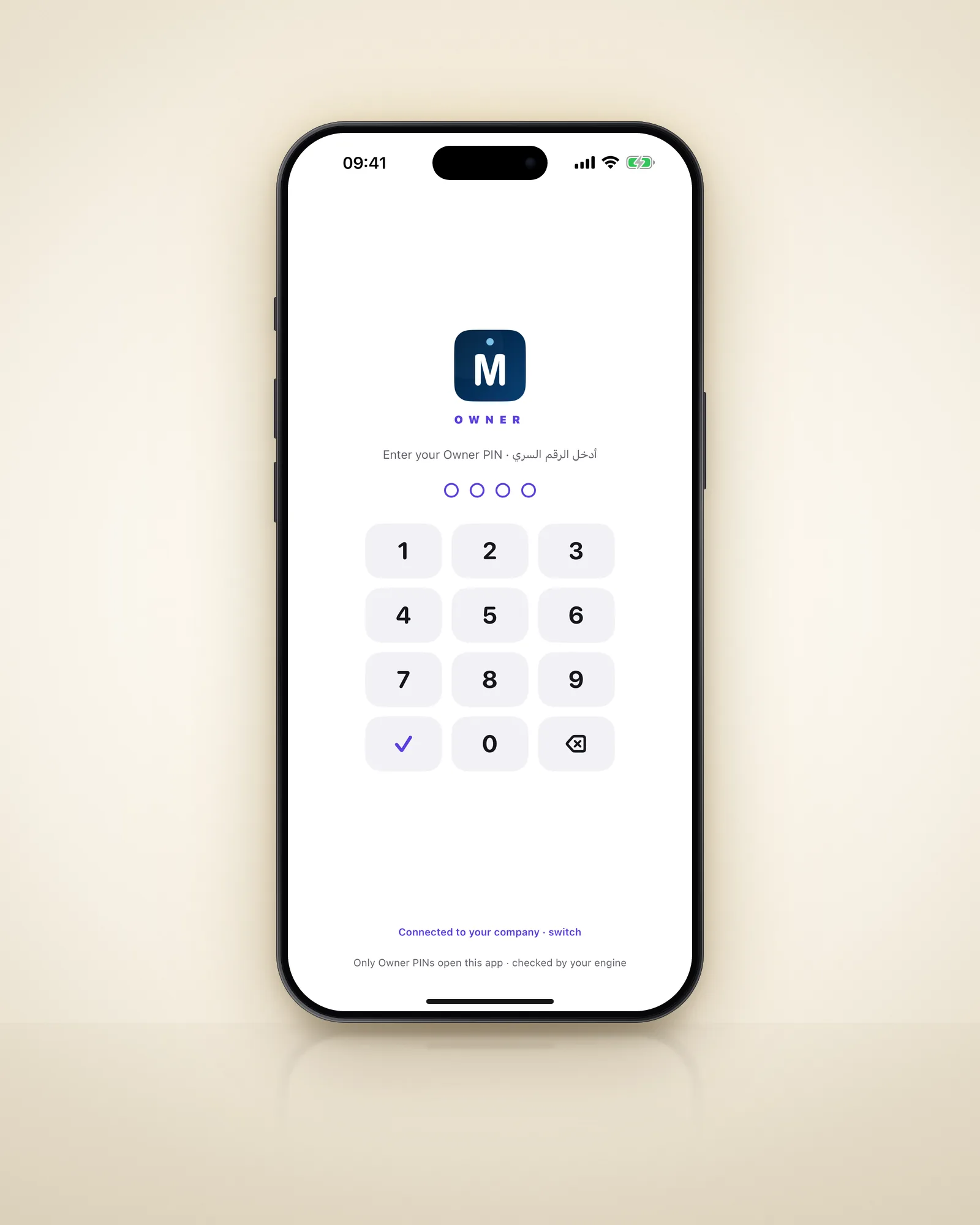
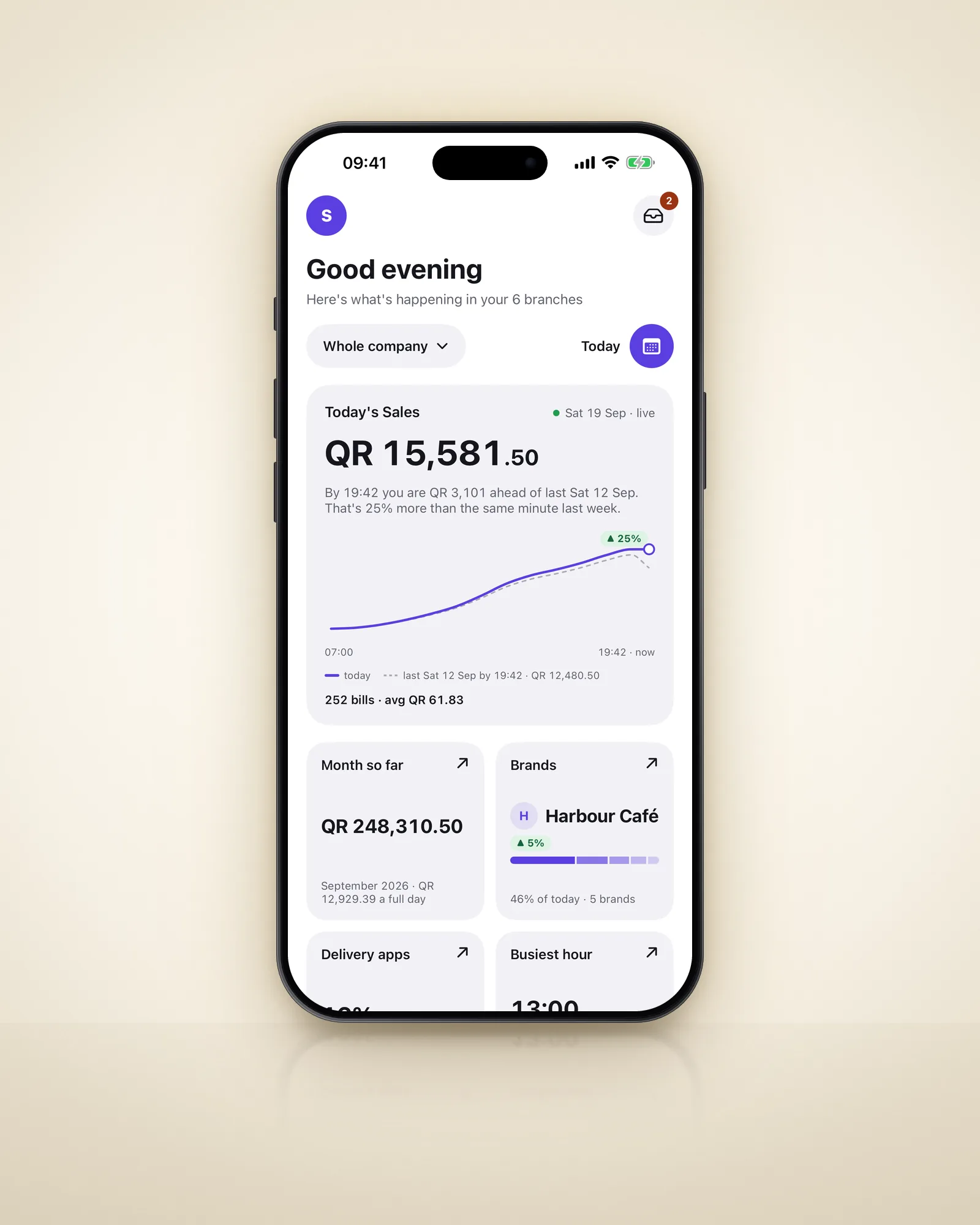
Owner PIN door Only Owner PINs open this app — checked by your engine.Home — today's sales Today against the same minute of the same day last week — in riyals and in percent.Home — the squares Delivery apps, busiest hour, top seller, payment, order types, the last 7 days — and the complaints still open.Whole company or one brand The home screen reads the whole company, or any one brand on its own.Where today's sales came from By brand, branch, type, payment or delivery — every branch with its bills and average.This month So far, against the same days last month — and the best day named.The PIN door, on an ivory backdrop It shows that it is connected to your company, with a switch — nothing opens without the Owner's PIN.Home, on an ivory backdrop Below today's sales: the month so far, and the brand leading today.
Marketing · answerable to the till
Did the post sell food?
Every marketing tool can say a post got 286 likes. Only the till holds the bill. MiM joins each post to the dish it names and to that dish's plates from the permanent book — and it refuses the marketing the kitchen cannot honour. Four screens, one law: a like belongs to Meta, a plate belongs to you.
1 · The room — analyse
What each post did to the kitchen
VIDEOno photo read — caption only
Jalapeño sliders, the way the kitchen eats them
Tue 1 Sept · 18:40
286
likes
5
comments
open on Instagram ↗
WHAT THE TILL DID+128%
Micro Sliders : Jalapeño18 → 41 plates/day
The lift is the 72 hours after the post against that dish's own 28-day mean — a correlation with a named baseline, never proof, and it says so.
A post whose window has not closed shows no figure, not a zero. Bills with a refund or a void are left out of every baseline.
The verdict reads in one sentence: "6 posts named a dish. 2 moved it. One named a dish the kitchen could not serve."
2 · What to post next — decide
Picked from margin, from what is slow, and from what the kitchen can serve
Worth pushingservable · margin known
1Stuffed Burrata71%✓ SERVABLE
2Kale Salad68%✓ SERVABLE
🚫 Refused — the kitchen cannot serve
Tea — off sale at JUNO · West Walk · equipment broken · 1,260h
⏰ When to postThu 17:00
12
13
14
17
18
19
20
21
Sun
Mon
Tue
Wed
Thu
Fri
Sat
likes low → high · hatched = kitchen at capacity · ring = best slot
Ranked by margin, then by how slow the dish is. A margin the till never stamped is unknown, never zero — it says "not costed yet".
A dish off sale anywhere the post would be seen is refused, not ranked. Meta does not know your oven is broken; the 86 list does.
The best hour to post is the peak of engagement on a kitchen that was not at capacity — a post that works on a full kitchen makes the wait worse.
3 · Who to bring back — act
The regular who stopped coming, with what they used to order
GuestVisitsUsually ordersQuiet for
Hessa M.
“sits by the window, no ice”
9
Stuffed Burrata ×7
41d
Ahmed K.
…9018
7
Micro Sliders ×9
38d
Sara N.
“birthday 14 Oct — ask about the cake”
6
Kale Salad ×5
36d
Rewarding a regular costs food at cost, not menu price — the cheapest marketing in the building.
Three or more paid visits, then thirty days of silence. Identity is the phone on the bill — the same number the hostess desk remembers, with her note.
The only marketing here whose result you can prove: the phone rings the till again, or it does not.
Points and offers ride the WITHSTAND card; the balance lives on the engine and every earn and spend is a journal line.
4 · Instagram, per brand — listen
Every comment, in the guest's own language
MiM
@mimrestaurants● CONNECTED
linked to the Mim restaurants Facebook Page · page token never expires
BRANDSMimJUNOSaffron HouseBake & Coone account per brand, one token each
G1
@guest.one متى تفتحون في الوكرة؟
under: Jalapeño sliders · 2h agoUNDER A POST THAT SOLD
G2
@guest.two Are the sliders spicy? Asking for my kids
under: Jalapeño sliders · 5h agoUNDER A POST THAT SOLD
G3
@guest.three Is the burrata available at West Walk too?
under: Stuffed burrata · 1d ago
One Meta app, one token per brand, the company account as the fallback — connected once, read hourly, the token kept on the engine, never on a till.
Comments arrive in Arabic or English under the post they belong to, and a comment under a post that sold is marked so.
Reach, saves and publishing are marked coming, not promised — the screen says what it could not see.
Marketing is money-blind
The marketing department sees demand in portions — never a riyal, never a price, never a cost. A gate refuses any marketing screen that reaches for money.
The 86 list is the editor
Nothing can be drafted for a dish that is off sale where the post would be seen. The refusal is the same fact the End-of-day screen already holds.
Campaigns with an approval trail
A campaign is planned, budgeted and asked for; Finance approves the spend. Its uplift is measured in portions of the named dishes, during against before — calculated, so it cannot be flattered.
Reviews, routed honestly
From the guest's receipt: loved it → the branch's own Google review link; not quite → a private note to the manager and the Owner's phone, never the internet.
Instagram · Facebook · TikTok
Each network in its own colours
Every brand's posts, likes and comments, inside Head Office. Read-only: MiM never posts, replies or deletes.
Instagramper brand
After its Monday post, Mini Truffle Arancini went from 6.2 to 10.0 plates a day (+61%).
Each post is joined to the dish it names, and to that dish's plates in the permanent book.
Facebookper brand
Blackout's last 10 posts took 1,284 likes; Burnt Cheesecake alone took 312.
Comments arrive in the guest's own language, next to the post they were left on.
TikTokper brand
Juno's 10 newest videos took 24,386 likes; one carried 6,912 on its own.
Each brand connects its own TikTok Business account; the token never reaches a till.
What it cannot do. A post cannot be traced to a bill: nobody scans a story at the till. Every lift is a dish measured against its own four-week average, a comparison with a named baseline, never proof.
The number most systems quietly invent
What the plate should have cost
Theoretical against actual, per ingredient, per room. The gap in kilos and in riyals — and an honest blank where the answer isn't known.
TodayHome2End of dayDrawer & payoutsInboxStockStock — every roomStock statementReconciliationStock moneyFood-cost flowTransfersCentral units P&LStock auditAssets
🥩 Food cost — theoretical vs actual Opening count + deliveries and transfers in − transfers out − what the recipes say the sales ate − logged waste = what SHOULD be on the shelf. The count says what IS.JUNO · West Walk 1–7 Sept 2026
Theoretical29.8%QR 29,800.00 · what the recipes say
Actual31.4%QR 31,400.00 · what the shelf says
The gap+1.6 ptsmoney leaving unexplained
Recipe coverage100%0 of 1,130 sold lines have no recipe
Missing (shortage)QR 1,648.005 items · 🥩 QR 1,648.00 · 📦 QR 0.00
More than expectedQR 48.001 item — over-count, unlogged delivery or a recipe that over-states
Judged12 / 120 rows not judged — no count or no price
📋 JUNO · West Walk · 1–7 Sept 2026per ingredient, the whole equation, in the room's own units
Item
Opening
In
Out
Recipes used
Waste
Should be
Counted
Variance
Money
Parmesankg
1.4
24
0
13.2
0.4
11.8
1.8
-10
QR -620.00
Chicken breastkg
6.2
112
0
90.2
2.4
25.6
3.6
-22
QR -528.00
Lemonskg
3
48
0
19.2
0.8
31
7
-24
QR -192.00
Tomatoeskg
4.5
96
0
57.6
6.4
36.5
8.5
-28
QR -182.00
Kalekg
1.2
32
0
22.7
3.5
7
0
-7
QR -126.00
Potatoeskg
14
160
0
148.8
11.2
14
26
+12
QR 48.00
Olive oilL
6
20
0
17.5
0
8.5
8.48
-0.02
QR -0.30
Ricekg
12
50
0
46.5
0.5
15
15
0
QR 0.00
Unknown is never zero
Every row is judged or says why not — here 12 of 12. A shelf with no price on file shows its shortage as real and its money as unknown, never rounded to zero to make the report look complete.
Blind is not variance
Recipe coverage sits beside the gap — here 100%, no sold line without a recipe. A dish sold without one is quarantined, not counted as a saving — a dish nobody costed is a hole in the map, not good news.
Grams never become pieces
“20g of saffron” against a kilo shelf used to read as 20kg — a 1000× lie in the food cost and a shelf that empties on paper. Conversions are same-dimension only, or they refuse.
Nothing is seeded
No dish is given a made-up cost at 30% of its price to fill the table. Uncosted means uncosted, and it says so on the screen until someone enters the recipe.
Every question HR gets asked, answered without HR
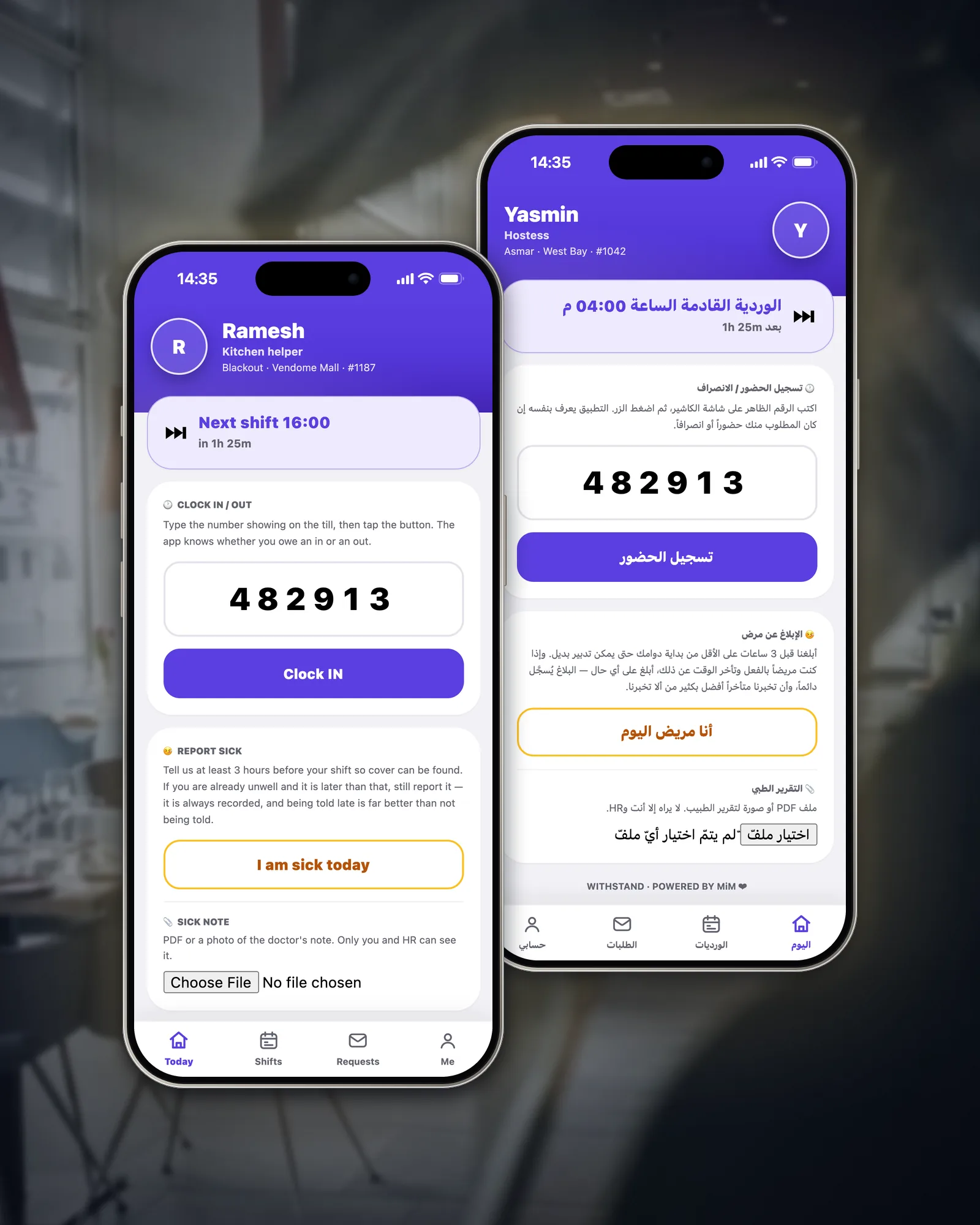
Each person, their own phone
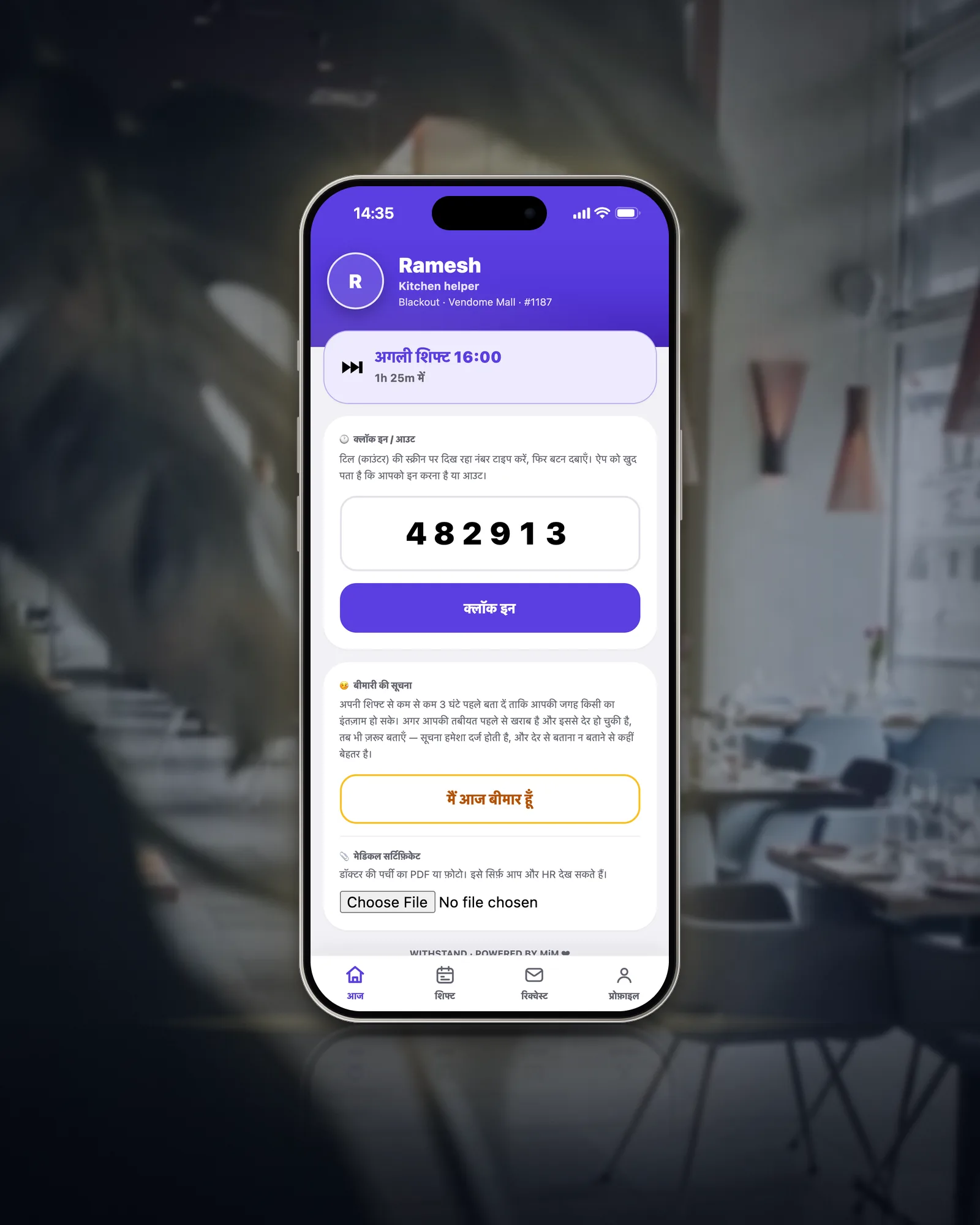
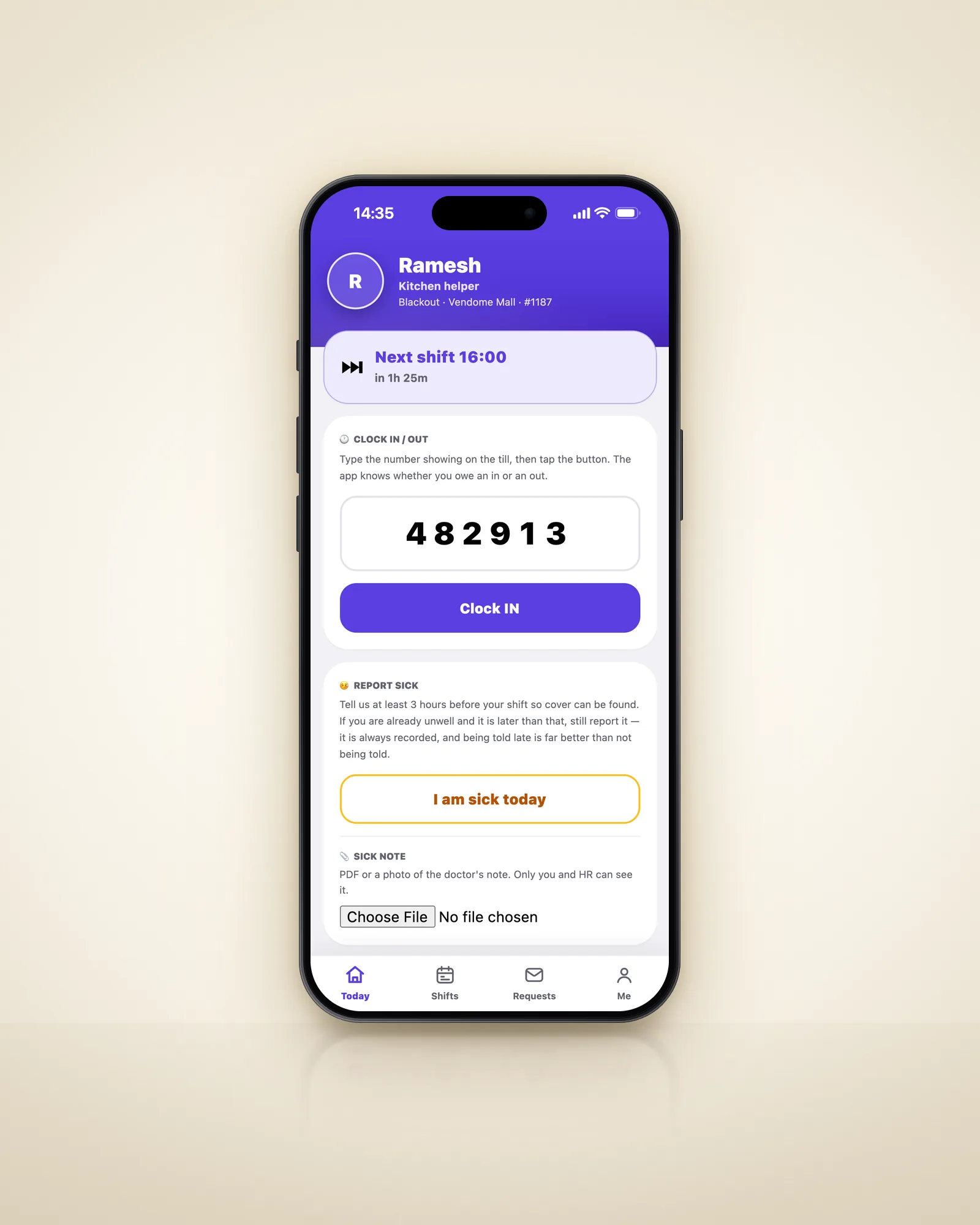
A thousand staff cannot share a four-digit PIN pad. Each person scans one personal code and their own phone becomes their self-service — and nothing else.
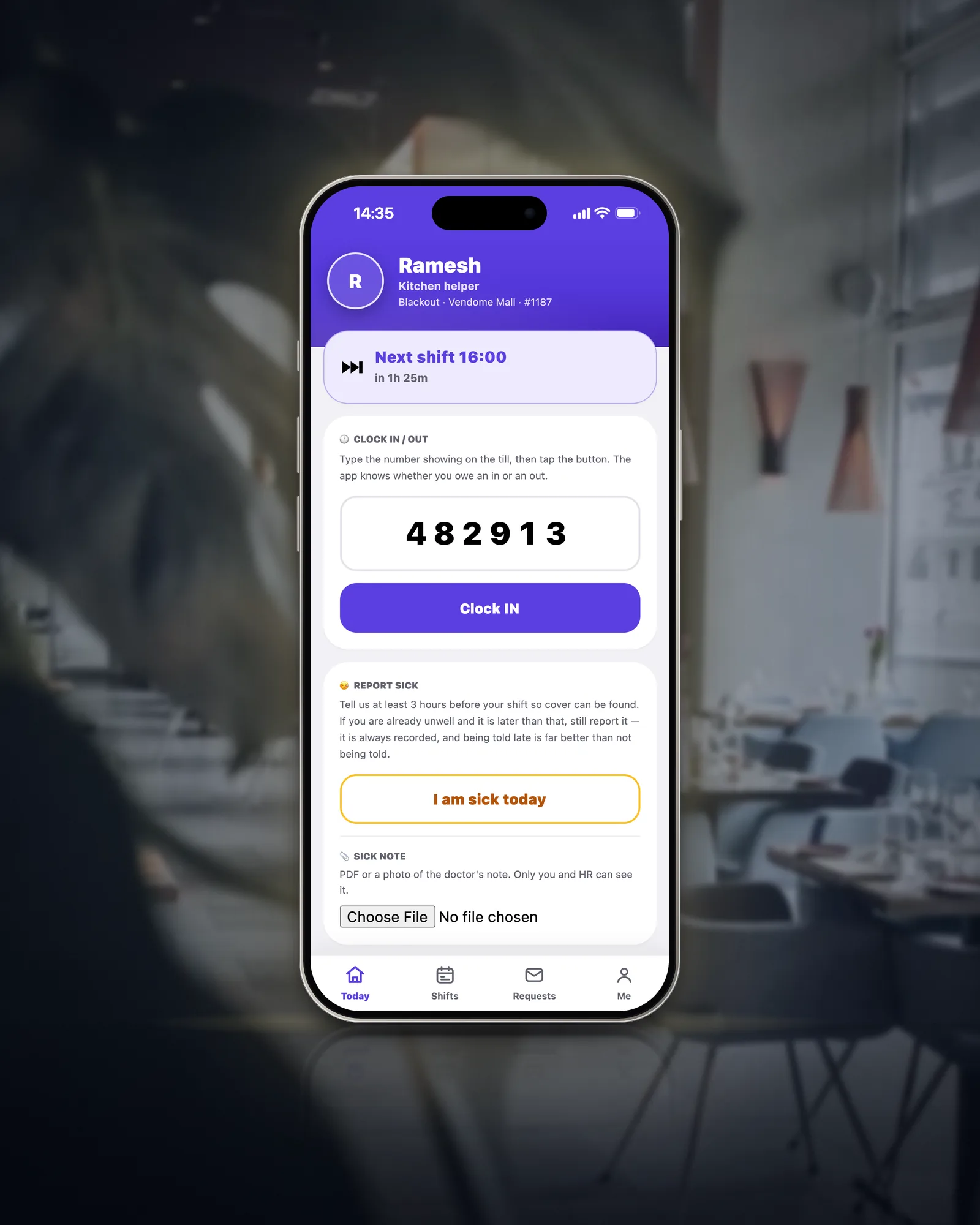
RKRaza K.ServerJUNO · West Walk
🟢You are clocked in4h 16m so far
↓ in 16:58
🕐 CLOCK IN / OUTType the number showing on the till, then tap the button. The app knows whether you owe an in or an out.
······
Clock OUT
🤒 REPORT SICKTell us at least 3 hours before your shift so cover can be found. If you are already unwell and it is later than that, still report it — it is always recorded, and being told late is far better than not being told.I am sick today
TodayShiftsRequestsMe
Their leave, to the dayDays owed and what they are worth, accrued to today. The figure on the phone and the figure in HR are the same code run twice — a test compares both on the same data and fails on a single riyal of disagreement.
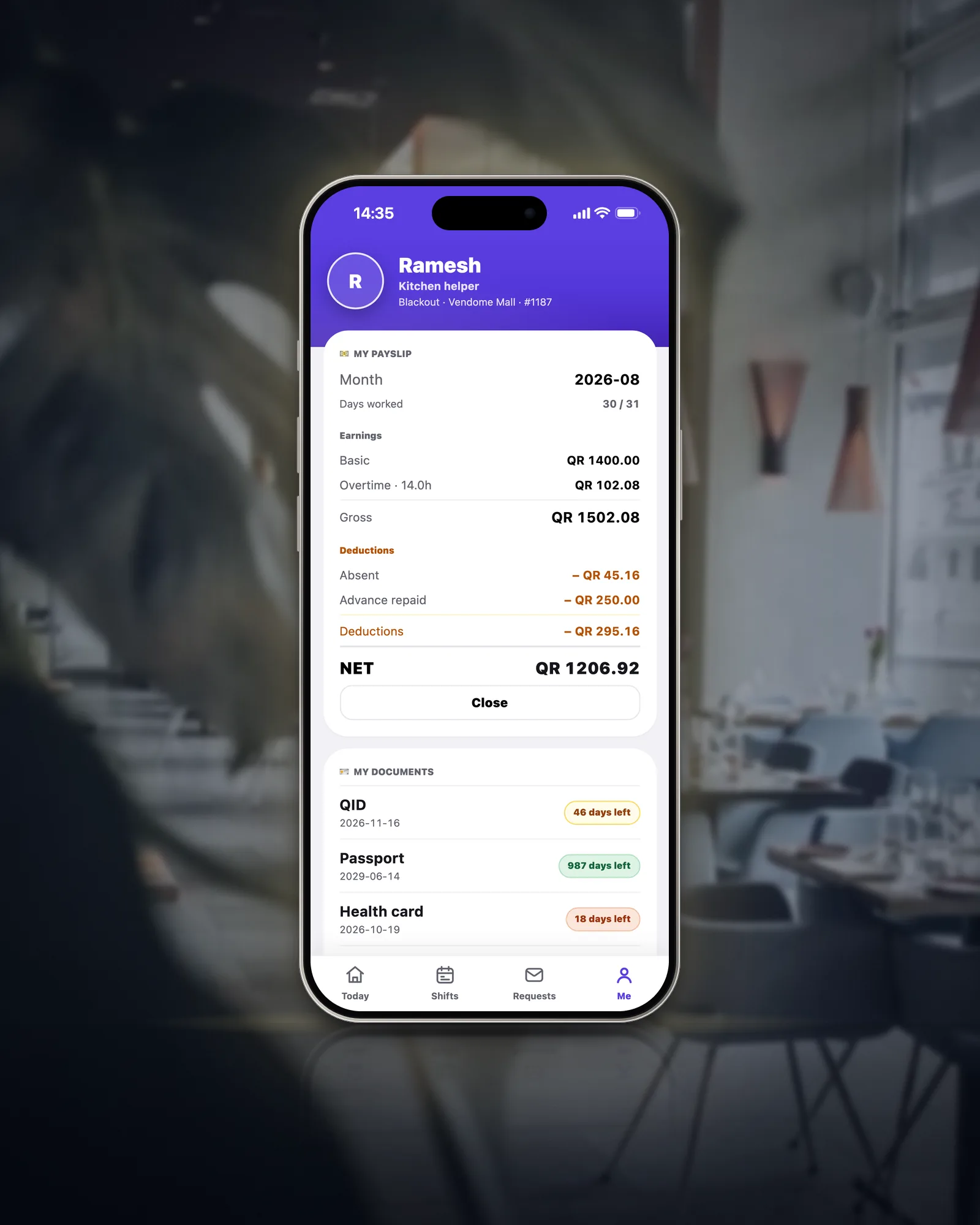
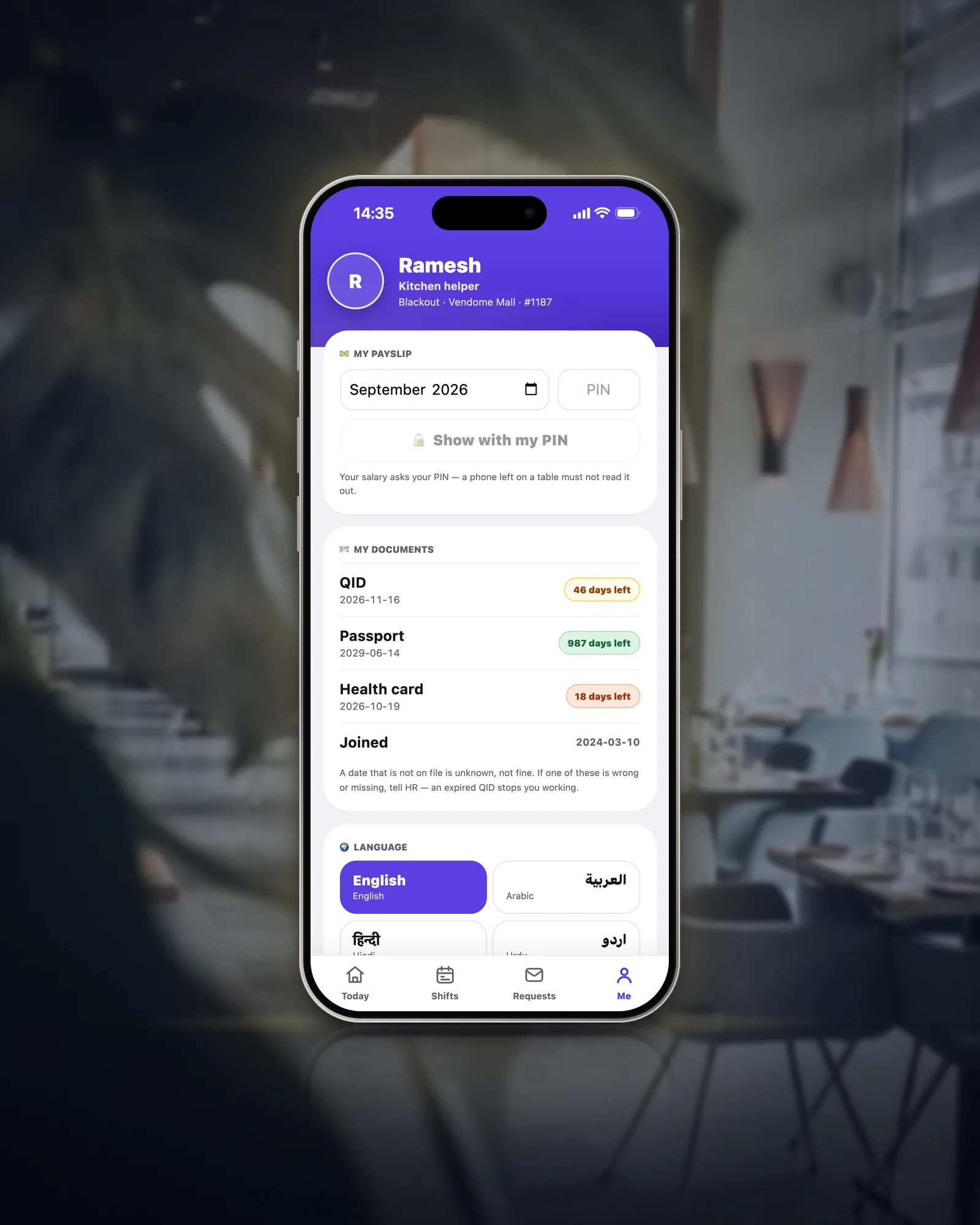
Their payslip, behind their own PINNot their manager's PIN. Five wrong tries locks that phone for fifteen minutes.
Their documents, before they expireHealth card, residence permit, passport — with the date, so nobody works a shift on an expired card by accident.
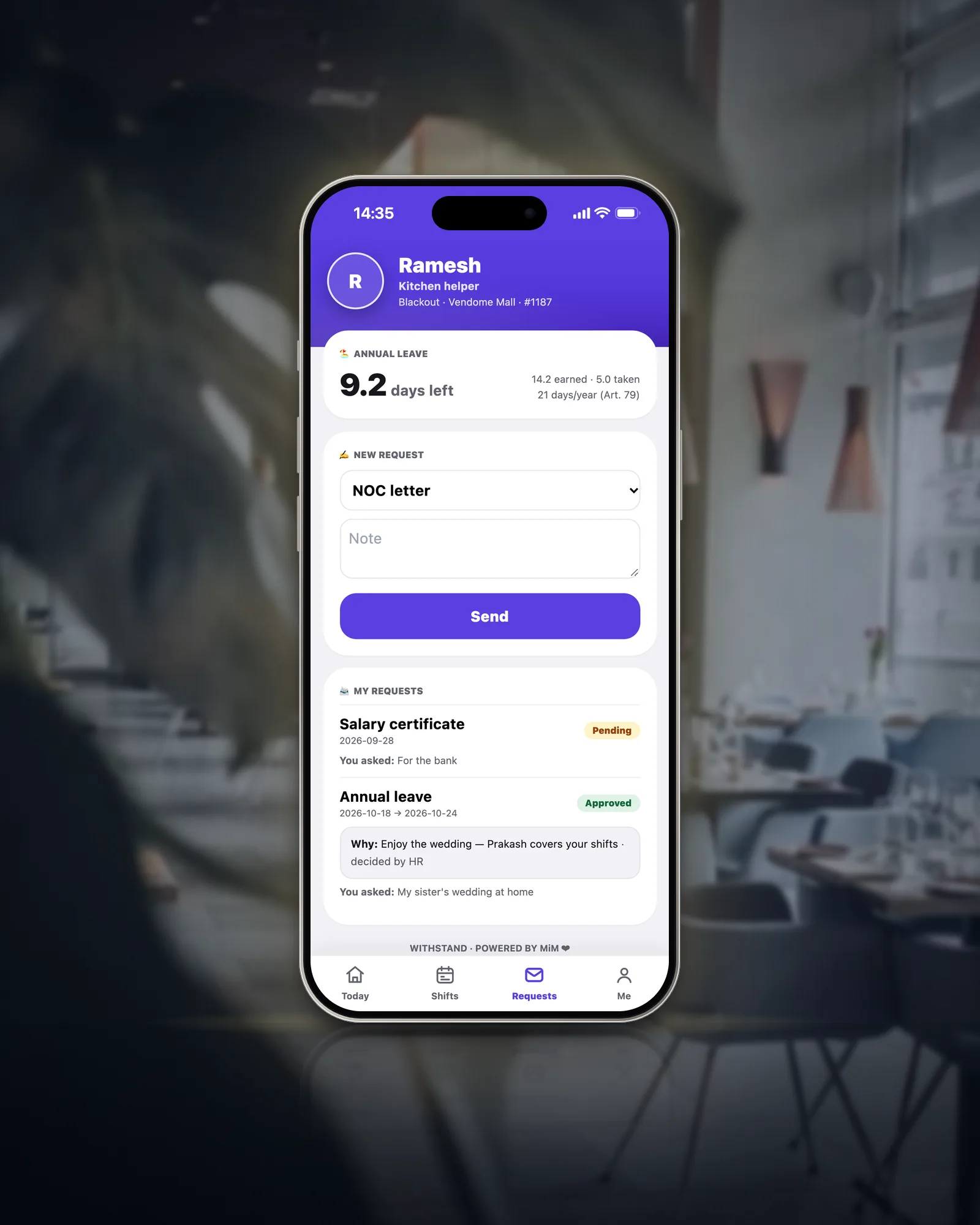
Requests that cannot get lostLeave, a salary certificate, a punch correction. Each one is a line in an append-only ledger HR pulls from — not a WhatsApp message that scrolls away.
And nothing that isn't theirsNo colleague's salary, no IBANs, no PINs, no company data. The phone is served a person-sized view — it is not a till with a smaller screen.
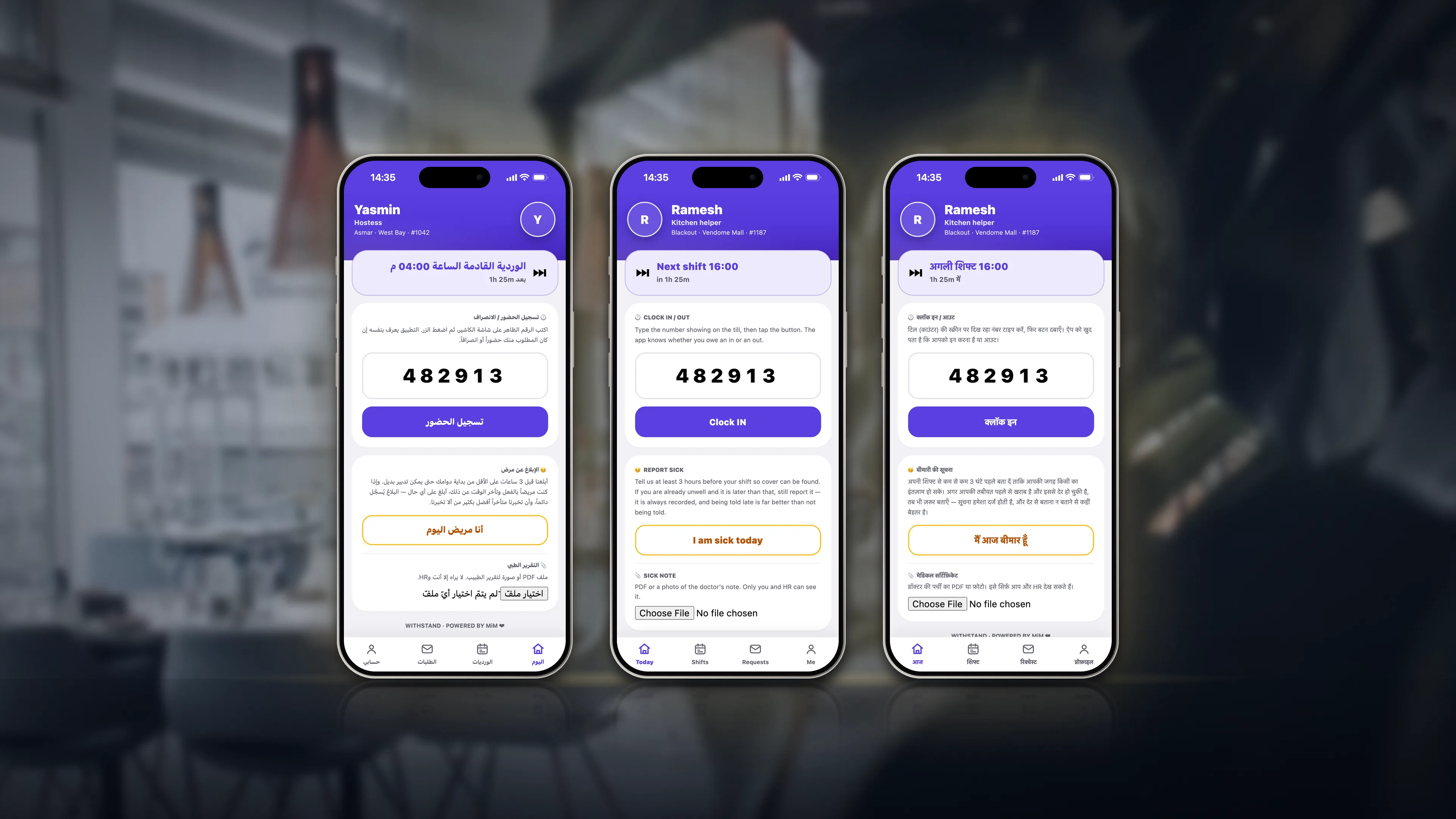
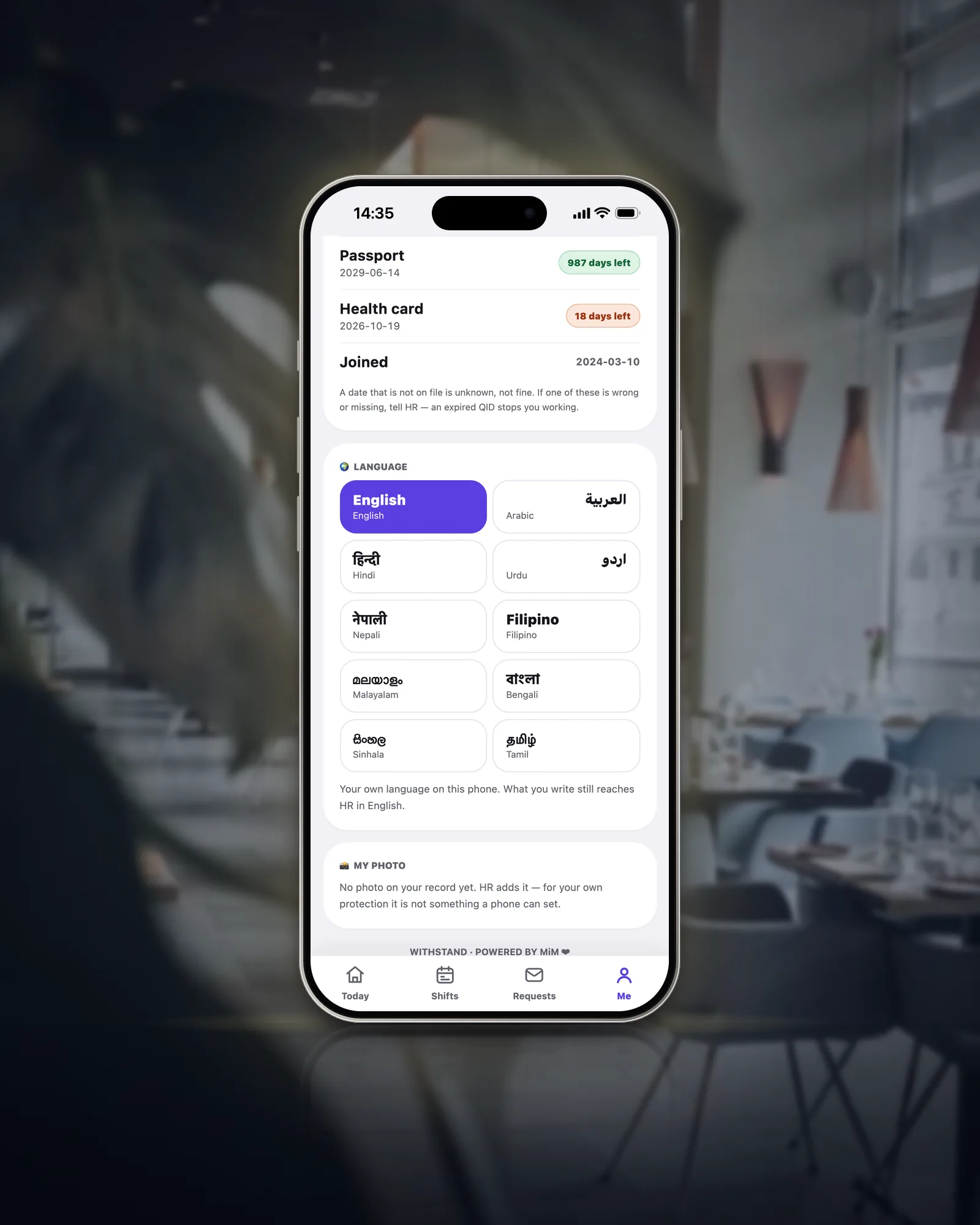
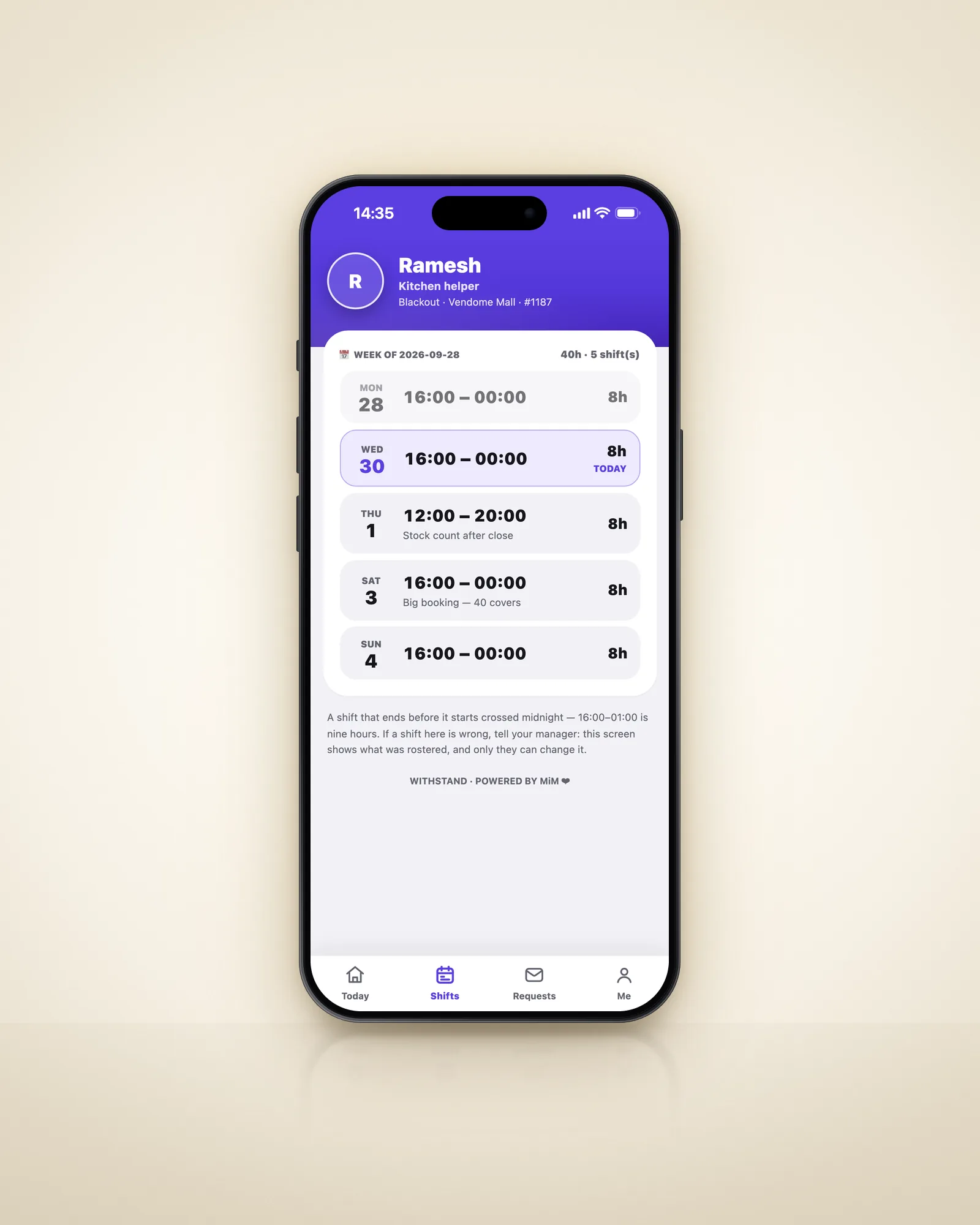
One staff phone, in each person's language Yasmin in Arabic, Ramesh in English and in Hindi — with the same clock-in number from the till on all three.Arabic and English Ramesh's phone in English beside Yasmin's in Arabic, laid out right to left.Ten languages Each person picks their own — and what they write still reaches HR in English.
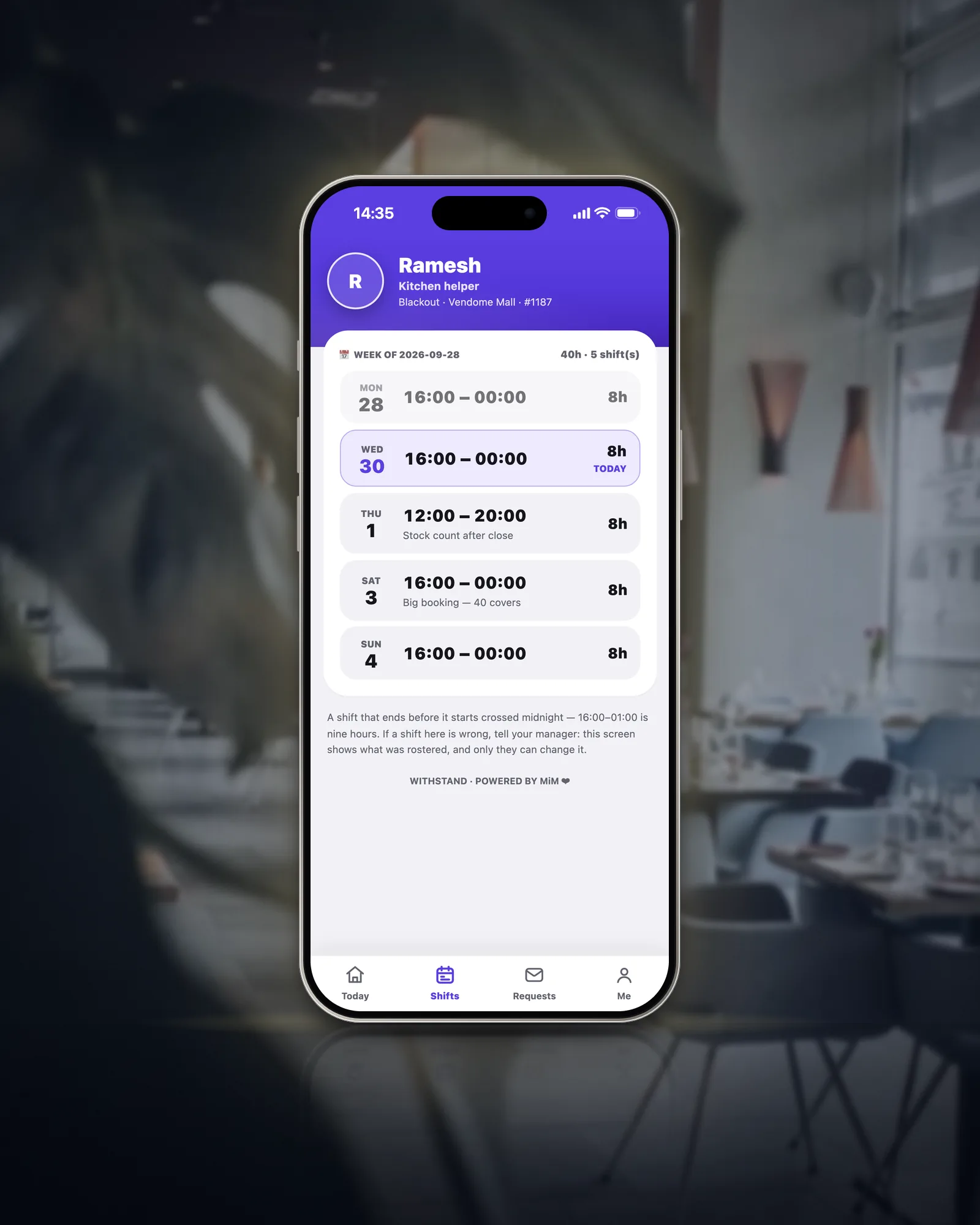
Today Ramesh's next shift, the clock-in card and Report sick — on his own phone.Shifts The week's shifts and hours, today marked — with a note on anything special, like a big booking.Requests His leave balance, a new request in a tap, and every answer with its reason.Payslip The month's pay: the gross, each deduction by name, and the net.Documents Each document with its days left — and the payslip waits for his PIN.Hindi The same Today screen for Ramesh, in Hindi.Today, on an ivory backdrop Report sick at least 3 hours before the shift, so cover can be found.Shifts, on an ivory backdrop A shift that crosses midnight counts whole: 16:00 to 01:00 is nine hours.
Points are money, so they are audited like money
Smart Loyalty
The balance lives on the engine, not on the card — so it cannot be edited at the till.
J JUNO0+ points
POINTS
286
VALUE≈ QR 143.00
TIERBRONZE
MEMBERMaryam
J JUNO500+ points
POINTS
640
VALUE≈ QR 320.00
TIERSILVER
MEMBEROmar
J JUNO1,000+ points
POINTS
1,180
VALUE≈ QR 590.00
TIERGOLD
MEMBERMona
J JUNO1,500+ points
POINTS
1,760
VALUE≈ QR 880.00
TIER♛ PLATINUM
MEMBERHessa
Shown here as the JUNO card of the demo group — Maryam’s 286 points include the 13 she earned on bill #1200029. Each group’s card carries its own brand and colours, never ours. Tiers, thresholds and rewards are yours to set; every balance is simply points × QR 0.50, the same rate at every branch.
1,284
points · worth QR 642.00
Every point is worth exactly QR 0.50. One rate, every branch.
Scan to spend. The till asks the engine, never its own copy.
A refund returns points as points — never as cash.
No manager override can mint a point out of nothing.
Why the balance can be trusted
Every earn and every spend is a line in a permanent journal.
Offline, the till queues the spend — it never guesses the balance.
The guest's phone number is theirs; staff screens never show it in full.
Points outstanding appear on the P&L as the liability they are.
Twelve audit holes were found and closed before this shipped.
Smart marketing · the WITHSTAND card
Know who to bring back, then bring them back
One card, every brand. Rules propose an offer; nothing reaches a customer without the Owner's tap. An approved offer appears on their lock screen, in its own words.
Members7+3 new in 30 days
23.5%
Member salesQR 13,18923.5% of all sales
Average spendQR 1,884per member
Average visits8.9QR 213 a visit
What members orderplates, and what they paid
Stuffed Burrata40 plates · QR 2,778
Calamari27 plates · QR 1,836
Micro Sliders: J Original26 plates · QR 1,950
Micro Sliders: Jalapeño25 plates · QR 1,875
Parmesan Fries22 plates · QR 792
J Fire Bird20 plates · QR 1,100
Kale Salad14 plates · QR 682
Green Fries12 plates · QR 456
Who they arerecency × frequency
1Champions
0Loyal
3Promising
1At risk
2Lost
Tiers
Silver · 1Bronze · 6Gold · 0Platinum · 0
When they visit
1Morning
44Lunch
17Evening
Where members spend
Juno · West Walk61 visits · QR 13,026
Blackout · MOQ1 visit · QR 163
Win-back, approved by youthe rule proposes, the Owner taps
Comes every ~1 day · loves Stuffed Burrata · usually lunch
On her card now: 20% off the next visit
GGuestBronze · ••• 1212 · 1 visit · QR 14314 pts
No rhythm yet · loves Stuffed Burrata · usually lunch
Not in a Wallet yet: the card was opened but never added
Single-use, or standing
One redemption uses a single-use offer up, and the card says thank you. A standing offer works on every visit until you clear it.
Checked at the till
Identify the member at payment, ring the item, and the redeem button comps it. Refused twice, refused at the wrong branch, audited every time.
Real bills only
Every number comes from paid bills, with refunds and voids left out. Members are matched by phone.
Names and phone numbers on this page are samples.
J
JUNO
West Walk
ENالعربية
Total paid
QR 132.00
✓ PAID
Receipt
#1200029
Date
8 Sept · 21:14
Table
T2 · 2
Server
Raza
1×Kale Salad48.00
1×J Fire Bird84.00
1×Parmesan FriesON US0.00
TotalQR 132.00
JUNO card
This bill earned +13 points
Add your card to Apple Wallet
WhatsApp
Save PDF
The guest's receipt, as the software really draws it — bilingual, with the points that bill earned.
The guest's receipt · e-invoice ready
Their bill, for ever
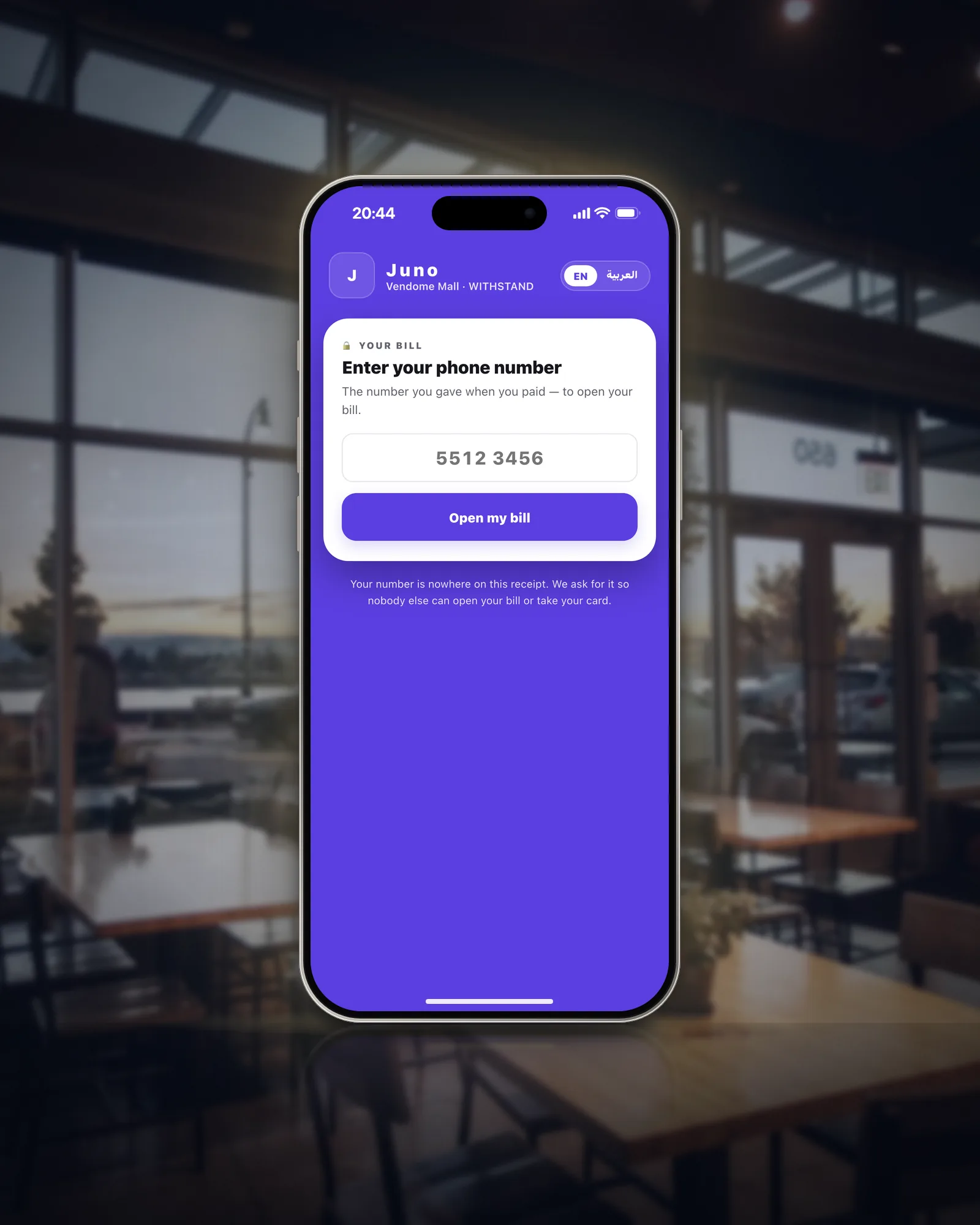
Every printed receipt carries a QR. Behind it is the guest's own copy of that bill — a link that lives exactly as long as the permanent record does, which is for ever. No login, no personal data in the address, and an unknown link answers one constant "not found".
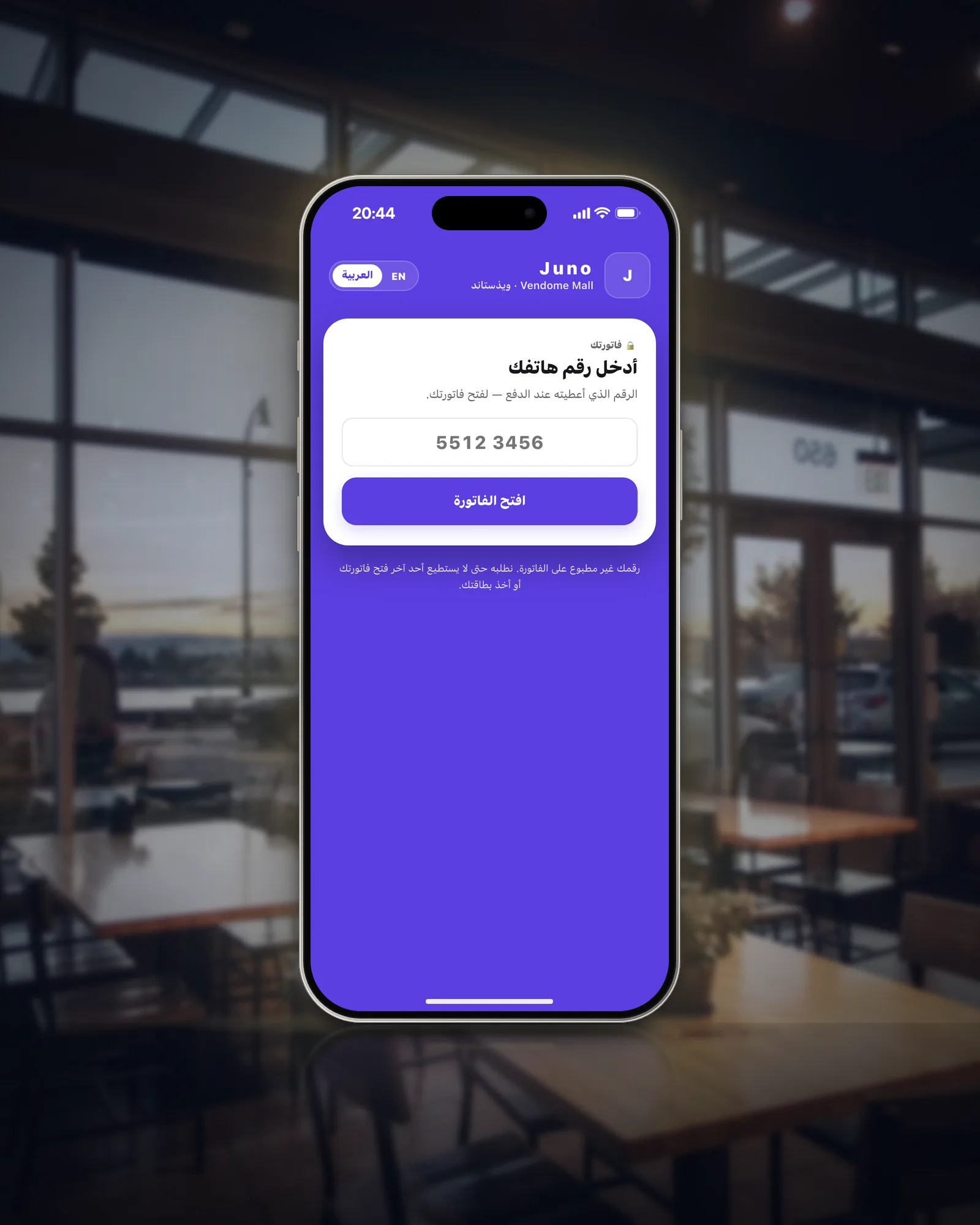
English or Arabic, one tapBoth languages ride the page; the switch flips it right-to-left without a reload.
The points that bill earnedThe brand's own loyalty card is offered exactly where every guest already is — on their bill — with Add to Apple Wallet.
Happy → Google. Not quite → the manager, privatelyThe unhappy road lands in the manager's inbox and the Owner's phone. It never appears on the internet.
Qatar e-invoicing, ready on timeThe same receipt answers as a structured document today — seller, sequential number, lines, tax totals. When the General Tax Authority publishes its formats, the fiscal strip is a mapping, not a rebuild. Nothing here is called a tax invoice before the law says so.
The bill asks for the number first The number is nowhere on the receipt — it is asked for so nobody else can open the bill or take the card.The same door, in Arabic One switch at the top turns the page to Arabic, right to left.
J
JUNO
West Walk
ENالعربية
الإجمالي المدفوع
132.00 ر.ق
✓ مدفوع
الإيصال
#1200029
التاريخ
8 سبتمبر · 21:14
الطاولة
T2 · 2
النادل
Raza
1×Kale Salad48.00
1×J Fire Bird84.00
1×Parmesan Friesضيافة0.00
الإجمالي132.00 ر.ق
بطاقة JUNO
هذه الفاتورة أكسبتك +13 نقطة
أضف بطاقتك إلى Apple Wallet
WhatsApp
حفظ PDF
The same bill after one tap on العربية — the page turns right-to-left, nothing reloads.
The receipt, redrawn
The guest's bill, in the Owner app's look
White ground, soft grey cards, one violet, a sentence under every number. The fourth frame is the fiscal strip: what the same bill will carry once Qatar publishes the e-invoice format. Figures are samples.
The guest's copy — English — opened from the QR on the printed receipt. Works forever, no app, no sign-in.
9:41Juno100%
JU
JunoWest Walk · Table 12
ENالعربية
✓ PAID
Total paid
QR 184.50
Saturday 19 September 2026 · 17:34 · bill 10482
2×Iced Spanish LatteQR 54.00
1×Egg Benedictno mushroomsQR 62.00
1×Avocado ToastQR 48.00
1×Flat WhiteON USQR 0.00
SubtotalQR 194.00
Discount− QR 9.50
TaxQR 0.00
TotalQR 184.50
Paid with Card · Visa ending 6411
You earned 369 points
QR 184.50 back as QR 184.50 of points value — 1 point = QR 0.50.
Add to Wallet
Send on WhatsAppSave PDF
Thank you for visiting
The same bill — العربية — the whole page turns around, not just the words. Digits stay Western, as Qatar reads them.
100%Juno9:41
JU
Junoويست ووك · طاولة 12
ENالعربية
✓ مدفوع
الإجمالي المدفوع
QR 184.50
السبت 19 سبتمبر 2026 · 17:34 · فاتورة 10482
2×آيس سبانيش لاتيهQR 54.00
1×إيغ بنديكتبدون فطرQR 62.00
1×توست أفوكادوQR 48.00
1×فلات وايتضيافةQR 0.00
المجموع الفرعيQR 194.00
الخصم− QR 9.50
الضريبةQR 0.00
الإجماليQR 184.50
مدفوع بالبطاقة · فيزا تنتهي بـ 6411
حصلت على 369 نقطة
النقطة الواحدة تساوي QR 0.50.
أضف للمحفظة
أرسل بواتسابحفظ PDF
شكراً لزيارتكم
How was your visit? — “Loved it” goes to Google; “Not quite” goes privately to the branch manager and never appears on the internet.
9:41Juno100%
JU
JunoWest Walk · Table 12
ENالعربية
✓ PAID
Total paid
QR 184.50
Saturday 19 September 2026 · 17:34 · bill 10482
How was your visit?
Loved itNot quite
Privately, to the branch manager
Your messageTell Layla what went wrong…
Your number, if you want a replyOptional
Send privately
This never appears on the internet.
Thank you for visiting
The e-invoice strip — NOT built. This is what the same bill will carry once Qatar's authority publishes the format. Drawn so you can see where it lands.
9:41Juno100%
JU
JunoWest Walk · Tax invoice 2026-10482
ENالعربية
✓ PAID
Total paid
QR 184.50
Saturday 19 September 2026 · 17:34
Tax invoicewaiting on Qatar
Invoice numberQA-2026-0000010482
CR number—
Tax ID—
Reported at—
Stamp—
The dashes are not missing data — they are the fields Qatar has not published
the rules for yet. The bill already carries everything else they will need.
SubtotalQR 194.00
Discount− QR 9.50
TaxQR 0.00
TotalQR 184.50
Thank you for visiting
Not a settings page
Built for Qatar
The local rules are not a checkbox we added. They are the way the system counts.
👥 Human ResourcesMim restaurants · 84 staffTue 8 Sept 2026
HR (Omar B.) → Finance → the Owner · the WPS file follows the signatures
STAFF ON PAYROLL846 branches · 3 brands
GROSSQR 312,400basic + allowances
DEDUCTIONSQR 15,450absence · advances
NET TO THE BANKQR 296,95084 bank transfers
✍️ SIGNATURES — IN THIS ORDER, NONE SKIPPED
1HROmar B. · sent✓ sent
2FinanceLayla T. · approved✓ approved
3The Ownersigns from his phone⏳ waiting
🧾 PAYSLIP PREVIEW — RAZA K. · SERVER · WEST WALK
Basic salaryQR 2,400.00
Allowances (housing · transport · food)QR 1,050.00
Rest day worked — paid per Art. 74none this month
Net payQR 3,450.00
HOURS THIS MONTH176 h
LEAVE DAYS LEFT18
End-of-service gratuity accrues every month — 3 weeks’ basic per year of service (Art. 54), shown on the file, never typed
🏦 WPS FILE — QIB SIF FORMAT
Company details for the WPS file· set once✓ set
QID on every bank-paid row· 84 of 84✓ clean
IBAN on every bank-paid row· 84 of 84✓ clean
One SIF per establishment (Computer Card)· 6 filesper branch
⬇ Build the SIF files🔒 locked until the Owner signs
⛔ an empty QID cannot ride the WPS file — it is stopped here, not at the bank
WPS salary file
The real SIF format, accepted by the bank
Labour Law 14/2004
EOSB, rest-day pay, wage floors, Art. 70
Hijri calendar
Ramadan and Eid computed, not typed
Arabic, right to left
Every screen, including the receipt
4 AM trading day
Thursday night belongs to Thursday
Allergens, GCC list
14 categories · undetermined is never "free"
Your own numbers, your own arithmetic
What is one point worth to you?
Prime cost is food plus labour. Move the sliders to your group and see the size of the prize — before anybody promises you anything.
Group sales a year
—
Across every branch you set above.
Prime cost
—
Food plus labour, as a share of sales.
One point off food cost
—
A year. That is what a single percentage point is worth.
Half a point off labour
—
A year. Rosters that match the forecast, not the habit.
What you are paying to not know
—
This is not a saving we promise. It is the amount that moves when your food cost moves one point and your labour half a point — the range most operators find sitting in the gaps between their systems. What you do with it is your work; ours is to make it visible on the day it happens, not at month end.
Prime cost benchmark: under 55% is healthy for most full-service operations, 55–65% is worth watching, above 65% usually means the menu or the roster is carrying a problem. Nothing here is sent anywhere — the arithmetic runs in your browser.
Customer number one
We run our own money through it
MiM was not built for a market. It was built because we needed it, and we are the first ones it has to be right for.
We did not set out to sell software. We set out to stop losing money in the gaps between five systems — and then we could not go back to the old way.
Adel Briki
Founder · MiM Smart
6
Brands on one database
17
Branches in the group
297
Gates that must pass to ship
0
Numbers re-typed between screens
The third question every serious buyer asks
Where your data lives
You are handing over payroll, bank matching and every sale you make. Here is exactly what happens to it — and why the number on the screen can be trusted.
297
Safety gates
Every one runs the real code, none just reads it — and every fix is proven by putting the bug back until the test catches it.
One database, backed up daily
PostgreSQL on a paid tier with daily automatic backups, and restores that are tested — a backup nobody restored is not a backup.
The public data door is shut
There is no open API reading your tables. Every request goes through the engine, with a key, and the key is per install.
Nothing is ever edited away
Sales, voids, refunds and wage changes are appended to a permanent journal. A correction is a new line, so the original stays readable for ever.
Staff see only their own business
Salaries, ID numbers and documents sit behind a separate HR key. A waiter's screen cannot reach them, and neither can a manager's without it.
The line can drop
The till keeps selling offline and queues every sale. When the link returns it settles up — and an empty answer is never mistaken for a real zero.
One rule, two screens
The Owner’s cockpit and the P&L are computed by the same code, so they cannot disagree.
Your numbers leave with you
Every table exports to a spreadsheet. If you ever stop paying us, you keep your history — that is the point of a permanent journal.
How it starts
First branch live inside a week
The switch is the part people fear more than the price. Here is the whole of it.
1
Before you sign
A 20-minute demo on WhatsApp video
The same screens we run our own restaurants on, with demo data. Bring your menu; we type three dishes in front of you.
2
Day one
Install day
The till app on your machine from a USB, the engine key on a wallet card, printers found on the network. Your Mac, POSBANK or Windows till — nothing new to buy unless you want to.
3
The same week
Your data, from the spreadsheets you already have
Menu, staff, suppliers and stock arrive through four templates. Every row gets a verdict; a blank is never turned into a zero.
4
The same week
Tablets pair by QR
Waiters, the chef, the hostess desk and each staff phone scan one code each. One device, one identity — a lost tablet is revoked in a tap.
No hidden module list
How pricing works
Every department is included in every plan — you are never sold "the HR module" a year later. Prices are quoted per group, because a two-branch café and a seventeen-branch operation are not the same job.
One branch
Single
One restaurant, one kitchen, however many tills you need on the floor.
Branches and tills. Not modules, not seats, not how many people log in. Add a department and nothing changes on your invoice.
What costs extra
Only onboarding — bringing in your menu, ingredients, suppliers and staff records, and the first branch install. Quoted once, never recurring.
How to get a number
Tell us your branch count and what you run today. You get a written quote, not a call from a salesperson.
What you need
A till: your Mac, a POSBANK or any Windows machine
80 mm receipt and kitchen printers on the network
Android tablets for waiters, the chef and the hostess
The Owner app on your iPhone
Each staff member's own phone for self-service
Internet — and the till keeps selling without it
Included in every plan
Every release, every week — nothing is an upgrade
Training on the floor, in Arabic or English
Your data out as a spreadsheet, any day
The permanent journal, backed up and restore-tested
All 15 departments and unlimited staff accounts
Support on WhatsApp, same day
Coming from another system? Your menu, your ingredients, your suppliers and your staff records come in from spreadsheets — there are ready templates for each. Every row is checked before it lands, and anything that cannot be read is reported back to you rather than guessed at. A blank cell is never treated as a zero.
Straight answers
Questions we get asked
What happens when the internet goes down?
The till keeps selling. Orders, payments and voids queue locally and settle with the engine when the line returns. The one rule that matters: an empty answer is never treated as truth — if the till cannot reach the engine it shows the last known floor, menu and branch list rather than a blank screen that looks like a closed restaurant.
Does it handle Qatar labour law and WPS properly?
Yes, and not as a report you export somewhere else. The payroll file is the real SIF format the bank accepts. End-of-service benefit, rest-day pay, the Article 70 cap and the wage floors under Law 17/2020 are computed by the system, and it flags a salary that sits below the legal minimum before payday rather than after.
Can I get my data out?
Every table exports to a spreadsheet, and the underlying journal is append-only — so your history is complete rather than a snapshot of today. If you ever leave, you leave with the whole record. We would rather earn the renewal than hold your numbers hostage.
Do I have to enter every recipe before it is useful?
No. The till, the floor, payroll, the store and the P&L all work from day one. Food cost is the part that needs recipes — and until a dish has one, the system says "not costed yet" rather than inventing a number. An unknown is never shown as a zero, and it is never quietly averaged into your margin.
What about Arabic?
Every screen runs right-to-left in Arabic, including the receipt. It is not a translation layer bolted on top — the layout itself flips, so nothing ends up reading backwards or colliding.
Does it connect to Talabat, Snoonu and the others?
Not yet, and we will not tell you otherwise. The delivery door for Talabat, Snoonu, Rafeeq and Keeta is built on MiM’s server and stays locked until each platform issues its key; our Talabat partner application was filed on 5 September 2026. Everything connected today is marked “Running” under Integrations; everything that is not is marked “Coming”, with what it waits for.
Who actually uses this?
We do. MiM runs a 17-branch, six-brand group in Doha, and it was built because we were losing money in the gaps between five systems. We are customer number one, and we have no third-party case studies to show you yet — when we do, they will be real and named.
What hardware do I need?
A Mac or Windows machine for the till, and any tablet with a browser for waiters, the chef display and the hostess desk — tablets pair by scanning a QR code and stay paired to that one branch. Standard 80mm kitchen printers. If you already have tills, we will look at whether they can be reused before you buy anything.
Doha, Qatar
Ready to close the gap?
Send one line about your group — how many branches, and which system hurts most. We will show you the same screens we run our own restaurants on.
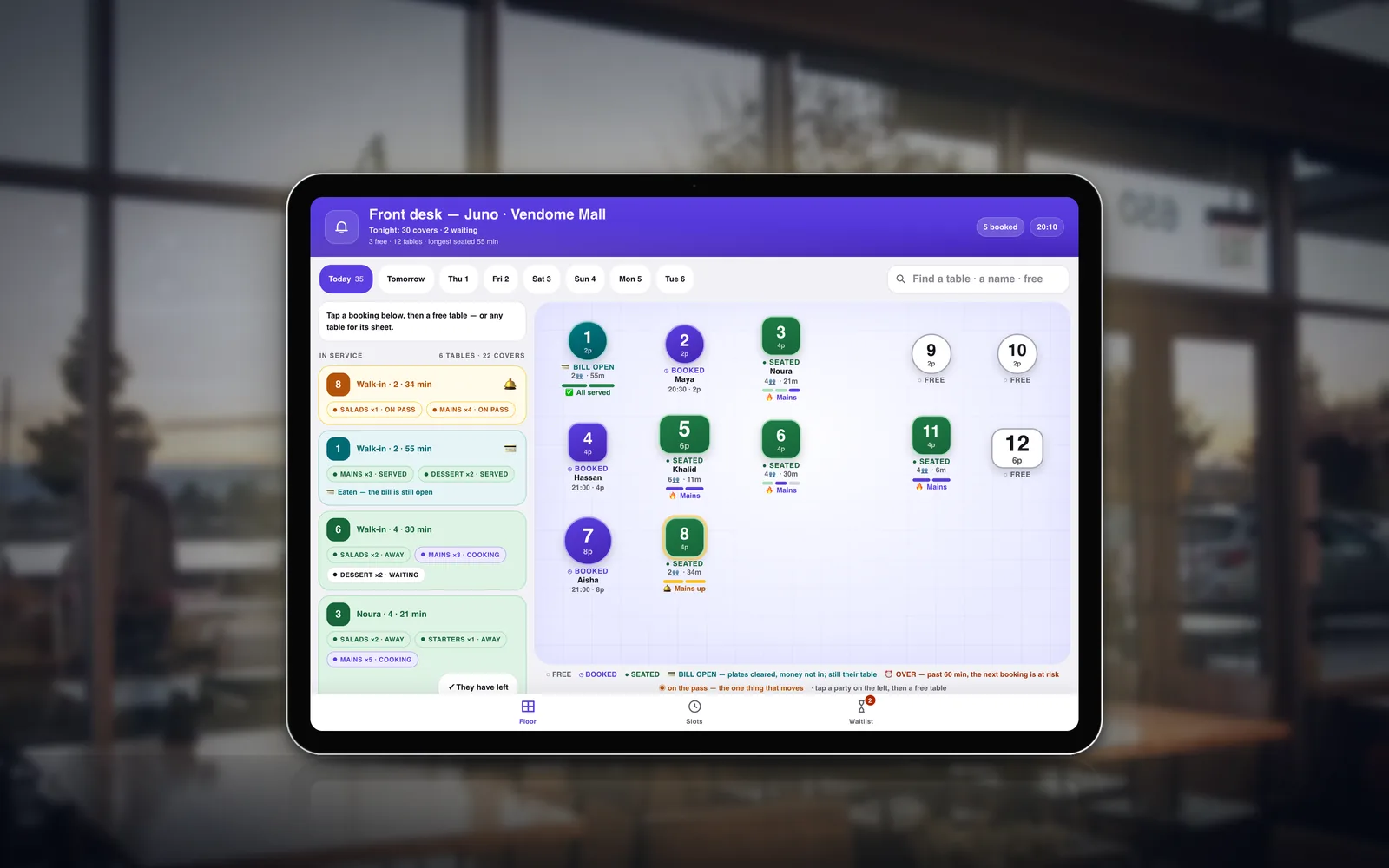
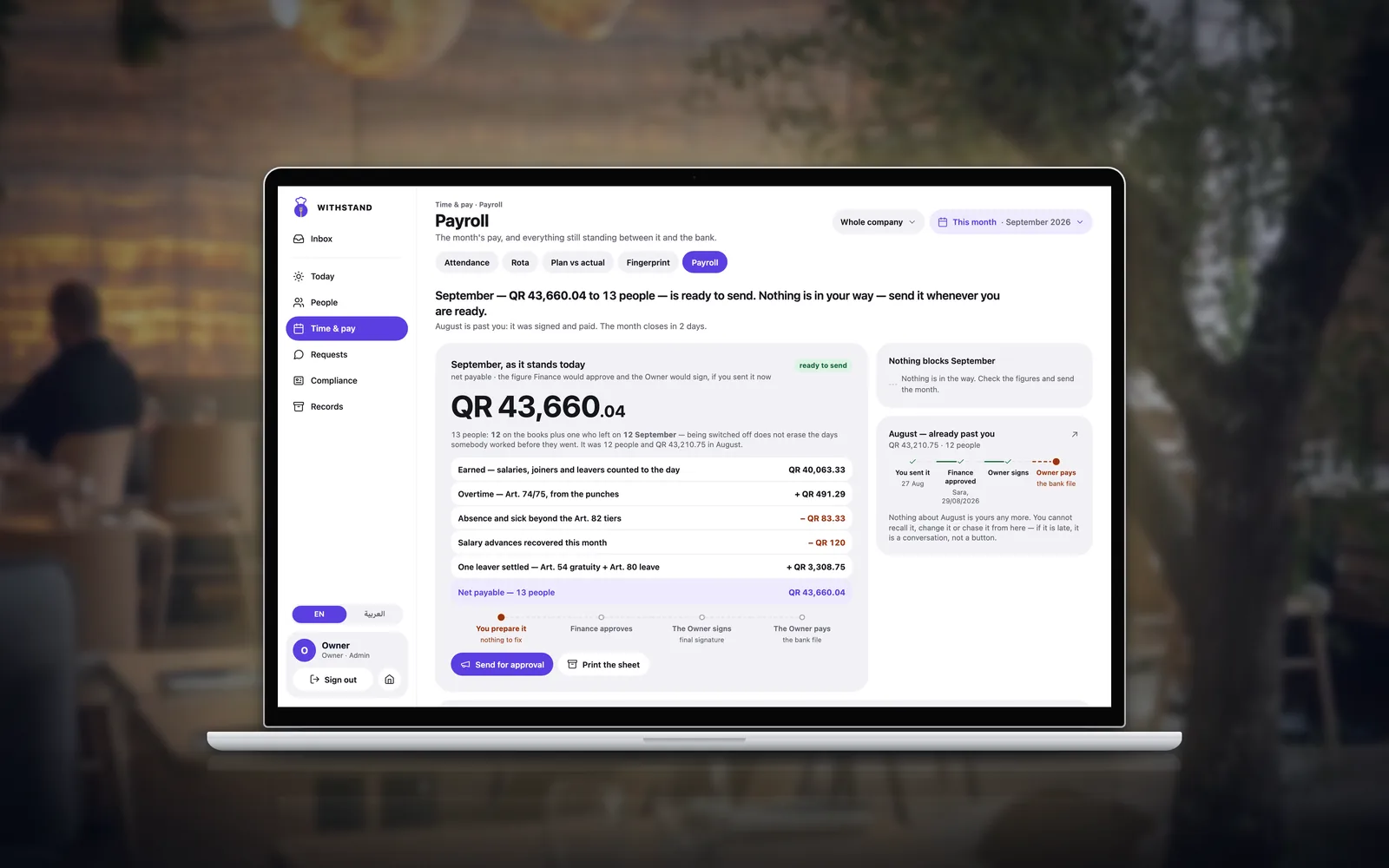
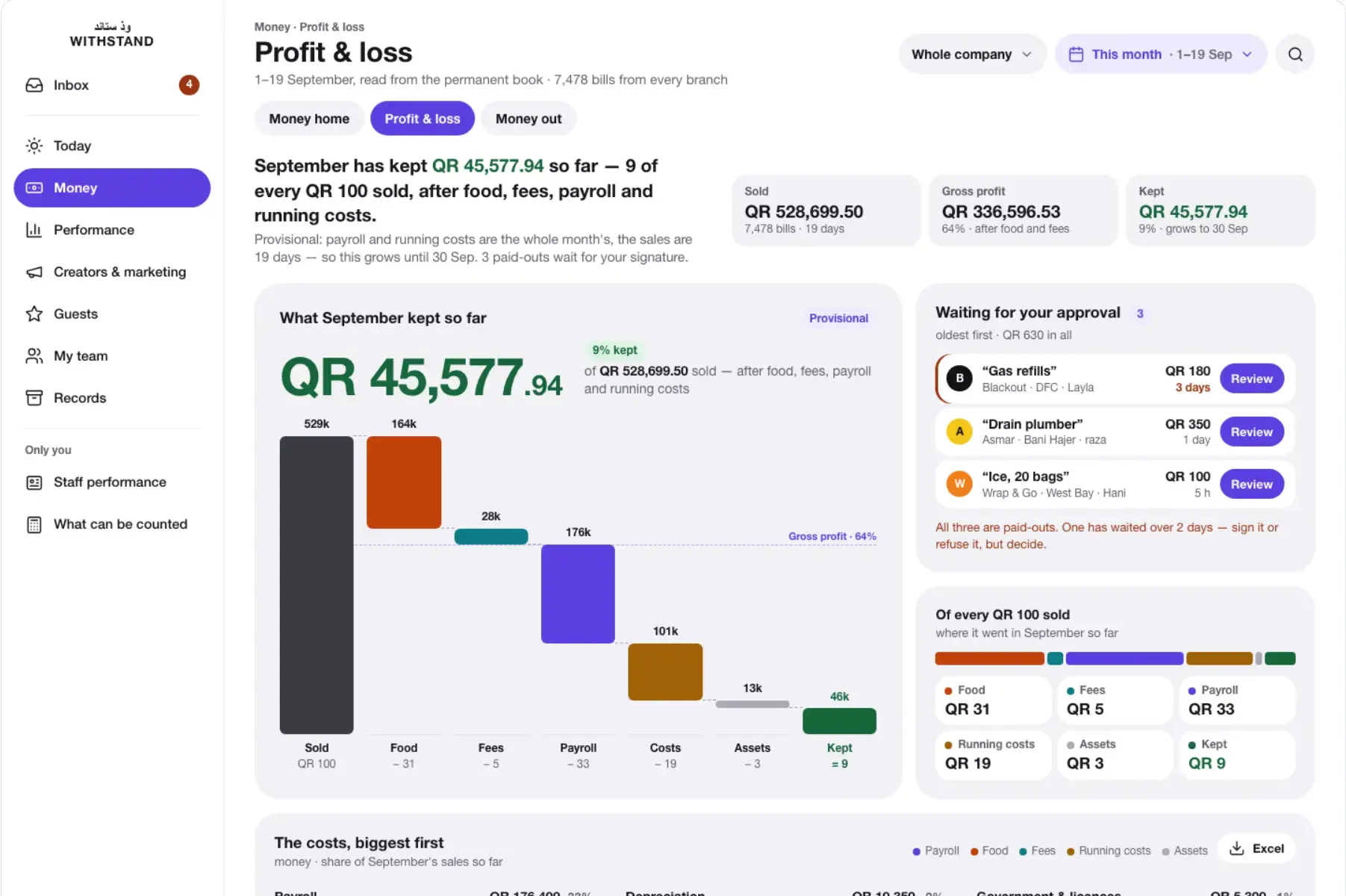
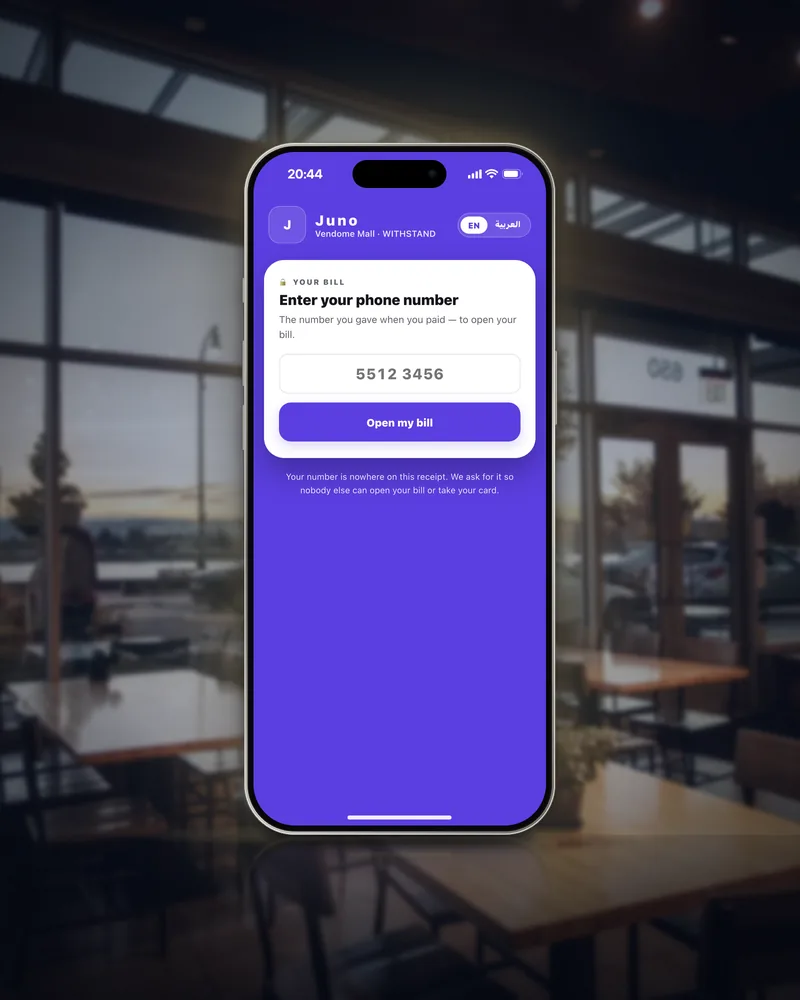
Each network in its own colours
Every brand's posts, likes and comments, inside Head Office. Read-only: MiM never posts, replies or deletes.
After its Monday post, Mini Truffle Arancini went from 6.2 to 10.0 plates a day (+61%).
Each post is joined to the dish it names, and to that dish's plates in the permanent book.
Blackout's last 10 posts took 1,284 likes; Burnt Cheesecake alone took 312.
Comments arrive in the guest's own language, next to the post they were left on.
Juno's 10 newest videos took 24,386 likes; one carried 6,912 on its own.
Each brand connects its own TikTok Business account; the token never reaches a till.
What it cannot do. A post cannot be traced to a bill: nobody scans a story at the till. Every lift is a dish measured against its own four-week average, a comparison with a named baseline, never proof.